SC spending $3M more annually to grow dual high school and college enrollment
Jun 30, 2025 | 3:35 pm ET
Description
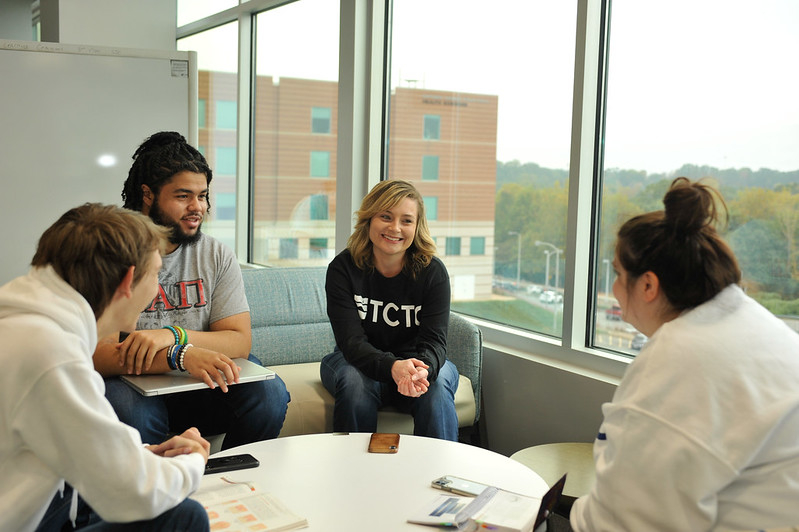
Students gather in the Student Success Center on Tri-County Technical College’s Pendleton campus. (Provided/Tri-County Technical College)
COLUMBIA — South Carolina’s technical schools have more money to hire faculty and offer new classes as the state seeks to grow the number of high school juniors and seniors simultaneously enrolled in college courses.
Dual enrollment has grown to some 19,000 South Carolina high school students in the state since it started 20 years ago. SC Technical College System President Tim Hardee told the SC Daily Gazette he’d like to see that number rise to 25,000 within the next decade.
To spur the program along, legislators added $3 million annually (out of $5 million the technical system requested) to the new budget that starts Tuesday. That’s on top of the $10 million more annually added to the college system’s general operating budget, Hardee said.
The new funding will be split among South Carolina’s 16 technical colleges.
“There’s a market there, in partnership with the K-12 school districts, for us to grow our dual enrollment,” Hardee said. “That obviously won’t happen overnight, but we feel like the Legislature has invested in our technical colleges.”
High school students from both public and private schools can enroll in college classes which also count toward their high school diploma. This gives them a head start on an associate’s degree for in-demand fields, such as health care, manufacturing or welding. Or they can work ahead on freshman-level general education courses for those planning to attend a four-year university, often entering with a semester or more worth of college credit under their belt before ever stepping foot on campus.
More than 75% of these students receive scholarships to cover the cost of tuition. And at about half of the state’s 16 technical colleges, nearby K-12 school districts also pay for the textbooks students will need to complete the course, making it completely free, Hardee said.
Compare that to more than $27,000 annually for tuition, room and board at Clemson University, South Carolina’s most expensive public college, for South Carolina graduates before any scholarship aid, according to data from the state Commission on Higher Education. The in-state costs for Winthrop University and College of Charleston are both above $25,000. And at the University of South Carolina, it’s more than $24,000.
Dual enrollment courses help get students into the workforce faster or at least make a bachelor’s degree more affordable.
“Beyond just the financial affordability, it gives students an opportunity to experience a college course in a small classroom setting and really helps them to understand that they can be successful in college,” Hardee said.
Still, while 18% of the technical colleges’ student body are dual-enrolled high schoolers, the state is below the national average of 20%.
“We hope to be able to say, statewide, that dual enrollment courses are available for high school students with no cost to parents and their students,” Hardee previously told the SC Daily Gazette.
The best way to do that, Hardee said, is not to grow class sizes but to offer a wider range of classes.
Nearly 109,000 juniors and seniors attended South Carolina’s public high schools this past school year, according to the latest figures from the state Department of Education. About one-sixth of them are taking classes at the state’s technical colleges.
Trident Technical College has the largest number of dual-enrolled students — about 3,200. While the smallest program, Williamsburg Technical College, has just shy of 300 students. The 16 schools combined offer more than 850 courses.
The colleges will split the funds based on their total enrollment, Hardee said. The formula is weighted, however, to award more on a per pupil basis to rural colleges where it costs more per student to teach. Those colleges located in rural areas with a smaller tax base also tend to have less financial support from the counties and school districts they serve.
In those districts where students’ expenses aren’t totally covered, the technical colleges may choose to use their share of the state money to fill in the gap.
Columbia