Michigan Supreme Court hears arguments in discrimination case involving former Calvin professor
Oct 08, 2026 | 5:01 pm ET
Description
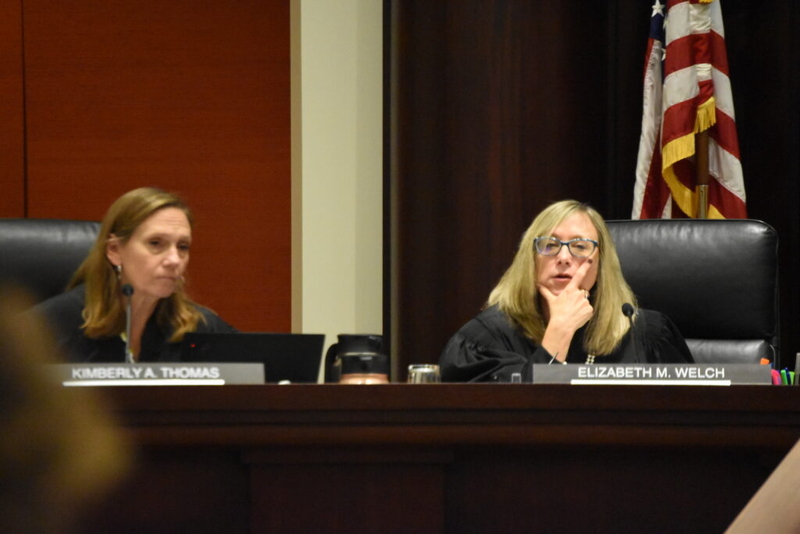
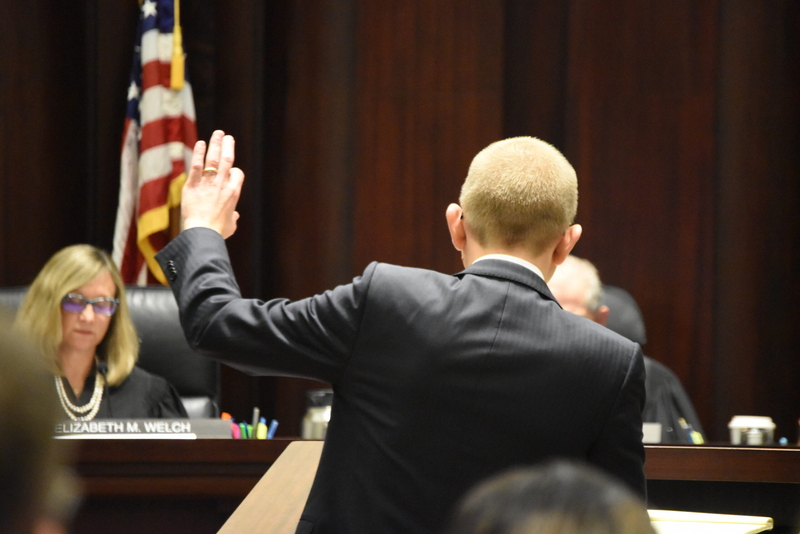
Michigan Supreme Court Justices Kimberly Thomas and Elizabeth Welch listen to oral arguments on Oct. 8, 2026. (Photo by Katherine Dailey/Michigan Advance)
The Michigan Supreme Court heard oral arguments Thursday in a case where a former Calvin University professor, Joseph Kuilema, alleges that he was the subject of associational discrimination when he was fired in 2022 after officiating a wedding for a same-sex couple. The Supreme Court will rule on whether that associational discrimination claim — the fact that he was fired over his association with LGBTQ+ individuals — can proceed in a trial court.
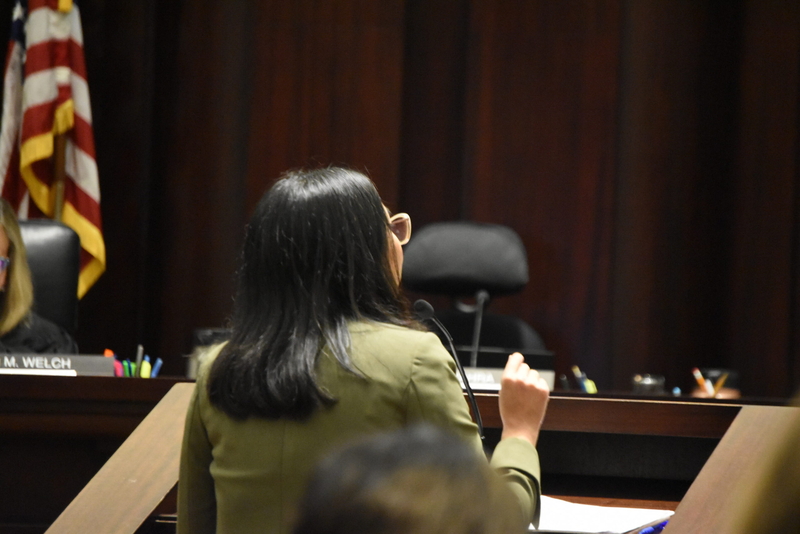
Charissa Huang, Kuilema’s lawyer, argued to the justices that court precedent on associational discrimination on the grounds of sex discrimination “would ask not whether Joe was fired because he’s a man, but whether he was fired because of the sexes of the people in the wedding. This claim is not clearly unenforceable.”
For Huang, the question in front of the court is broader than just Kuilema’s case — she argued to the justices that, if a prior Court of Appeals ruling stand, it will “misdirect courts across the state and leave people who are discriminated against because of a protected characteristic without recourse.”
“Allowing this Court of Appeals holding to stand that it must be because of the plaintiff’s own sex, that would have a chilling effect upon people of different races and cultures and sexism, sexual orientations, they could be fired for associating with one another with no recourse,” Huang said.
The Court of Appeals, in its ruling that Kuilema appealed, argued that, because the decision to fire Kuilema had no bearing on his own sex — it would have been the same if he were a woman or a man — his argument of associational discrimination is invalid.
“Kuilema’s sex is irrelevant to Calvin University’s decision to terminate his employment. The university’s decision to terminate his employment was based upon his decision to officiate a same-sex wedding,” the appellate court’s decision read. “Based upon the allegations in the complaint, the discriminatory action would have occurred regardless of Kuilema’s sex.”
Huang, however, argued that the appellate court misinterpreted the intention of Michigan’s Elliott-Larsen Civil Rights Act, and that though it does not explicitly include discrimination of associates of people of a protected class, it does implicitly include those associations.
“The Court of Appeals read a limitation into the Elliott-Larsen Civil Rights Act that the Legislature never wrote, in holding that associational discrimination must be because of the plaintiff’s own sex. That holding contradicts the act’s plain language and its purpose. ‘An employer shall not discharge an individual because of sex.’ That language is unambiguous, and it should be enforced as written. Calvin University fired Joe Kuilema because he officiated a wedding for an LGBTQ couple.”
Stephen J. Vanstempvoort, the attorney for Calvin University, disagreed about that interpretation of the state’s civil rights law.
“I think the plain text of the statute is actually pretty clear that it has to be the individual who’s experiencing discrimination,” he said. “It has to be their protected characteristic that’s at issue.”
Vanstempvoort also said that, because the individuals in the wedding officiated by Kuilema were not directly harmed by Calvin’s action to fire Kuilema, then court precedent involving race-based associational discrimination should not apply in this case.
“If a plaintiff says, well, somebody else experienced illegality, and then I suffered damages as a result, well, then that plaintiff has a claim under the plain text of the statute, right? So that’s how Miller works. But that’s not what the claim is here,” he said, referring to Miller v. Michigan Department of Corrections, a 2024 court case.
In response to questions from Chief Justice Megan Cavanagh, who asked if performing an LGBTQ+ marriage is different than other hypothetical claims, based on the fact that sexual orientation is a protected characteristic in Michigan’s civil rights law, Vanstempvoort said that distinction would be difficult to only protect association with groups deemed “inclusive.”
“Having an anti-discrimination statute hinge upon ideology, I think, is very problematic from a First Amendment perspective. But second, I think, in practical terms, it may be very difficult to implement,” he said. “For example, consider somebody who opposes or who disapproves of affirmative action, like a race-based affirmative action program. I don’t know what camp that falls in.”
Huang noted that any discrimination in that hypothetical would be viewpoint discrimination.
“The questions that were asked about viewpoint discrimination really helped to clarify that this is not about viewpoint discrimination,” Huang said after arguments concluded. “In fact, Joe expressed all kinds of viewpoints throughout his career at Calvin for many, many years, and he was not fired for those viewpoints. He was fired after he officiated the wedding for these people, his friends.”
Kuilema, now a professor at Grand Valley State University, sued his former employer for both retaliation and associational discrimination under Michigan’s Elliot-Larsen Civil Rights Act.
He told Michigan Advance after the oral arguments, “I was encouraged by the justices’ questions. I think we made our case effectively and persuasively, and I think this is an area that’s been clarified around issues of race, and it’s just time to clarify what it means for issues related to sex. It’s high time that the court does that.”
Kuilema and Huang both said that they were glad to continue fighting a case that they said will “clarify some aspects of the law that will benefit a lot of people, especially LGBTQ people, but lots of other people too,” Kuilema said.
“We wouldn’t even be here if this couple had been a heterosexual couple,” Huang said in her final remarks during oral arguments.

Lansing, MI