AG: Benson gubernatorial announcement in public building violated campaign finance act
May 19, 2025 | 4:11 pm ET
Description
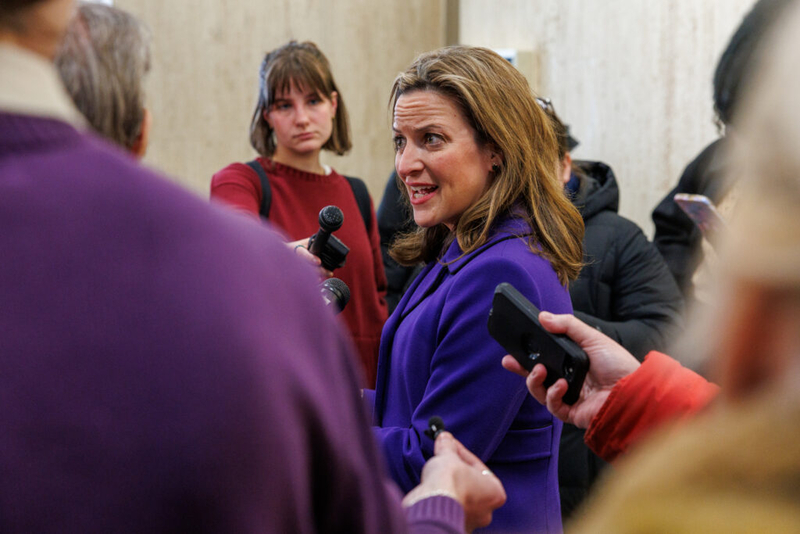
Secretary of State Jocelyn Benson speaks to reporters after launching her campaign for governor in Lansing, Mich., on Jan. 22, 2025. (Photo by Andrew Roth/Michigan Advance)
Story updated on 5/20/25 at 7:13 a.m.
The secretary of state’s use of a government building – one that houses the department she oversees – to announce her candidacy for governor violated Michigan’s campaign finance laws, the Department of Attorney General said Monday.
That said, the department noted it did not have the authority to impose any civil penalties against Secretary of State Jocelyn Benson, nor any criminal penalties outlined in the law.
Benson jumped into the 2026 gubernatorial ring on January 22 with a press conference held in the lobby of the Austin building. Benson said then that the announcement was being held inside the building due to the cold weather. Reporters at the event questioned whether other candidates could also use the lobby for similar announcements, with some noting that other candidates had not been allowed to do so in the past.
Benson says she’s focused on ‘efficiency and transparency’ in Michigan governor campaign
Benson told reporters that other candidates could use the lobby if they’d like to announce their campaigns – which led to complaints from Republicans.
In a letter sent to Benson on Monday, Joshua Booth, chief of the opinions division with the Department of Attorney General, said the secretary of state had violated a portion of the Michigan Campaign Finance Act.
That said, Booth wrote that the Jocelyn Benson for Governor campaign committee had not violated the law because it was not a public body and because there was no allegation that the campaign committee was acting on behalf of a government body.
The act prohibits candidates from using public funds, personnel, office space, equipment and other property paid for by public resources. In that regard, Booth said Benson herself violated the act.
“Secretary Benson invited members of the press inside the Austin Building and then conducted a press conference, professionally dressed, during the day, in the lobby of the building that houses her office,” Booth wrote. “She gave no indication that would lead a reasonable person viewing the press conference to believe that she was there on her ‘personal time.’ Instead, the circumstances would lead a reasonable person to believe that Secretary Benson was acting as secretary of state with the authority of the Department of State, which is a ‘public body,’ to invite members of the press inside her office building and use the lobby for the press conference.”
As to Benson’s belief that other candidates could also use the Austin building to announce their candidacy, the law does allow for the use of public buildings for campaign events or candidate announcements. But Booth said her belief was misplaced because the Department of Technology, Management and Budget oversees the building, and therefore, the facility was not one that any candidate or committee had an equal opportunity to use.
Benson’s committee also raised First Amendment concerns, and argued that any violation of the act enforced against it would in turn violate her constitutional rights. But Booth said limiting candidates from using the building was a legitimate purpose because such a gathering could interfere with the entering, exiting and the general business of those working inside the building.
A violation of the act carries a civil penalty of a fine not more than $1,000 imposed by the Department of State and a conciliation process helps determine the amount of the fine. If an agreement cannot be reached, the Department of State can refer the matter to the attorney general’s office.
The act is, however, silent on how the Department of Attorney General should resolve a complaint against the Secretary of State if it’s determined that a violation occurred. Booth said there are no provisions establishing a conciliation process, other informal method of resolving the complaint, or giving authority to the attorney general’s office to order a hearing or issue a civil fine following a hearing. There is also no provision allowing the secretary of state to appeal a fine imposed by the Department of Attorney General.
The same goes for criminal penalties, Booth said. The act states that anyone in violation of Michigan campaign finance law is guilty of a misdemeanor, but because the complaint was referred to the attorney general by the secretary of state, the attorney general’s office lacks the authority to charge Benson with a misdemeanor.
Booth said that it may sound odd and seem unfair that Benson is subject to the Campaign Finance Act’s rules but none of its penalties, but the Legislature never expressly gave the attorney general the authority to enforce the law against a secretary of state.
“Consequently, the attorney general is left with no choice but to simply identify the violation, remind the secretary of state of her obligations under the MCFA, and warn her against violating them in the future,” Booth wrote. “That said, it is by no means unusual for the Secretary of State to resolve campaign finance complaints with a similar reminder and warning. … Under the circumstances, resolving these complaints with a reminder and warning is the appropriate sanction, but it is also important to take this opportunity to point out the lack of enforcement options available to the attorney general under the current language of the MCFA.”
In a statement, state Rep. Angela Rigas (R-Caledonia), chair of the House Oversight Subcommittee on Weaponization of State Government, said the department’s actions against Benson were mostly “theatrics” and amounted to a slap on the wrist.
“Let’s be clear: [Attorney General Dana] Nessel only went after Benson to save face,” Rigas said. “This is a weak, last-ditch attempt to look fair after years of protecting her Democrat allies and targeting conservatives. … This wasn’t justice. It was damage control, and it proves everything we’ve said about Nessel’s partisan double standards.”
This story was updated with comment from state Rep. Angela Rigas (R-Caledonia).
Lansing, MI