Airport officials consider privatizing TSA screening duties at T.F. Green
May 01, 2025 | 5:41 pm ET
Description
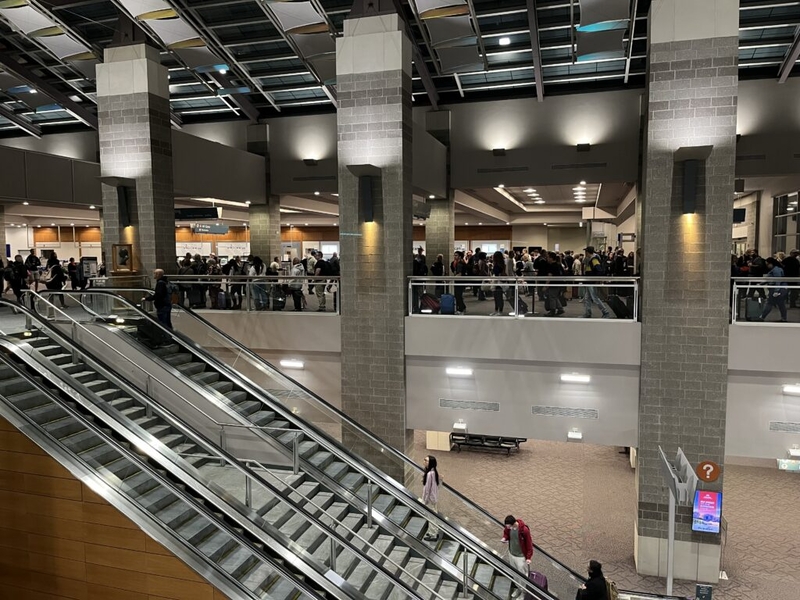
Passengers wait at the Transportation Security Administration (TSA) checkpoint at T.F. Green International Airport on Nov. 1, 2024, between 5:01 and 5:35 a.m. (Courtesy photo from the Rhode Island Airport Corporation)
State airport officials claim the wait for passengers to get through the Transportation Security Administration (TSA) checkpoint at Rhode Island T.F. Green International Airport is taking too long, and they might have a solution: Replace the federal officers with private security workers.
The Rhode Island Airport Corporation (RIAC) filed a petition on April 25 to join the TSA’s Screening Partnership Program, which allows use of private screening contractors for airport security. Airport spokesperson Bill Fischer confirmed the application after the move was first reported by WPRI-12 Tuesday.
A copy of the petition was not immediately made available.
Fischer said the recommendation came from Virginia-based consultant Studdiford Technical Solutions after RIAC hired the firm last November to analyze increasing passenger numbers and “unusually long checkpoint lines” officials noticed the month prior.
“We have in fact seen unacceptable and increased lines and wait times that have become a concern for the board and management team,” Fischer said in a statement. “In anticipation of sustained higher passenger volumes, we feel it is important to evaluate every option.”
Fischer said airport officials are only exploring the option and have not made any final decision on the matter. Even if the TSA were to approve the petition, Fischer said the federal agency would retain oversight and continue to set security standards at T.F. Green.
‘That’s not a reason to privatize’
The head of the union representing New England’s TSA officers called RIAC’s justification for pursuing the possibility of privatizing screening “ridiculous.”
“That’s not a reason to privatize,” Mike Gayzagian, president of the American Federation of Government Employees Local 2617 headquartered in Boston, said in an interview. “Wait times are fluid.”
Since the start of 2025, TSA spokesperson Daniel Velez said 100% of all standard lane screenings at T.F. Green remained under the agency’s projected peak wait of half an hour.
The longest wait time in the last month was at 27 minutes, according to TSA data obtained by Rhode Island Current. The average maximum wait travelers experienced in April was 10 minutes. Travelers who used TSA Precheck had an average maximum wait time of five minutes last month.
The average wait time nationally is just over four-and-a-half minutes and a little more than two minutes for those who’ve pre-checked.
TSA tracks the data by handing a yellow card to the last passenger in line at the top, middle and bottom of the hour. Those passengers hold the card until they get up to an airport’s X-ray, Velez explained in an email Thursday. An officer will then add all of the time up and average out the wait time for that hour.
Federal officers may also use closed-circuit television to track how long passengers wait to be screened.
Velez said travels may see long wait times due to rescheduled flights or staffing shortages. T.F. Green has roughly TSA 170 officers, but Velez declined to state how many vacancies there are citing security reasons.
“We work closely with our airport and airline partners to be able to project the busiest times of the day and make sure we are prepared,” Velez said in an emailed statement.
Fischer acknowledged TSA has worked out some of the performance issues and that wait times in April have improved quite significantly.
“We will continue to monitor this situation and make recommendations that are in the best interest of our passengers,” he said in an email.
Objections from congressional delegates
So far, three quarters of Rhode Island’s congressional delegation has expressed opposition to RIAC’s privatization proposal.
U.S. Rep. Seth Magaziner, whose congressional district includes the Warwick airport, said he has concerns about shifting duties away from the TSA.
“Privatizing security services at T.F. Green is not in the best interest of Rhode Island travelers or local workers who keep the airport safe and running smoothly,” Magaziner said in a statement to Rhode Island Current. “As a frequent traveler at T.F. Green I see no apparent need to make such a change.”
U.S. Rep. Gabe Amo said that with President Donald Trump already going after unions and TSA workers, there’s no justification for outsourcing airport security at T.F. Green.
“Privatizing essential government functions like public safety is a dangerous Pandora’s box best left closed,” Amo said in a statement.
U.S. Sen. Jack Reed said privatizing TSA duties could undermine safety and staffing at T.F. Green.
“We are fortunate to have a great airport, but the idea of privatization strikes me as the wrong approach,” he said in a statement. “I worked to ensure the airport got technology upgrades to make the security process more efficient and I also provide oversight to ensure TSA is accountable and reimburses the airport as needed.”
The TSA has 60 days to review RIAC’s petition to privatize screening duties. If approved, Fischer said existing transportation security officers would have the option to apply to be a screener under whatever private security firm airport officials would contract.
But Gayzagian said going private can come with a lesser salary and fewer benefits. TSA officers can make between $65,000 and $70,000 a year with a benefits package of health, dental and vision, and life insurance.
“Who do they expect to come to take those jobs?” Gayzagian said.
Gayzagian also claimed that privatized officers would have fewer worker protections compared to their federal counterparts.Fischer said that contracted screeners at other airports that have chosen to privatize TSA duties have unionized.
Sure, worker organization is possible, Gayzagian said.
“They’d have to start from scratch,” he added.
5% of U.S. commercial airports in program
TSA screens passengers at more than 430 federalized, commercial airports nationwide. Twenty-one airports, including Kansas City, Orlando and San Francisco have opted into the TSA Screening Partnership Program. The only New England airport participating is Portsmouth International Airport in New Hampshire, which joined in 2014.
TSA officers continue to run checkpoints at Bradley International Airport in Connecticut and Boston Logan International Airport, where Massport spokesperson Benjamin Crawley said there are no intentions at this time to privatize.
“We have a great relationship with our TSA partners,” Crawley said in an email.
RIAC’s decision to explore privatization comes after rumors that airport officials sought to privatize its police force rather than hire sworn officers. Airport officials signed a five-year contract last October with Illinois-based Andy Frain Services for $5.5 million to provide workers who would inspect security badges, inspect vehicles entering restricted areas, and manage traffic outside the terminal.
Fischer reiterated that RIAC has no plans to replace its police or fire departments with private contractors.
Updated to include comment from U.S. Rep. Gabe Amo.
Providence, RI