Former CIA, defense leader Robert Gates cringes at Trump’s gutting of national security agencies
May 01, 2025 | 11:58 am ET
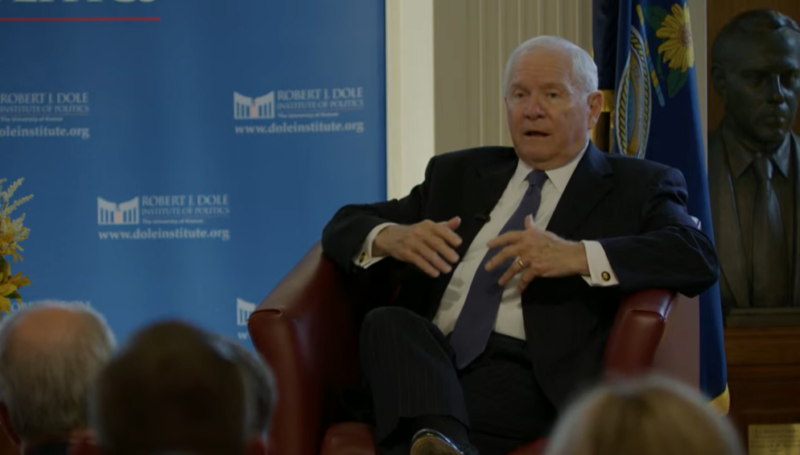
Description
Robert Gates, a former CIA director and secretary of the Department of Defense, said during a forum at University of Kansas that President Donald Trump's firing of federal workers had damaged the national security agencies. He also expressed concern about severing of federal research grants to colleges and universities and dysfunction in Congress that inhibited manufacture of military hardware. (Kansas Reflector screen capture of Dole Institute's YouTube channel)
LAWRENCE — Former CIA director and defense secretary Robert Gates is convinced zealous decisions by President Donald Trump to fire thousands of federal government probationary employees wiped out a generation of personnel committed to public service at the national security agencies.
Gates, a Wichita native who served under eight presidents during his career, said during a question-and-answer forum Wednesday at the Dole Institute of Politics at the University of Kansas that the Trump administration’s dismissal of newly hired staff in the first 100 days of his term caused sustained damage.
“There has been harm,” he said. “The firing of probationary employees at defense and at CIA, I think, was a supremely bad idea and will have long-term consequences because who they have fired are all the young people. These people are really the future of these agencies. I worry this is going to discourage this sort of stratum of young people interested in public service.”
Trump fired probationary employees across the federal government based on assertions they had to be terminated due to poor performance. The dismissals have been challenged in court with some individuals ordered reinstated by federal judges. Most of these workers were lower-level staff, but some were experienced federal employees who recently transitioned to new positions.
Gates, who was recruited into the CIA while working on a master’s degree at Indiana University, was the only career officer in CIA’s history to rise from entry-level employee to director. He was the only secretary of defense in U.S. history to be asked to remain in that job by a newly elected president, moving from an appointment by Republican President George W. Bush to serve in the administration of Democratic President Barack Obama.
‘People die’
Gates said it would be “foolish to pretend” disruption among senior-level leadership at the Department of Defense under Trump hadn’t been a distraction. He said those individuals were preoccupied with questions about whether they would be terminated, who would replace ousted staff in the chain of command and how defense policy would be summarily altered.
The nation ought to be skeptical of people in government committed to a mantra in which they routinely made rapid decisions designed to crack the status quo, he said.
“That works in the private sector actually,” Gates said. “But if moving fast and breaking things means people don’t get their Social Security checks, that’s actually a problem. There is sort of this feeling on the outside, if only business people could get in and run the government, then everything would be okay. Well, the problem is government isn’t a business. If something breaks in the private sector, people lose money. If something breaks in the government, people die.”
He said a leadership style dedicated to smashing international institutions was a “formula for disaster.” No one in the Trump administration has publicly argued on behalf of the NATO alliance, spoke of the value of United Nations agencies or championed the World Trade Organization, he said. It was disappointing to watch as the Trump administration obliterated the U.S. Agency for International Development, he said.
Gates, who serves as chancellor of the College of William & Mary in Williamsburg, Virginia, said he was distressed Trump showed a willingness to undercut the system in which the federal government provided funding for basic research carried out at public and private universities. This innovation pact has incubated research talent and fueled gains in the U.S. economy, he said.
“It was worth the federal government investing money,” Gates said. “It was pretty efficient in many respects. Now, were there crazy projects that got funded over the past 25 years? You can bank on it. But, for the most part, they have propelled the United States ahead economically and in terms of our technical prowess that is the envy of the world.”
He said the stream of federal investment brought the world’s smartest people to the United States where a portion of immigrants established major U.S. companies.
“There’s already been damage because lots of research projects have been interrupted,” Gates said. “Fundamentally, if this research isn’t done in universities, it won’t get done. We will begin to lag technologically. We’re playing with the future here and my hope is this is a temporary disruption. Putting Humpty Dumpty back together again is going to have costs.”
He said social science faculty on college and university campuses could benefit from self-reflection about the tendency to offer one-sided instruction of history and government.
‘Disarray in America’
Gates was in Lawrence to participate in the KU Security Conference aimed at understanding China’s geopolitical objectives and how they influenced U.S. national security. He was asked by Dole Institute visiting fellow Jerry Seib to step into the shoes of Xi Jinping, president of the People’s Republic of China, and examine the political, military and economic landscape.
“Well, I think I’m in pretty good shape because my principal adversary is not. There is a lot of disarray in America,” Gates said.
He said Xi was leading the world’s second-largest economy and had built a massive military force, including a rapidly expanded Navy driven by huge investments in ship production. From 2017 to 2024, Gates said, China built 150 warships during a period in which the number of U.S. Navy ships remained static.
China has been wrestling with a demographic time bomb due to the one-child policy, a 21% unemployment rate among young people and unprecedented tariffs imposed by the Trump administration, Gates said. Rigidity of a Chinese Communist Party that prioritized internal security over economic progress was a weakness, he said.
The one area of consensus among Republicans and Democrats in Congress was hostility toward China, Gates said, but that rhetoric in Washington, D.C., could be useful to Xi as he sought to rally domestic support.
“He’s probably prepared to be patient,” Gates said. “The last thing he can do is show weakness in dealing with the United States and President Trump. I think he must be worried about the possibility of significant unemployment in turning tens of millions of workers out of those factories that are not going to be delivering goods to the United States.”
Gates said it was unlikely a trade war would lead to armed conflict involving China and the United States. He said lack of open communication between the two governments should be a concern given China’s aspirations to control of Hong Kong, Taiwan and the South China Sea.
‘Gasbags’ in D.C.
The U.S. military industrial base has eroded at the same time China dedicated resources to expanding production of military hardware, Gates said. China possessed 250 times the ship-building capacity of the United States, he said. China holds more than half the global capacity to build ships while the United States possessed less than 1%, he said.
He said Congress was partly to blame because it had been 15 years since the House and Senate produced a regular budget for the Department of Defense. The approach made it difficult to comply with demands from politicians to be nimble in development of new technology or to create an effective military acquisition network, he said.
“You’ve got all these people making speeches up on the Hill about how slow the defense department is to integrate new technologies. You’ve got them all yelling and they’re waving their arms about the lack of ship-building capacity and so on. And they’ve not appropriated a single dollar to do anything,” Gates said.
He said the Department of Defense required authority to enter lengthy contracts for ship and ammunition manufacturing that couldn’t be broken in two or three years.
“The fundamental thing is for the gasbags in Washington to stop talking and start doing,” Gates said.

Topeka, KS