Judge to rule by Tuesday whether jailed Democrat will appear on Alaska’s U.S. House ballot
Sep 09, 2024 | 11:03 pm ET

Description
(Getty Images)
An Anchorage Superior Court judge will rule as soon as Tuesday on a lawsuit that will decide whether a man imprisoned in New York will remain on Alaska’s U.S. House ballot.
Democratic candidate Eric Hafner received the sixth-most votes in the August primary election, but he was promoted to fourth after two Republican candidates withdrew.
The Alaska Democratic Party, fearing the possibility that a second Democrat on the ballot could draw votes away from incumbent Rep. Mary Peltola, D-Anchorage, sued the Alaska Division of Elections last week, arguing that Hafner is ineligible under state law and the U.S. Constitution and should not be on the ballot.
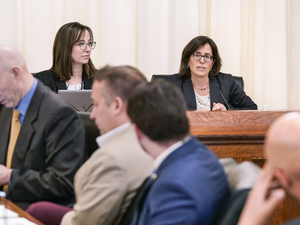
Judge Ian Wheeles heard an hour of oral arguments in court on Monday morning before taking the case under consideration.
“I think it’s highly likely I would have a decision for you by (Tuesday),” he told attorneys.
Wheeles was appointed to the bench by Republican Gov. Mike Dunleavy in 2022 and has not previously adjudicated an elections lawsuit. An appeal to the Alaska Supreme Court is possible, regardless of the verdict.
Hafner received less than 1% of the vote in August’s primary election, but the case matters because the margin between Peltola and Republican challenger Nick Begich is expected to be tight.
“The harm that we fear is less that he will win (and more that) he will affect the results of the election,” said attorney David Fox, representing the Alaska Democratic Party.
Alaska’s elections system promotes the top four vote-getters from the primary election to the general election. In the November general election, voters pick up to five options —four candidates and a write-in— in order of preference, which could dilute any spoiler effect.
Despite that, Democrats are worried that some Democratic voters will be confused and vote only for Hafner.
“That would eliminate those voters, essentially, who only named him and didn’t name anybody else?” Wheeles asked.
“Yes, your Honor,” Fox replied.
Fox works for the Elias Law Group, which represents Democratic interests nationally, and his presence was a further sign of the case’s importance.
The U.S. House of Representatives is expected to be closely divided between Democrats and Republicans after the November election, and Alaska’s U.S. House district is one of only a handful of districts that could go to either Democrats or Republicans.
The Democratic Party’s case relies on two arguments: that state law doesn’t allow a sixth-place finisher to be promoted into the “final four” and that Hafner fails the requirement in the U.S. Constitution that a candidate be a resident of the state “when elected.”
The party’s suit is opposed by the Division of Elections and the Alaska Republican Party, which intervened shortly before oral arguments began.
To obtain an injunction that removes Hafner from the ballot, the Alaska Democratic Party must prove that removing Hafner is less harmful than keeping him on the ballot.
Wheeles asked what might happen if legal proceedings meant delaying election preparation by two weeks.
Attorney Tom Flynn, representing the Division of Elections, said that would mean postponing the mailing of ballots bound for international and military voters. The deadline for that mailing is set in federal law.
If Wheeles or the state Supreme Court were to mandate changes to the ballot, elections officials have said that the switch would take time. Plaintiffs and defendants disagree on the amount of time.
If it takes too long, the division could still go ahead with the international mailing on time, but only if it used the old ballots. That would result in two different sets of U.S. House ballots.
“The public’s confidence in elections would undoubtedly be affected by multiple ballots out there, changes midstream, things like that,” Flynn said.
Lt. Gov. Nancy Dahlstrom, who is in charge of the state’s elections system, is a Republican and was a candidate for the U.S. House this year until she withdrew after the primary. Dahlstrom selected the current elections director, Carol Beecher, who was a registered Republican at the time of her selection.
“I think that the time pressure of the ballot printing issue is overstated,” Fox said.
During oral argument, Wheeles pressed Fox about the idea that the Democratic Party is bringing this lawsuit too late.
“There’s some element here of one’s failure to plan has become someone else’s emergency by the way this has been filed. Is that not fair?” Wheeles asked.
“I don’t really think that is fair,” Fox replied.
One of the party’s key arguments is that the language used in state law allows the Division of Elections to promote only a fifth-place finisher into the top four if one of those top four quits the race.
Fox argued that the law doesn’t allow the division to promote the sixth-place finisher if a second member of the top four withdraws.
“The way the statute is written, it allows only a single replacement, so, just very clearly, by implication, if two people drop out, there’s not a second replacement,” he said.
Flynn, of the Division of Elections, opposed that argument, saying that “the court should … look at these statutes in light of precedent, reason and policy,” and that Alaska’s elections system is built around the idea that the top four candidates advance.
If someone withdraws from the top four, the sixth-place finisher becomes the fifth-place finisher and is eligible for promotion into the top four, he said.
That was echoed by attorney Richard Moses, representing the Alaska Republican Party.
“When read in harmony with the statute as a whole, the statutory scheme that the voters chose to enact is that, when possible, there should be four candidates on the general election ballot.”
Fox also argued that Hafner cannot come to Alaska before Election Day and would fail the U.S. Constitution’s requirement that he be an inhabitant of Alaska in the unlikely event that he were elected.
Hafner is slated to be in prison until 2036, has not requested parole, and his legal appeal is at an early stage.
“If ever there is a person who cannot possibly become an inhabitant of the state in which they seek elections by election day, that person is Mr. Hafner,” Fox said.
But Flynn countered by arguing that Hafner has a right to run for office, even if he can’t serve. Disqualifying Hafner now, instead of in November — in the unlikely event that he won — “would be adding to the exclusive list of qualifications in the U.S. Constitution, which the state can’t do at this point.”

Juneau