Senate approves private-school voucher program
Mar 08, 2024 | 1:33 pm ET

Description
Craft time for preschool students at the Evanston Child Development Center on Jan. 25, 2023. (Katie Klingsporn/WyoFile)
After more than 30 amendments, House Bill 166 – Education savings accounts-1 bore little resemblance to its original iteration.
Gone was a component aimed at helping parents pay for early childhood education — something the state is lacking. Gone were income-based eligibility requirements that many said are required for the measure to conform with Wyoming’s Constitution.
What remained on Thursday afternoon was a measure that would give families $6,000 in public funds to pay for non-public-school costs like private school tuition or instructional material for homeschoolers.
“We now have an opportunity to provide universal school choice to all children,” Sen. Evie Brennan (R-Cheyenne), who pushed for the most drastic changes, told her colleagues.
Despite concerns that what remains won’t stand up to constitutional challenges, the chamber passed the bill by a vote of 20 to 10.
Later that day, the House declined to accept the new version. That sent the legislation into a process of negotiation.
The history
House Bill 166 – Education savings accounts-1 has been killed and revived, amended heavily and contested by everyone from the Wyoming Education Association to homeschool parents. Throughout its journey, it’s been dogged by concerns that it violates the Wyoming Constitution’s prohibition on the use of public funds for private or parochial schools.
House Bill 166 emerged from the ashes of twin education bills that failed in the 2023 session and reflects growing conservative advocacy for parental choice. Those bills would have given families $6,000 per K-12 student for tuition at any non-governmental school or related educational expenses.

After taking heat from the far right for blocking the legislation, Speaker of the House Albert Sommers (R-Pinedale) brought what he touted as compromise legislation to the Joint Education Committee during the interim.
Sommers’ bill would have created “education savings accounts” for qualified families to spend state funds on costs associated with preschool or non-public-school education.
Though it was committee-sponsored, which traditionally translated to a better chance of consideration, it failed introduction on the first day of the session.
Rep. Ken Clouston (R-Gillette), along with co-sponsors in the Senate, then introduced the latest bill version. This one included a tiered-income system, providing $1,000-$5,000 based on family income. It also allowed expenses for kids as young as 4.
It passed the House relatively unscathed before coming to the Senate, where its next transformation began.
In the end, the final version closely resembles those failed 2023 measures, which Brennan touted. “This bill as it is now is very similar to the bill that we, the Senate body, supported last year,” she said.
What it didn’t resemble was the original text. “We don’t often see a bill with 31 amendments to it,” Sen. Jim Anderson (R-Casper) said. “This bill has been so changed that probably the originators don’t recognize it.”
Co-sponsor Sen. Bill Landen (R-Casper) confirmed that. He was inspired to draft the bill by an amazing private school in his community, he said, and he wants more families of all income levels to have access to that kind of education.
“I sponsored a bill that I thought would work,” he said. “And, now it’s not my bill anymore. I mean, it just isn’t. It’s something entirely different.”
Landen and fellow co-sponsor Sen. Eric Barlow (R-Gillette) both voted no.
The debate
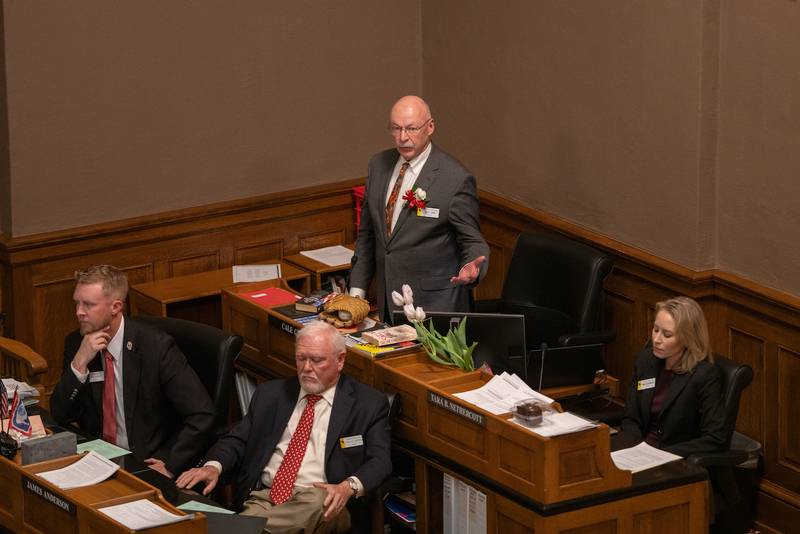
The Senate debated for hours on the measure this week through the course of three readings. At times the debate strayed into topics like climate change, biblical literalism and biological sex.
Several amendments were offered; most failed. Senators attempted to tack an early childhood program back on and also endeavored to mandate science-based curricula, to no avail.
In the end, the measure became a voucher program that threatens equitable education in the state, Wyoming Education Association President Grady Hutcherson told WyoFile Friday. “We need to take care of the 93% of students enrolled in our public schools, without chipping away at their resources by diverting taxpayer dollars away to support the inequitable, ineffective education students receive through voucher programs.”
The constitutionality question hovered through Senate debate.
“We know that it says clearly in the constitution that when we’re using public funds, that it cannot be private school, it cannot be sectarian,” said Sen. Chris Rothfuss (D-Laramie). “And these are tenants that were laid down by the framers of the Wyoming Constitution for good purpose. So the question here is, do we want to disregard that?”
Sen. Wendy Schuler (R-Evanston) noted the measure had been “hammered into oblivion” by amendments.
“This bill is clearly unconstitutional,” Schuler said. “And what really surprises me about some of the folks in here is we use that constitution when we want to and when we don’t want to, we just dance around those things that are clearly in there. So that $20 million that we have in there, we’re gonna be spending that on lawyers. And I think that’s a shame.”
Cheyenne, WY