Kansas advocates weave able-bodied, waiting list arguments into Medicaid expansion debate
Dec 27, 2023 | 2:54 pm ET
Description
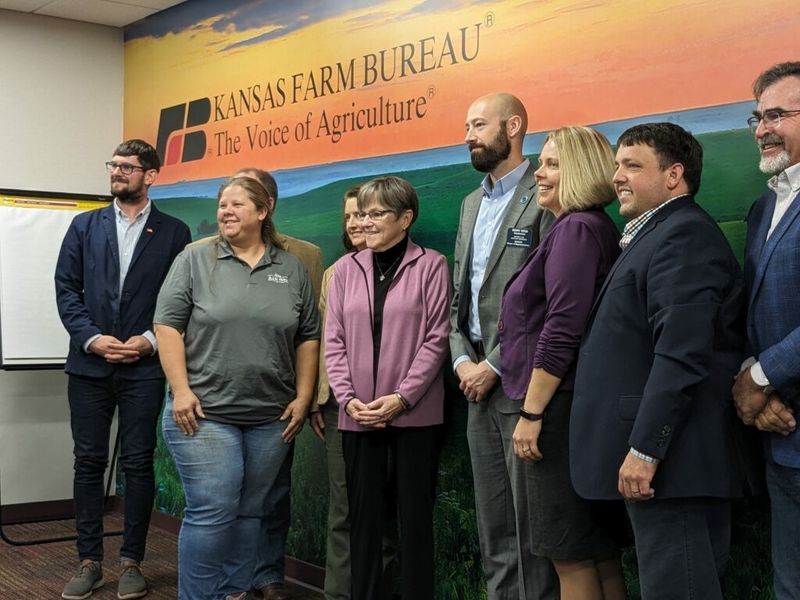
Gov. Laura Kelly, who is proposing the 2024 Legislature expand eligibility for Medicaid to about 150,000 low-income Kansans, stands with a group following a Medicaid discussion at the Kansas Farm Bureau headquarters in Manhattan. (Tim Carpenter/Kansas Reflector)
TOPEKA — Americans for Prosperity-Kansas director Elizabeth Patton denounced the idea of expanding Medicaid to include “able-bodied” adults living barely above the poverty line because reform would deny assistance to people with disabilities.
In response to Gov. Laura Kelly’s latest legislative proposal for upgrading Medicaid, Patton said Kansas would be prudent to remain among the 10 states that have declined expansion for nearly a decade. She said adding Kansas to the list of 40 expansion states, including the four bordering Kansas, would interfere with access to health care among “the most vulnerable in our society.”
“Allocating Medicaid funds to able-bodied adults in Kansas means diverting resources away from disabled individuals, pregnant mothers and children living in poverty,” Patton said. “We hope that Governor Kelly realizes that perpetuating a failed program instead of protecting it for the most vulnerable is not the right answer.”
She has said extending Medicaid to an estimated 150,000 Kansans would make it more difficult for people with disabilities already on Medicaid to secure services.
The waiting lists in Kansas for intellectual or developmental disability services through Medicaid has grown during the past eight years from 3,400 to 5,200. The physical disability waiting list in Kansas has ballooned from 822 to 2,400 in that period.
The able-bodied claim
Sean Gatewood, co-administrator of a Kansas coalition of more than 50 organizations and individuals who advocate on behalf of 400,000 Kansans who depend on Medicaid, said AFP-Kansas and some Republicans in the Legislature perpetuated a myth Medicaid expansion would exclusively benefit “able-bodied” Kansans and shove aside people with disabilities.
Gatewood, a lobbyist with KanCare Advocates Network, said the truth was Kansans of working age with disabilities would benefit from expansion because only a small percentage currently had health insurance through Medicaid or Medicare. Federal data showed 93,000 of 599,000 Kansans age 19 to 64 with disabilities and of working age qualified for those two health programs.
Although a portion of the 500,000 with disabilities in Kansas might have access to health insurance, he said, it was often not affordable to them. If Kansas adopted a model that added 150,000 low-income residents to Medicaid — a program in which the federal government pays 90% of costs — the coverage gap would narrow, he said.
Kansans with physical or mental conditions that interfere with steady employment and maintenance of health coverage could benefit from widening eligibility for Medicaid, he said.
“We know there are a ton of folks in need,” Gatewood said. “There are ‘able-bodied’ people with mental health conditions of some kind that prevents them from holding down a job.”
He said expansion of Medicaid would build capacity in the state’s health care workforce, including those providing in-home, direct-care services to Kansans with disabilities. A University of Kansas study of direct-care personnel in Kansas found 24.1% were uninsured, which was nearly twice the national average of 12.2%
“It’s difficult for people with disabilities to hire direct-care workers when they are competing with fast-food restaurants or retail jobs, which may offer better benefits, including access to health care,” Gatewood said.
The waiting lists
Kansas Senate President Ty Masterson, an Andover Republican and opponent of Medicaid expansion, said the governor’s proposals were flawed because it would “push able-bodied adults off of private insurance and onto a government program that was intended for the truly vulnerable.”
Masterson said change sought by Kelly would make it more difficult for the state to address needs of people with disabilities who should be the state government’s priority. Masterson and House Speaker Dan Hawkins, R-Wichita, have said in the past the Legislature must be “laser focused on eliminating the Medicaid waiting lists.”
Those lists have grown by thousands of people in the past eight years, said Rocky Nichols, executive director of the Disability Rights Center of Kansas.
He said the Legislature increased state funding once in that span to broaden delivery of Medicaid services to people with disabilities on waiting lists. That was in 2020 when the Legislature allocated $3 million to take 150 people off the lists, he said.
During that same eight-year period, Nichols said, the Legislature appropriated $234 million to increase rates paid providers of services to Kansans receiving intellectual or developmental disability services.
Nichols said investing state resources in provider rates and waiting lists should both be priorities of Kansas lawmakers. The disparity in allocation of state dollars was unacceptable, he said.
“It shows the Legislature has been focused on one at the expense of another,” Nichols said. “There is only one way to reduce waiting lists and that is to fund new slots. Our hope is the governor proposes a significant increase in funding.”
He said the Big Tent Coalition of Kansas recommended the Legislature and governor reduce waiting lists by 20% annually over the next five years.
Kelly’s suggestion
Kelly took a road trip to Holton Hospital in mid-December to outline the latest incarnation of her proposal to expand Medicaid. It followed months of visits to cities across the state on her “Healthy Workers, Healthy Economy” campaign to generate support for expansion.
She said there Kansans were eager to expand health coverage to people who earned too much income to qualify for Medicaid in Kansas but not enough to afford private health insurance. Currently in Kansas, a single mother of two could qualify for Medicaid if making less than $9,500 per year. Her bill would serve interests of an individual earning $14,580 to $20,120 or a family of four earning $30,000 to $41,400 annually.
“We have taken such a bipartisan approach to incorporate what I’ve been hearing from Kansans during my tour and to reflect conversations we’ve had with Republican lawmakers,” Kelly said.
The governor included a requirement so adults benefitting from expansion would have to provide evidence they were employed during the past 12 months to maintain eligibility. Exemptions to the mandate in Kelly’s plan would include caregivers, veterans, full-time college students, the homelessness, people with a permanent disability or who were mentally or physically unfit for employment, residents who volunteered at nonprofits for 20 hours a week and parents of children under the age of 18.
“This is nothing more than smoke and mirrors because Governor Kelly most surely knows that the Biden administration has not approved any Medicaid work requirement,” said Hawkins, the House speaker.
The administration of President Joe Biden opposed work requirements tied to Medicaid, but former President Donald Trump took the opposite view and could seek adoption of work rules if elected in 2024.
Kelly said her bill would reduce the cost to hospitals and clinics of uncompensated care. Her plan would offer coverage to uninsured inmates in prisons and jails so law enforcement could redirect resources to fighting crime and local governments could reduce pressure on property taxes to finance health care costs.
She said the state’s 10% share would initially be covered by drug rebates, other cost savings and federal funding. Two years after implementation of Medicaid expansion, she said, hospitals would share in some of the cost through a surcharge capped at $35 million.
Topeka, KS