Congressional Republicans want permitting reform, an Ohio project shows how tricky that could be
Oct 02, 2026 | 4:00 am ET
Description
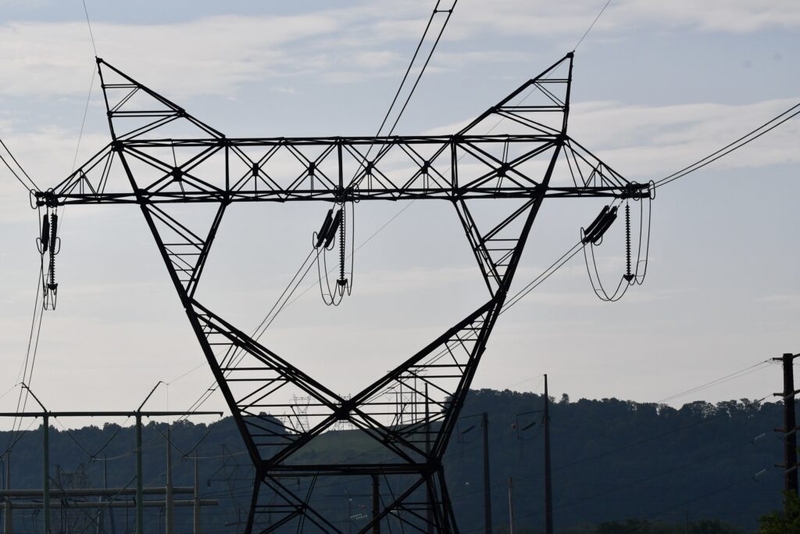
Power lines cross the Susquehanna River near the Hummel Station power plant in Snyder County, Pennsylvania. (Photo by Peter Hall/Capital-Star)
Several of Ohio’s GOP Congressmen swung through Columbus recently to tout the importance of permitting reform. With data centers driving demand for power and an ocean of natural gas beneath our feet, they argued, federal red tape can’t be the bottle neck delaying new pipelines and transmission lines from getting built.
“We can have all the energy in the world from oil and natural gas, but if we can’t move it from point A to point B, it’s worthless,” Bowling Green U.S. Rep. Bob Latta said after a panel discussion hosted by the Ohio Manufacturers Association.
At a different event hosted by Arnold Ventures and the Club for Growth, Ohio Republican U.S. Sen. Jon Husted said permitting reform could end “junk lawsuits” and the “political gamesmanship” of energy policy whipsawing from one administration to the next.
“We literally have the opportunity through things like permitting reform to reduce the time it takes to do things like build roads and bridges, to build transmission lines, to build power supply that people need to fund and run all of these different operations,” Husted said.
A major energy transmission project in Western Ohio offers a glimpse of just how difficult a needle lawmakers are trying to thread.
State and local officials seemingly agree that investments in energy infrastructure are worthwhile. The problem is they also agree those investments should be made elsewhere.
What’s the project?
Grid Growth Ventures, a company with backing from AEP and FirstEnergy, is planning to run power lines from two substations in Central Ohio all the way to the Indiana border. The project will carry high voltage power for hundreds of miles on steel lattice structures from 130 to 175 feet tall.
Demand for power in Ohio is growing, and transmission lines like the Grid Growth project are meant to serve that expanding capacity.
In a press release, the company compared transmission lines to interstate highways, “helping move power more efficiently to where it is needed most while creating multiple transmission pathways that strengthen reliability across the region.”
The regional grid operator, PJM Interconnect, manages the transmission network across its 13-state footprint. PJM approved the Grid Growth’s project in February as part of a broader effort to expand the network’s capacity and reliability.
“This project is not being built for hypothetical future growth.” Grid Growth spokesperson Lauren Siburkis said in an emailed statement.
“PJM identified critical reliability vulnerabilities in this region and selected this project as the solution to address those needs and help ensure power can continue flowing safely and reliably to millions of homes and businesses across Ohio.”
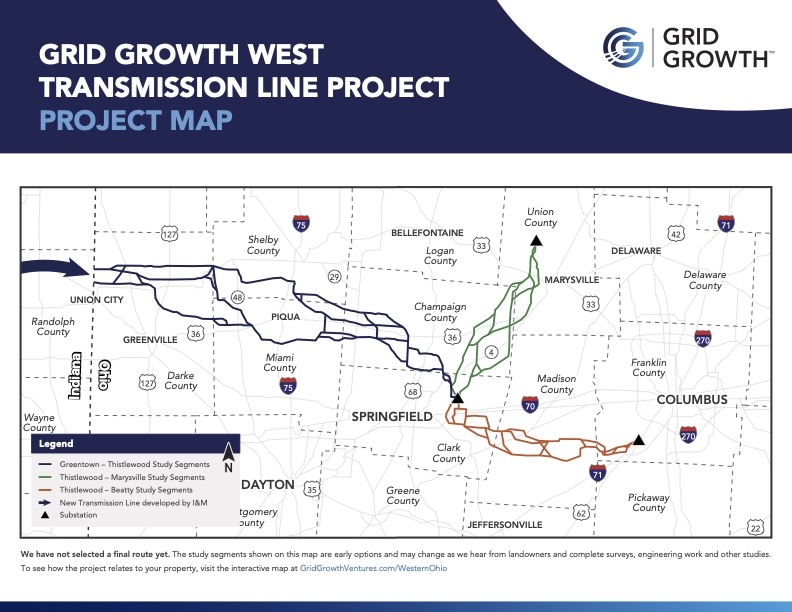
The company must now get approval from the Ohio Power Siting Board for a specific route. The board has several options before it. The members can accept or reject the proposal, make modifications, or apply conditions to the project’s buildout.
“A strong transmission system does more than keep the lights on,” Siburkis said. “It helps support economic growth, gives businesses confidence that the power they need will be available and helps ensure Ohio remains a competitive place to locate, expand and invest.”
Grid Growth’s path crosses Ohio’s western border a bit north of Union City in Darke County and runs east to a substation outside of Springfield. From there the path splits — one line running northeast to Marysville while the other moves Southeast to Grove City.
Within that broader plan, though, the lines branch out like a river system, with alternative proposals cutting their own unique path to the same endpoints. The company has held several open house events in the affected counties to hear from residents.
As the company figures out the exact course its transmission line should take, several state and local leaders have chimed in with the same answer: not here.
Criticism
Ohio state Rep. Johnathan Newman, R-Troy, represents a district covering Miami County and part of Darke County. In letters to state regulators, he argued on behalf of both their interests.
Miami County cities along the I-75 corridor are growing, Newman said, and running the transmission line through the area could disrupt that development. He pointed to a Meta data center beginning construction this fall and suggested more businesses could follow.
“A power line passing through this area to the north of south of Piqua is incompatible with the outstanding progress taking place,” Newman told regulators.
Instead, Newman voiced strong support for “a northern pathway, avoiding Miami County.”
That northern route would go through Shelby County.
They don’t want it either.
“This position is not based on opposition to a reliable electric grid,” the Shelby County Commission said in a press release. “We understand that the electric grid throughout the PJM region needs to continue to improve.”
Still, commissioners determined a Shelby County corridor isn’t “in the best interest of our community.”
Just to the east, the Champaign County Commission offered a similar message — safe, reliable power is an understandable goal, but why here?
“Our citizens are being asked to bear the burden of miles of our county farms and homesteads being forever changed,” the Champaign County commission said in a press release expressing opposition to the project.
Ohio state Rep. Tim Barhorst, R-Ft. Loramie, represents both Shelby and Champaign Counties, but he expressed sympathy with elected officials in neighboring counties, too.
“It’s all the same issue,” he said, “I don’t want this to become neighbor vs. neighbor, community vs. community, landowner vs. landowner.”
Barhorst readily acknowledged, “we need more electrons,” but he sees the transmission line as band-aid, bringing energy from Indiana (a net-exporter) to Ohio (a net-importer).
“I’d like to see us shift to a debate of Ohio handling its own needs instead of relying on neighboring states,” he said.
In far west Darke County there’s less question about the route shifting north or south to pass through a different county — all three proposed lines cut straight across it.
The Darke County Commission isn’t happy, and Ohio state Rep. Angela King, R-Celina, is pulling out all the stops in a letter to the Ohio Power Siting Board.
A “sound process,” King said, would “give meaningful weight to agricultural viability, private-property impacts, livestock operations, drainage systems, induced-voltage concerns, historic resources, and rural community continuity.”
King cited potential impacts on agricultural production — Darke County is the state’s biggest in terms of acreage and ag sales — but she also expressed concerns about the environment, historic or archaeological sites, and even the potential for power lines to electrify nearby conductive objects.
King pointed to state law requiring the siting board to demonstrate not just the project’s necessity but that the route in question is the best available option. She included an eight-point plan she wants the board to follow in developing and analyzing alternative routes.
The balancing act
In Washington D.C., lawmakers are preparing for a lame duck push on permitting reform. After sending a handful of proposals to die in the U.S. Senate, the House Energy and Commerce Committee packaged 19 different permitting measures into one bill called the POWER Act.
U.S. Rep. Latta and Zanesville Republican U.S. Rep. Troy Balderson both sit on that committee, and at the Ohio Manufacturing Association panel earlier this month, they touted the measure as their best path forward.
Speaking afterward, Balderson acknowledged the challenge in balancing needed development with local interests.
“We can do that. We have to do it,” he said. “We have to work very hard at it. It’s not easy.”
Balderson described working with the Ohio Department of Transportation on a pipeline project.
“We navigated it completely, didn’t impact anybody around that,” he said. “So, we have to look for those resources, work with the agencies that want to do that — that’s our first stop, and then we can go from there.”
Institute for Local Self-Reliance co-executive director John Farrell contends the regional planning process is “already kind of broken,” and leaves many residents living near big projects with a sense of “powerlessness.”
Farrell explained by the time a project lands with state regulators the question is mostly about permitting and siting, rather than which alternatives offer the best outcome. A project’s neighbors often find out relatively late in the process, he said, “and I think it rightly makes them really mad.”
“People look at it and they say this thing will be near me, it may have impacts on me, and I have very little say in how it happens,” Farrell said. “But also, I’m getting very little benefit from it. Some other big corporation is going to cash in on it, and I’m not going to see anything.”
Farrell acknowledged some opponents of development may reject any project at all, but he said the way to overcome the not-in-my-backyard response is to “actually demonstrate that an effort was really made to explore other ways to do this.”
The money
With the Grid Growth project already midway through the development process, federal legislation like the POWER Act isn’t going to affect its rollout. But its supporters are aiming to get projects like it greenlit more quickly.
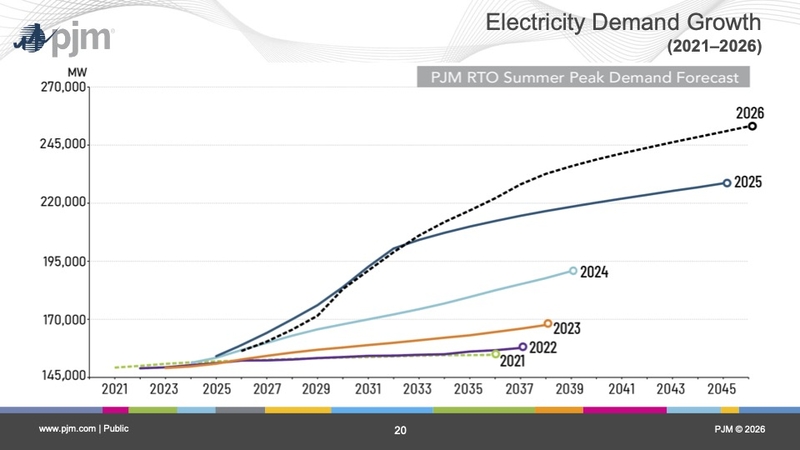
That’s understandable, perhaps, in light of future demand projections. A recent audit notes the Public Utility Commission of Ohio expects Ohio’s peak demand to grow by 56% in the next 20 years.
Similar projections for PJM’s 13-state footprint have risen dramatically year by year. In both cases, data centers are regularly cited as primary driver for demand.
But Ohio Consumers’ Counsel Maureen Willis warned speed shouldn’t be the only consideration.
“Transmission reform shouldn’t just be about building projects faster,” Willis said. “It should also be about making sure PJM is identifying the right needs, choosing the right solutions and protecting consumers from paying for infrastructure they don’t need or that is being built to serve someone else.”
Utilities plan $1.4 trillion in grid investments, likely pushing bills higher in Ohio and elsewhere
For all Grid Growth’s cheerleading about its project’s positive economic impacts, it’s also good business for them.
The cost of transmission projects gets reimbursed by ratepayers through their monthly utility bills.
For utility companies like AEP and FirstEnergy, who are involved in Grid Growth, transmission investments are an important and growing part of their business.
Between now and 2030, companies around the country are planning $1.4 trillion in transmission projects.
Lauren Siburkis from Grid Growth noted that because a final route hasn’t been selected, overall project costs haven’t been finalized. She acknowledged “customers throughout the PJM region share in the cost of transmission projects, while areas receiving greater reliability or congestion-relief benefits may be assigned a larger share.”
Those recovery costs get spread over the life of the infrastructure, which could be decades, and so the impact is “generally gradual and distributed broadly across the region.”
According to projected costs reported to PJM, Grid Growth’s transmission lines will come to roughly $1.075 billion. Based on existing cost-allocation rules, the Consumers’ Counsel office estimates Ohio ratepayers would pay about $660 million.
Because PJM’s decisions about which projects to fund are based on future demand projections, Counsel Willis contends its assumptions “deserve careful scrutiny.” And because data centers are driving those projections higher, she said, regulators should account for that when divvying up the costs.
“If a transmission project is needed primarily because of new large-load customers, then the planning and cost-allocation processes should recognize that,” Willis said. “Existing residential consumers should not be left paying costs that were caused by new customers.”
Follow Ohio Capital Journal Reporter Nick Evans on X or on Bluesky.
Columbus, OH