Five Haitians from Springfield, Ohio have been deported after Trump ended protected status
Oct 02, 2026 | 3:55 am ET
Description
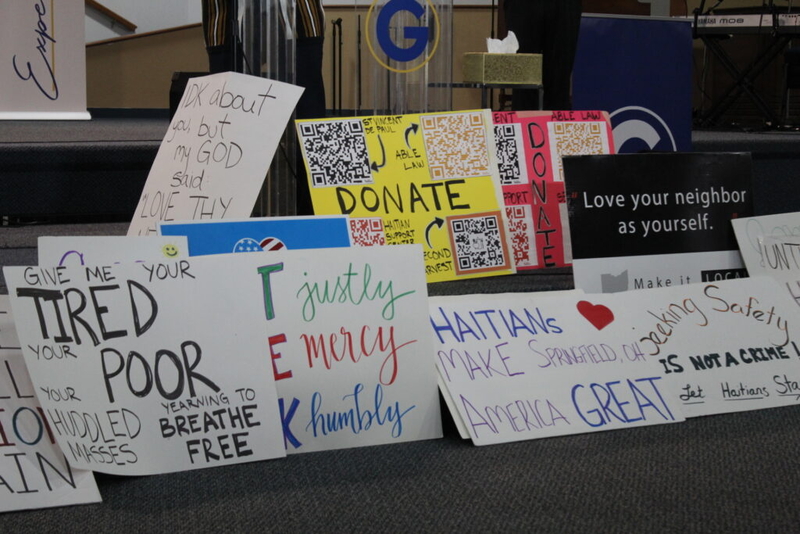
Signs of support for Haitians in Springfield after temporary protected status for Haitians ended on July 27. (Photo by Megan Henry, Ohio Capital Journal).
Five Haitians from Springfield, Ohio have been deported back to Haiti after President Donald Trump revoked their legal status, said Theresa Hice-Fromille, a board member of the Haitian Community Help and Support Center.
More than 470 people have been deported from the United States to Haiti between Aug. 20- Sept. 17 — including some with pending asylum claims, according to Haiti’s National Office for Migration.
This is happening after the U.S. Supreme Court ruled at the end of June that the Trump Administration could end temporary protected status for the 330,000 Haitians who’ve fled violence in their home country. Legal protected status officially ended for Haitians on July 27.
“The Trump administration is engaged in an all-out assault on our immigrant communities across the United States,” U.S. Sen. Chris Van Hollen, D-MD, said during a U.S. Senate spotlight hearing this week.
“ICE has already forced hundreds of Haitian TPS holders back into danger in Haiti.”
The U.S. Department of State currently has a Level 4 “Do Not Travel” advisory for Haiti “due to the risk of crime, kidnapping, terrorism, unrest, and limited healthcare,” according to the agency.
A top security official and chief of staff to the nation’s defense minister was kidnapped in June.
“The fear of going back to Haiti is so palpable and so strong,” Carl Ruby, pastor of Springfield’s Central Christian Church, said during the Senate hearing.
Deportation flights to Haiti have increased from once a month to once a week. Flights are landing in Haiti’s second-largest city Cap-Haïtien because criminal groups have made the airport in Haiti’s capital Port-au-Prince unsafe, according to a recent report from Human Rights Watch.
Upon arrival, migration officials give deportees a meal, a drink, and 10,000 Haitian gourdes (around $77). The Departmental Judicial Police Service takes the deportees to a central police station for more registration, and then they are left on their own, according to Human Rights Watch.
Human Rights Watch interviewed officials from nine Haitian government institutions for their report.
“All said Haitian authorities lack the capacity to provide shelter, continuing food assistance, safe onward transportation, sustained health or psychosocial care, or an established channel with US authorities to help deportees recover missing belongings,” HRC said in the report.
At least 1,408 people were killed and 656 were injured in Haiti from April 1-June 30, according to the Human Rights Service of the United Nations Integrated Office in Haiti.
“Now we’re saying to these people, hundreds of them, go back into this situation, this dangerous situation. It doesn’t have to be this way,” U.S. Sen. Dick Durbin, D-IL, said during the hearing.
“Protect the people who are the most vulnerable, refugees who leave countries and situations not of their own creation, but are just trying to keep their children alive and keep themselves alive.”
Durbin shared how he once visited Haiti with Ohio Gov. Mike DeWine when they served in the U.S. Senate together.
“Mike did more than visit,” Durbin said. “He and Fran went there regularly and adopted churches and groups to try to help them along.”
Mike and his wife Fran DeWine help support the Becky DeWine School in Haiti, named after their late daughter, but the school had to close due to gang activity in 2024.
The U.S. House voted in April to extend TPS for Haitians through 2029. The bill is now in the U.S. Senate, but the White House said Trump would veto the bill.
Van Hollen introduced a Senate bill that would provide TPS recipients a pathway to citizenship in the United States.
U.S. Sen. Alex Padilla, D-CA, talked about Pierre Damas Bel, a 20-year-old Wright State University student, who died in an apparent suicide on Aug. 31, which his family said happened after he was forced to wear an ankle monitor by U.S. Immigration and Customs Enforcement.

“Pierre’s story is a tragedy and an insult to our history as a nation of immigrants, and that’s what this administration is causing to so many across the country,” he said.
“It’s a powerful reminder of the human consequences of irresponsible and short-sighted decisions being made by this administration.”
Pierre’s funeral is Saturday afternoon in Springfield, hours before Trump will be speaking about 25 miles away in Vandalia at a rally ahead of the midterm elections.
“(Pierre’s) friends and family have told me that the relentless fear, shame, and pressure created by ankle monitoring weighed heavily on him,” Ruby said.
“His death shook our Haitian community to its core.”
About 15,000 Haitians live in Springfield, with a mixture of temporary protected status, citizenship, and other legal statuses. Springfield became a flashpoint in the 2024 Election when Donald Trump and JD Vance spread racist lies about Haitian immigrants there.
“Springfield’s Haitian community are not a burden. They are a blessing,” Ruby said.
“(Ending TPS) has made Springfield more vulnerable economically, socially, and spiritually. Springfield cannot afford to lose them, and morally, we should not be willing to.”
About 50 Haitians used to regularly worship at Ruby’s church, but that number dropped to two when ICE arrived in Springfield over the summer.
“Families who had prayed with us, sung with us, and served alongside us are now afraid to leave their homes,” Ruby said.
Springfield’s faith community is delivering food to Haitians, helping pay rent for families who are no longer able to work, and driving students to and from school because their parents are afraid to leave their house, Ruby said.
“I wish (Trump) could see firsthand how terrified people are of being sent back to Haiti, and to see what it’s like to see whole families hiding behind locked doors,” he said.
Nearly 75 Haitians living in Ohio have been detained since July 27 at one of four Ohio detention facilities that contract with U.S. Immigration and Customs Enforcement, according to a report from the Ohio Immigrant Alliance.
Haitians living in Springfield have been receiving letters requiring them to report to the ICE offices in Blue Ash or Westerville to accept ankle monitors after TPS ended. ICE has also recently started using the smartphone app SmartLINK to track Haitians in Springfield.
Follow Ohio Capital Journal Reporter Megan Henry on X or on Bluesky.
Columbus, OH