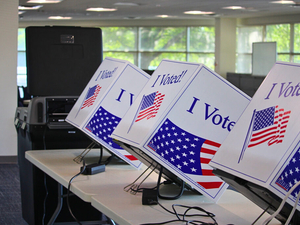
States move to fortify elections against Trump
Since his loss in the 2020 election, President Donald Trump has continued to deny the official results and baselessly sow doubt about election integrity. With an executive order to restrict mail-in voting and lawsuits demanding states turn over their voter rolls, Trump and his administration have been pushing for more federal involvement in how elections are run. That has some state leaders preparing for worst-case scenarios.





In Episode 43 of Stories From The States, you’ll hear from Stateline staff writer Kevin Hardy. He spoke to some state attorneys general about how they’re getting ready for the possibility of federal agents at the polls and contested election results.
You’ll also get a weekly news wrap-up from Evening Wrap newsletter writer Danielle Gaines and Daybreak newsletter writer Madyson Fitzgerald. They’ve got you covered on the latest about: the nation’s first confirmed measles-related deaths of the year, Meta paying out penalties and the declining enrollment in the Affordable Care Act insurance.
Episode produced and edited by Mallory Cheng. Music for Stories From The States composed by David Singer.
Got questions? An episode idea? Email us at [email protected].
Subscribe to Stories From The States on Apple Podcasts, Spotify or YouTube.
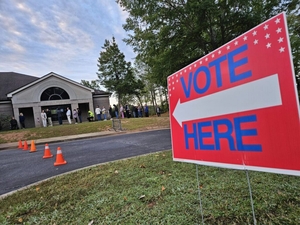
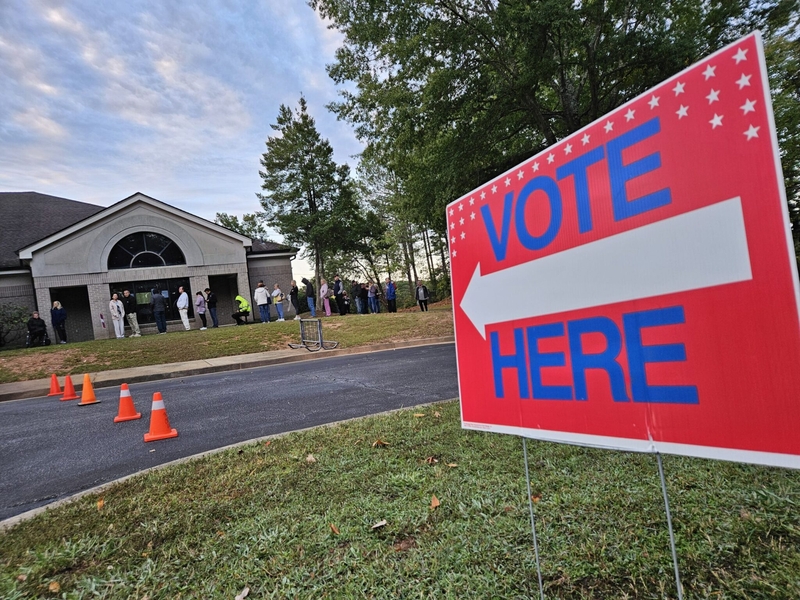
Photo: Georgia residents line up to vote in 2024. State Democratic officials nationwide are bracing for potential federal interference during November’s midterm elections. (Photo by Ross Williams/Georgia Recorder)
Stories From The States is a production of States Newsroom, the nation’s largest state-focused nonprofit news organization, with reporting from every capital. At this pivotal moment in American democracy, our veteran journalists from all 50 states are reporting the consequences of government decision-making. By zooming in on one story each week, Stories From The States contextualizes and gives a human voice to what is happening now.
Transcript was created using an automated software.
Chris Fitzsimon
This is Stories From The States. I'm Chris Fitzsimon. Here at States Newsroom, we know there's a lot going on around the country in every state capital. So thank you for being here. First, we're going to jump in with the news of the week from around the country. The first two measles-related deaths have been confirmed this year, b...
Transcript was created using an automated software.
Chris Fitzsimon
This is Stories From The States. I'm Chris Fitzsimon. Here at States Newsroom, we know there's a lot going on around the country in every state capital. So thank you for being here. First, we're going to jump in with the news of the week from around the country. The first two measles-related deaths have been confirmed this year, but a member of the Trump administration is questioning the accuracy of that report. Also, some big news for folks who are chronically online: Meta agreed to pay out billions in penalties over claims that its social media platforms are addictive and a danger to kids. Now it's up to states to decide how to spend that money, and there are already some interesting ideas. We're also going to hear about the latest news on how some states are dealing with the falling enrollment in the Affordable Care Act plans, and the Trump administration has been pushing for more federal involvement in local elections. Later in the show, we're going to chat with Stateline reporter Kevin Hardy about how state lawmakers are preparing for the worst-case scenario at the polls. But first, let's check in on the news with our States Newsroom newsletter authors, Madyson Fitzgerald and Danielle Gaines. Well, hello, Madyson and Danielle. How are you guys?
Madyson Fitzgerald
Doing well. How are you?
Chris Fitzsimon
Good. What have you guys been up to? Danielle, you were on vacation. It's nice to have you back.
Danielle Gaines
Thank you so much. I just got back from sunny California. I was talking about the highlight of the trip was going to the fancy Taco Bell on the beach in Pacifica. My kids were absolutely thrilled. We watched whales while we ate our. What do my kids eat? They have like a 15-item Taco Bell order, so I can't even remember it all.
Chris Fitzsimon
Okay, I have to. I have to say, I did not have orca whales and Taco Bell on my menu.
Danielle Gaines
It was magical, honestly.
Chris Fitzsimon
Madyson, do you have anything to top that?
Madyson Fitzgerald
Um, no, honestly, I haven't been up to anything this week. But I will say, I went to the Taco Bell that has alcoholic drinks in Florida once. I didn't end up getting anything, but it was so strange because they had special foods and like the like spiked Baja blasts, I was like, "That's crazy. My sister was great too. Oh yeah?
Danielle Gaines
But it was like 11 in the morning, so I didn't want to get a spiked Baja blast in front of my in-laws.
Madyson Fitzgerald
Understandable.
Chris Fitzsimon
Well, I'm I've been missing out. I had no idea. So let's jump into the news. Another crazy week. Speaking of something that we didn't wouldn't be guessing a few years ago that we'd even be talking about, how in the world are we still talking about measles?
Madyson Fitzgerald
It just keeps spreading and seemingly getting worse. But this week there was a lot of news regarding measles, starting with Pennsylvania. The Department of Health confirmed two measles-related deaths this week, and those were actually the first in the nation, and so both both of the people lived in Lancaster County, and they were unvaccinated, and no other personal details were shared at the time. But the deaths come amid the country's largest outbreak of measles in decades. The disease had been declared eliminated in 2000 due to the success of a widespread vaccination campaign, but the country's measles-free status is now at risk, with 2777 cases confirmed by the Centers for Disease Control this year so far.
Chris Fitzsimon
Yeah, it's a. It's. I think part of the problem it feels like is that we are hearing such mixed messages from the people at the Center for Disease Control and other people in our government, Danielle.
Danielle Gaines
Yeah, I mean, one of the things the Pennsylvania Health Secretary said after you know having to announce these terrible deaths was that because it's been largely eradicated for decades, people don't understand the severity of the illness, and they're hearing mixed messages about the vaccinations. And so she was encouraging everyone to please go out and get vaccinated. The governor had the same message. Of course, this is all exacerbated by the messaging from the White House itself. So a few weeks ago, President Donald Trump signed an executive order altering the MMR vaccines for kids, and he claimed that the vaccine the vaccination combination could be lethal. That's despite no evidence at all. Medical professionals say the shot is safe. It's effective, and of course, you know U.S. Health Secretary RFK Jr. has a long history of sowing vaccination doubt. Generally, he's made unfounded claims related to autism and has exaggerated the potential for harm. He has since called for people to get the MMR vaccine as the outbreak has gotten worse. But then, just this week in Florida, he actually questioned whether or not the folks in Pennsylvania actually died of measles.
Chris Fitzsimon
Yeah, right after they died, I think that...
Danielle Gaines
Right right after they died, and also you know in contradiction to like a Twitter or X message from the CDC acknowledging the deaths and and mourning them.
Chris Fitzsimon
I did notice that he and Governor Shapiro were going back and forth on social media arguing about it. It's it's it's so bizarre.
Danielle Gaines
Yeah, Pennsylvania is one of many states, as as we all know, that. Has decided to part ways with the official federal vaccine guidance at this point, and that was one of the sore spots that they were going over. And Pennsylvania is, of course, following the advice of medical professional groups.
Chris Fitzsimon
One other point I noticed that even Dr. Oz weighed in finally and was pushed about vaccines being lethal, and he said, "No, they are not lethal. So it's almost like they-they some of them want to say the right thing and somehow are afraid to. It's very confusing.
Danielle Gaines
Yeah.
Chris Fitzsimon
But talking about kids, I thought the some somehow the biggest news of the week was Meta and the settlement, which sort of caught me off guard. Just a massive settlement with Meta, which most people still think of, I think, as Facebook. What happened?
Madyson Fitzgerald
Yeah, this was some really major news within the big tech world. But for the people that are chronically online, like me, Meta, the owner of Facebook and Instagram, agreed to pay 47 states, the District of Columbia, and a handful of U.S. territories up to $17.1 billion in penalties over claims that its social media platforms are addictive and a danger to children. We've done a lot of reporting on this across news from the states about addictive feeds and things like that. But according to Stateline, Meta also pledged to make changes to Instagram and Facebook that are designed to reduce young people's use of the platforms. So there were a lot of responses from several different states. So in Nevada, you know, Democratic Attorney General Aaron Ford called the settlement a historic win and a first step toward a future in which social media companies do not treat our children as disposable products. And in Minnesota, Democratic AG Keith Ellison said at a press conference that Meta knew its platforms were hurting kids, and Meta does not admit to any wrongdoing as part of the settlement. And so it's definitely interesting to see the responses to this because I think it's been a long time coming, not just with Facebook and with Instagram, but also Snapchat and Roblox and a lot of other apps that kids are on these days. I'm a big fan of Roblox, though.
Chris Fitzsimon
Yeah, it's interesting that that said they they didn't admit to any wrongdoing, and yet they're paying $17 billion for something. But as a layperson that who's not a lawyer, that seems a little odd. Danielle, there's other other questions. Is that's a lot of money in a lot of these states, I wonder how they. What are they going to do? Are they going to spend this money to ameliorate the damage or to help kids, or what's going to happen?
Danielle Gaines
So you have a lot of states talking about investing in you know children's mental health or ways to you know, get kids off screens. South Dakota is one state where, kind of, even upon the announcement, the attorney general took the occasion to say that the legislature should give at least some of the money to his office to beef up consumer protection efforts. We talked on the podcast a few weeks ago about the, you know consumer protection laws that states are using to fight these kind of new media companies are antiquated and they're you know 40, 50, 60 years old and so he was saying that you need to give us better tools you need to send some of that money to our office.
Chris Fitzsimon
It's really interesting. It reminds me obviously the analogy is the tobacco settlement many many years ago, and states used that for so many different things. Some seemed effective, so I guess we'll be having to monitor how all this all this money is allocated.
Danielle Gaines
Yeah, and as the tobacco settlement money, you know, stayed in state coffers for longer, they found more different things to do with it. Of course, right. One notable thing is that Mady was talking about all the other apps and stuff, and so Meta is actually trying to drag some of its competitors along with it. So the $17.1 billion figure has been widely reported, but and it's accurate. But under the settlement terms, Meta will actually only pay out just about 70% of that, so $12.7 billion, unless states reach agreements also with TikTok and YouTube to also add child safety features, and those companies would also have to make some multi-billion-dollar payments to the states. And there were three states who didn't get involved at all.
Chris Fitzsimon
Yeah, what was that about?
Danielle Gaines
Well, New Mexico, we talked about here on the podcast. They've pursued their own, pursued and won their own settlements against Meta through trial. Texas negotiated separately its own $1 billion payment, and Florida, where you were talking about the dollar amount here, the Florida Attorney General James Utheimer, a Republican, he said that is peanuts. Like $18 billion is just pocket money for these companies, and so he is planning to go to trial and seek a lot more.
Chris Fitzsimon
Well, I don't know what would not be peanuts if 17 billion is peanuts, but right.
Danielle Gaines
I'd like those peanuts, please.
Madyson Fitzgerald
Yeah, those sound like walnuts.
Chris Fitzsimon
Yeah, Mady, healthcare back in the news. I mean, it's never really dropped out of the news, but all the changes in the so-called Big Beautiful Bill, the Obamacare or Affordable Care Act subsidies, it feels like it's just now hitting home for a lot of folks.
Madyson Fitzgerald
Yeah, and there was a really good story reported from Mississippi that I thought was really really good, just to show an example of this, but. Diabetes patients in Mississippi who had begun getting routine care over the past the past few years through subsidized Affordable Care Act insurance plans lost that when Congress actually allowed the so-called enhanced subsidies to expire at the end of last year. So now the number of diabetic Mississippians without insurance and thus regular care is once again on the rise, and according to state data, enrollment in ACA plans has fallen by nearly two thirds in just eight months, which is that's a really big drop. The medical and financial consequences could also be very very dire. So as of this week, the number of people enrolled in ACA plans, also known as Obamacare, has declined in 49 states, all but New Mexico, following the expiration of subsidies and coverage becoming more expensive, and so nationwide participation has declined and probably will continue to decline this year by nearly 3 million people to about 19.2 million from 28.8 million in 2025. This is according to numbers from the Trump administration. The 2025 figure was the highest ever recorded after six years of steady increases.
Chris Fitzsimon
Yeah, I'm old enough to remember when we used to have I forgot what they called them, but they had staff people in each state funded by the federal government who would help people enroll.
Danielle Gaines
I'm gonna say a word from Moana that it's not right, like wayfinders?
Chris Fitzsimon
Right.
Danielle Gaines
Navigators!
Chris Fitzsimon
Navigators. That's right. Navigators.
Chris Fitzsimon
It feels like we are a long way from navigators.
Danielle Gaines
Yeah.
Chris Fitzsimon
Well, and now we come to one last thing. You know, you could in in many weeks, Taco Bell serving alcoholic beverages is a would be one last thing. But this is a this week is there's something that I think it's very sad, but it's also in some ways somebody we could really celebrate.
Madyson Fitzgerald
Yeah, this week, you know, people around the world have been mourning the death of Dolly Parton, who passed at age 80 after decades of entertaining the world in her home state of Tennessee and beyond. People are remembering her philanthropy and remembering her transformative music, the first time I heard Dolly Parton, or at least really, really studied her music, was actually in a folk music class in college, and it was like a really cool class that I had no intention of taking. I was not interested in folk music at all. I just needed an elective at the time, but her music really is powerful, and so I do feel like we lost one of one of the greats.
Chris Fitzsimon
Yeah, it's interesting how she. It feels like the tributes to her, and she. I can't think of many people in our current society and our polarized world and all those cliches who everybody was mourning her and celebrating her. She really seemed to touch a nerve somehow. She was quite amazing.
Danielle Gaines
Yeah, I love seeing all the messages of like, what would Dolly do? And people pointing out, you know, she could have been a billionaire, and she wasn't. She used her considerable wealth to help other people. Our Tennessee site ran a whole story just about like the sheer scale of her philanthropy, especially in her home state. You know, and all around the world, she sends the books to kids every single month through the Imagination Library, but she started a program to encourage kids to graduate and near her hometown, and that program also gives scholarships. And one of the things me and my husband were remembering the other night is that at a time in the world where everyone was really scared, she helped us get a COVID vaccine. Going back to the vaccine conversation, so she funded the research at Vanderbilt University, and then took the you know bold step. I think we all remember when the first videos were coming out of people getting the vaccines to say like I'm doing it and you can do it too.
Chris Fitzsimon
Yeah, that that's amazing. That that really did stick out to me too. I was thinking about that. The book program to me is amazing. 10 million books each year to kids all over the world. It's really astonishing.
Danielle Gaines
Yeah, we don't get the books direct, but you know we see them on the neighborhood buy nothing and stuff. And so we've got some Dolly books in our own house. Do you guys have a favorite song?
Madyson Fitzgerald
Nine to Five. For sure.
Chris Fitzsimon
I love Jolene, and some of the covers of Jolene are also amazing, but nine to five is great. What about you, Danielle?
Danielle Gaines
I think my favorite is Coat of Many Colors. I like to sew, and I just think it's a beautiful tribute to her mother. One of my favorite things is that they lit up the Empire State Building at 9:25p.m. for nine to five, and I just thought that was like, who comes up with that on on a whim? Like kudos!
Chris Fitzsimon
One of my favorite, my favorite albums or songs ever. When she was singing with Emmylou Harris and Linda Ronstadt, that was just unbelievable. So we are all going to miss Dolly Parton. Well, thank you guys so much for keeping us up to date with the news. We appreciate it.
Madyson Fitzgerald
Thank you.
Danielle Gaines
Thank you.
Chris Fitzsimon
To stay up to date on the latest news happening in the states, please subscribe to Daybreak and Evening Wrap. You can subscribe at newsfromthestates.com/subscribe. Since his loss in the 2020 election, President Donald Trump continues to deny the official results and so doubt about election integrity, with a controversial executive order to restrict mail. In voting, as well as suing states for their voter rolls, the Trump administration has been pushing for more federal involvement in local elections. That's causing some state leaders to prepare for worst-case scenarios to protect their elections. We'll chat more with Stateline staff writer Kevin Hardy about what state lawmakers are preparing for.
Moses Esheit
Hi, this is Moses Esheit, product associate at States Newsroom. At States Newsroom, we believe journalism should be fair, fearless, and free. With reporters working on the ground in all 50 states and Washington D.C. we provide nonpartisan coverage of all the state issues that matter most to you. You can subscribe to our work by going to statesnewsroom.com/subscribe.
Chris Fitzsimon
Well, Kevin, thank you for being with us. We appreciate your time.
Kevin Hardy
Thanks for having me, Chris.
Chris Fitzsimon
Well, first, let's just jump in. You've done some great reporting recently about sort of the uncertainty in folks' minds about the election and what President Trump or the federal government might do. What prompted the piece? What were you? What what sort of made you do this reporting in the first place?
Kevin Hardy
So I recently attended the National Conference of State Legislator Legislatures annual summit in Chicago this summer, and this is just something that lawmakers continue to bring up concerns about, particularly on the left, that there may be there may be a potential for interference or questioning the upcoming elections as we have this very high stakes midterm election that will really determine the balance of power in Washington.
Chris Fitzsimon
Yeah, it's interesting that there. I guess I don't know whether it's rumors or fears or a combination of those, and you address some of these in your reporting. One of them is that ICE will be at the polls, or that there'll be some federal law enforcement. How real is that concern among the folks that you talked to?
Kevin Hardy
I think the concern is very real, particularly among Democrats. I think it's hard to tell, as with many things with this administration, it's hard to tell exactly what will happen. But as some folks, including Washington State AG Nick Brown, point out, you know this administration already has made efforts to question not only the legitimacy of this election but previous elections.
WA Attorney General Nick Brown
I think we're not any longer talking about hypothetical situations. We're talking about reflecting opposition to current efforts, as well as you know his intended stated efforts to do other things to interfere with our election. There are you know attacks on mail-in voting systems, the efforts that they've made across the country to demand voting data that they've now lost 20 straight cases on. You know, those are not targeted. There might be people in the administration that are specifically focused on districts or races or something like that. But you know, it does seem to be targeted towards voting and things that make it easier for people to vote.
Kevin Hardy
So it isn't hard to imagine a scenario where this president or this administration questions the results of an election they don't like.
Chris Fitzsimon
Yeah, I think it was interesting in your piece about that. I don't think anybody expects every state. Obviously, it's not feasible for every polling place, but that the worry is that some of these more targeted, heavily trafficked polling places in swing states, or where districts or congressional races or Senate races are in play, that those might be worries where troops or ICE could come. Whether they do or not, obviously nobody knows. But how are attorneys general and other folks getting ready for this possibility?
Kevin Hardy
So I think attorneys general, secretaries of state, other election officials are really working right now to just educate the public, local election officials, local election volunteers, and employees about what is acceptable, what is not acceptable under U.S. election law and state election law. So that that includes things like what are the parameters for having troops at the polls, or federal officers, or law enforcement at the polls. Which those laws can vary in different states, but there are some some clear parameters that that limit the federal government's reach on law enforcement or troop presence at the polls. So right now I think you you see a lot of education, a lot of kind of doomsday prepping around you know tables where people are thinking what's the worst thing that could happen and how could we respond how quickly we respond.
Chris Fitzsimon
Yeah, for folks who are listening haven't really thought about it, and we really haven't had to think about this kind of thing, and at least in my lifetime, the elections traditionally have been run by the states. How people vote, where they vote, all those things have always been sort of under the purview of the states, and that's why we have, in essence, 50 different. I mean, you know, within reason, we have a lot of different models out there.
Kevin Hardy
Absolutely. And what Republicans and Democrats will tell you is that that system largely works well. People trust, you know, their county, their city, their state much more than they would than they trust sort of a big national federalized system. So people know their their county recorder. They they know the people that are running their elections, and for years and years, that system has been really heralded by Republicans and Democrats with that local control, that state control, and the idea that you could really trust the people in your community who are running these elections.
Chris Fitzsimon
How much of all this, whether it's the fear or the justified or unjustified, goes back to the fact that President Trump and a lot of his supporters still refuse to acknowledge that he lost the 2020 election when it seemed so clear, and there were so many court challenges, and there have been Republicans in states that have spoken out saying that, and yet it still sort of hangs over all this. It feels like.
Kevin Hardy
Absolutely, and I mean that's that's a major driver. I think not only what may happen from Washington, but that now some of those election deniers are also holding positions of power in states and county governments where they they can influence or determine the outcomes of elections in some cases. So there is real concern that if those people are in the right or wrong spots or states, that they could really have outsized influence this cycle. And it's not just that the president won't won't acknowledge his his previous loss; it's also that he's he's already laying the groundwork for why this election, you know, why security or integrity are things we ought to think about and question. So he really has been putting that out there that you know you can't trust this system, you can't trust our election infrastructure in the U.S.
Chris Fitzsimon
There has been a lot of publicity and cases about the federal government trying to get voter rolls, trying to get a lot of information, some states, a lot of Democratic states, but some Republican states have actually balked at that, and it's an odd thing for the feels like just as a in the abstract, for the why would the federal government need all this voting information if they're not the ones administering the elections?
Kevin Hardy
Absolutely, that's been such a prolonged battle that is now playing out in the courts, with dozens of states suing the administration's efforts, I think what the White House and what DHS and other agencies would say is that this is about you know making sure non-citizens aren't voting, making sure that everyone who does vote is authorized to do so. But what election administrators, what election experts tell you is that those those problems are are so far and few between that it really seems to be much more of an overreaction on on the federal government's part.
Chris Fitzsimon
There's been a lot of studies. One that comes to mind from the Heritage Foundation, they compiled a database of instances of voter fraud over the years, and they found that voting fraud is actually very rare. Feels like every time there's a there's publicity about it, and then there's an actual study, there might be a handful of cases, but nowhere near what the sort of rhetoric involves.
Kevin Hardy
Right, and I was interested to to hear that lawmakers are so, especially on the right, are so worried about that perception that even one case could, you know, cast doubt on the entire statewide election system. So, in Mississippi, for example, they've recently passed new legislation to purge the voter rolls to check citizenship status at registration, which voting rights advocates are very concerned about, because not everyone has their passport or their birth certificate, not everyone can sort of jump through those hoops. But what the the bill sponsor there told me was that look, perception is reality, and all it takes is one case to sort of question the entire system. and And I thought that was an interesting, I guess, perspective because it does tell you that they acknowledge the numbers aren't aren't massive, that there aren't there isn't any any big evidence of problems, but they are worried about that one case that that could raise questions.
Chris Fitzsimon
Yeah, and I guess it's hard to prove the negative, or I don't even know if that's the right construction, but the opposite of that would be like I know the Save Act isn't law, but some proposals to say if a woman changed her name when she got married and was no longer registered and showed up to vote and hadn't done that, she might be denied the chance to vote. Those those sort of statistics don't show up in a way. So there's all sorts of permutations of this,
Kevin Hardy
Right. And all kinds of unintended consequences, and and who knows what kind of complications could arise not only at registration but also on election day.
Chris Fitzsimon
Yeah, we we touched on this a little while ago about the traditionally the the states run the elections in the federal government for the most part state. Out of it, although we have the Voting Rights Act primarily being repealed and all those things, do you feel like this there's some momentum to change or to how elections are conducted or to reassert the state's rights to do it the way they want? Sort of where do you think, from talking to AGs, where are we in that whole process?
Kevin Hardy
I think that there is still a very strong idea that elections should be run by the states and local governments. I think you hear that on the right and the left. There hasn't been a widespread move to embrace this idea of nationalized or federalized elections. And I think one piece of evidence is just that that Save Act has not been able to get through Congress. Right? I mean, you've got Republican-controlled Congress that cannot get that through. However, there is a there is interest on the right in doing some of these things in in putting in more restrictions or protections. They would call it in a state like Mississippi. A the legislative sponsor there of recent legislation told me that they they are in favor of of the restrictions or the protections that are in the Save Act. They'd like to see those implemented in law because they do mirror many of the things they've recently done around registration and citizenship status checks. But they also were very clear that they don't want to see federalized elections. They don't think that's the role of the federal government. They still think the states should set their own course, and they also acknowledge that you know their state is and should be different than California or Minnesota or other states.
Chris Fitzsimon
Yeah, and we're having this conversation almost at the end of August. November is right around the corner. How much of this do you think is a worry about 2026, which is really approaching, and how much is setting the stage for the presidential election, which could be even more acrimonious in a couple years?
Kevin Hardy
Right. I think that's a big concern. the The thing we also have to remember is that most likely the White House is focused and concerned on the balance of power in the U.S. Senate and the U.S. House, but in many of these very contested races that will determine who wins control, you also have control of of statehouses, of legislatures, of super majorities at stake. So there is this very real kind of down ballot consequence for states that if the president or or the federal agency decides to contest one of these elections, we have to ask what that means for control of a statehouse, for control of a governor's race. But I do think that there is a very big concern about what kind of precedents will be set, what that will mean for the next presidential election coming down the pike.
Chris Fitzsimon
Yeah, and finally, I wanted. I thought that was a great point. Thanks for raising that about the legislative elections, which don't get nearly enough attention, and who controls it. And ironically, who controls the legislature in states are the folks who make the laws about how people vote, which is what we're talking about!
Kevin Hardy
Right. And also importantly, who controls the legislature, as we know, is who controls the congressional redistricting, as that continues to play out across the state. So, for both parties, this year is a big, you know, offense or defense, however you put it, to control that they want to maintain or or seat control of who writes the who draws those new maps going forward?
Chris Fitzsimon
Yes, fascinating. Well, thanks for all your great reporting, Kevin, and we appreciate being with us.
Kevin Hardy
Thanks for having me.
Chris Fitzsimon
Since we talked with Kevin, a federal judge at the direction of the U.S. Supreme Court lifted a pause on Trump's executive order to change how the U.S. Postal Service processes mail-in ballots. Now, Democratic states and voting rights advocates have filed a new lawsuit, trying to block the Postal Service's finalized rule limiting mail-in voting in the midterms. To stay up to date on what's happening with mail-in ballots as we quickly approach those November elections, you can also visit us at newsfromthestates.com. Well, that's our show for this week. Thanks for listening to Stories From The States. I'm Chris Fitzsimon. Mallory Cheng produced and edited the podcast. David Singer produced our theme music. If you liked what you've heard today, please share it with somebody you think might enjoy it. To stay up to date on the latest episodes, subscribe now to Stories From The States, a podcast from States Newsroom, available wherever you listen to podcasts. We'll talk to you next week.