No issues reported as DOJ conducts monitoring of GOP Senate runoff in Charleston County
Aug 25, 2026 | 3:14 pm ET
Description
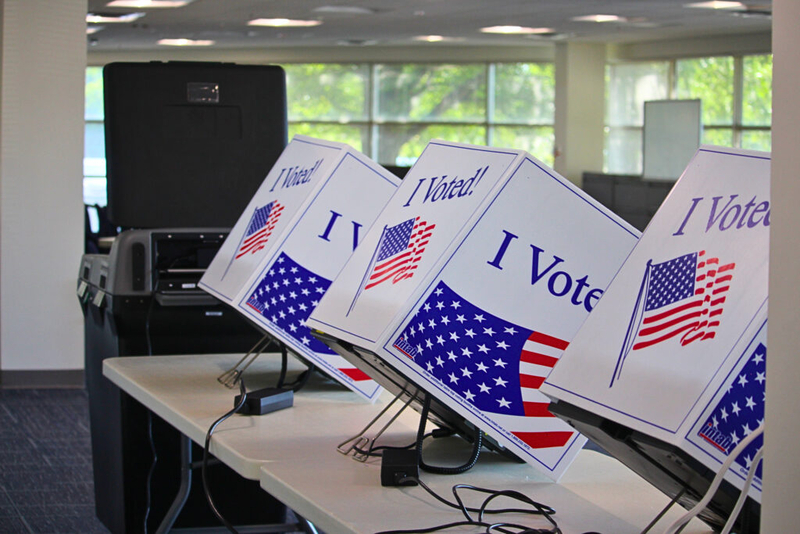
Voting machines set up in 2023 in Charleston County. (File photo provided by Charleston County Board of Voter Registration and Elections)
Two teams of federal election observers came to Charleston County as part of routine monitoring of polling places amid the special Republican primary runoff for U.S. Senate.
Charleston County election officials reported no polling place issues as of Tuesday afternoon in the runoff between U.S. Sen. Darline Graham and U.S. Rep. Ralph Norman to replace the late Sen. Lindsey Graham as the GOP nominee.
It is unclear why Charleston was the only county selected for observation out of the state’s 46 counties, especially given the heavier concentration of Republican voters in the Upstate and Grand Strand.
In the June primaries, when Lindsey Graham was on the GOP ballot for re-election, more Democrats than Republicans participated in Charleston County: About 29,700 people voted in the GOP primary, compared to 36,500 people who voted a Democratic ballot, according to results from the state Election Commission.
Two weeks ago, Charleston County ranked fifth in the number of people voting in the 10-candidate GOP primary. Greenville County topped the list, followed by Horry, Lexington, and Spartanburg counties, according to state election data.
This is the second time in two election cycles the county has had federal observers. The last time was in November 2024 under the Biden administration.
Isaac Cramer, executive director of the Charleston County Board of Voter Registration and Elections, said federal officials assured the county its selection was not because of any wrongdoing.
“South Carolina is the next stop in our ongoing effort to ensure election transparency,” Assistant Attorney General Harmeet Dhillon of the U.S. Department of Justice’s Civil Rights Division said in a statement.
The state Election Commission said it is the purview of the DOJ to decide when and where it wants to send observers. The agency is not aware of any requests from state officials for the DOJ to observe polling places.
“It’s a fairly common occurrence for us, and we welcome them as observers,” spokesman Chris Whitmire said.
The two teams of observers consist of a total of four DOJ attorneys, one assistant U.S. attorney from the South Carolina district office and one other South Carolina U.S. Attorney’s Office employee, according to the DOJ.
Some of the polling places the observers stopped by included the Hazel Parker Playground, the International Longshoremen’s Association building, the North Charleston Sports Complex, the Arthur W. Christopher Community Center, Morris Brown AME Church, Joseph Floyd Manor, and Harborview Elementary School, according to the county election office.
“Observers are a routine and well‑established part of the election process,” a statement from the county Board of Voter Registration and Elections reads. “They must follow specific rules while at any of our polling locations. Our election workers receive training on poll watchers and observers, so they understand the conduct guidelines outlined in state law and are prepared to manage these visits appropriately.”
According to the state Election Commission handbook, observers must stay within a designated area inside each polling location. They can’t take pictures or video, touch equipment, view confidential voter information, speak to voters inside the polling place, or tell a poll manager how to conduct an election.
The Department of Justice also recently conducted similar visits in other states, including Florida and Wyoming.
“Thus far the DOJ has deployed over 80 monitors across seven states and over 200 polling locations this primary season,” according to a statement by the federal agency. “By comparison, during the 2022 midterms the DOJ sent monitors to nine states during the primary season.”
Dhillon, the head of the DOJ Civil Rights Division, recently told Bloomberg News the agency plans to deploy 1,000 observers across the country for the midterm elections.
By comparison, during the Biden administration, the DOJ sent monitors to 86 cities and counties in 27 states for the 2024 presidential election and 64 cities and counties in 24 states, including Horry County in South Carolina, for the 2022 midterm elections.
During President Donald Trump’s first term, the department sent monitors to 44 cities and counties in 18 states, including Richland County in South Carolina, for the 2020 presidential election, according to news releases at the time.
Columbia