Your vote. Your child’s classroom. Your electric bill. Your water. Your health.
Sep 08, 2026 | 11:47 am ET
Description
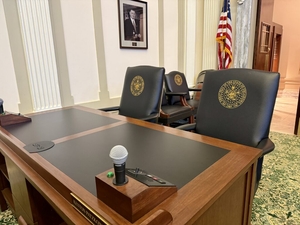
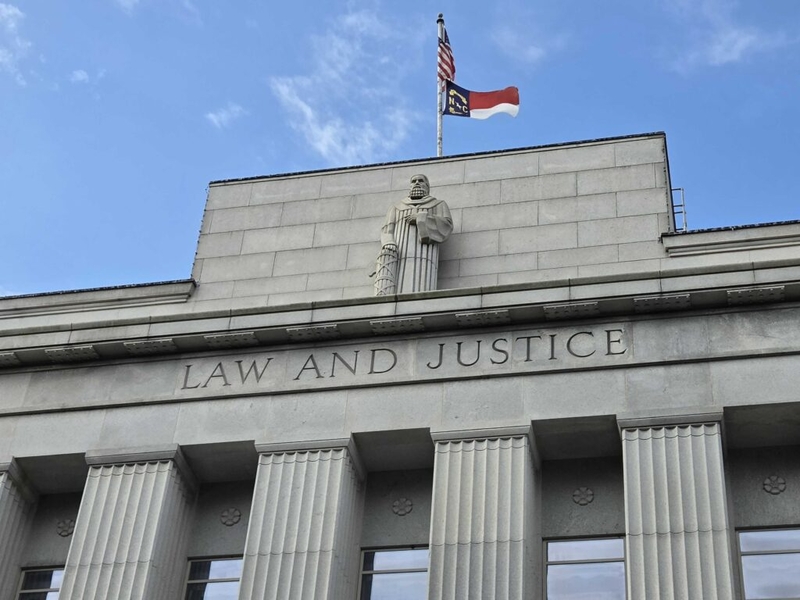
The North Carolina Supreme Court building, pictured on June 2, 2026. (Photo: Clayton Henkel/NC Newsline)
As the North Carolina Supreme Court begins a new session, we need to remember what this court is supposed to be. It is supposed to be a check on power. It is supposed to protect our constitutional rights when politicians overreach. And it is supposed to be a place where every North Carolinian can get a fair hearing.
That matters more today than ever.
More than 95% of cases in this country are handled by state courts. And as the U.S. Supreme Court pushes fundamental questions about our freedoms back to the states, state courts and state constitutions are increasingly important protectors of our rights.
But those protections only mean something if the judges sitting on our Supreme Court are willing to enforce them.
And for my family, this is personal. My daughter Ella was one of the North Carolina voters whose ballots were challenged after the 2024 Supreme Court election. Ella was a lawful voter. She was living and teaching abroad in Spain. She followed the rules. She cast her ballot. And months after the election, this court was willing to let her lawful vote be thrown out.
My daughter had to become a plaintiff in a federal class action lawsuit to protect her vote and the votes of other North Carolinians. Ultimately, a federal court stepped in and protected those voters. Think about that. North Carolinians had to turn to a federal court to protect their votes from their own state Supreme Court.
And voting rights aren’t the only place where this court’s decisions hit home for my family.
I have two adult children who went through North Carolina’s underfunded public schools. And now I have a young daughter, Anya, in the same schools. For two years, Anya spent nearly half the school year without a permanent classroom teacher.
Think about what that means for a child. Months without the stability of a teacher who knows her, knows where she is struggling, and knows what she needs to learn. And all the while, our state Constitution promises her something very different.
The Leandro case established that every North Carolina child has a constitutional right to a sound, basic education. Yet decades later, families like mine are still waiting for North Carolina to fulfill that promise.
My daughter cannot get those years back.
That is what I want people to understand about the decisions made in this building.
These cases aren’t abstract legal arguments. They become classrooms without teachers. They become children falling behind. They become parents lying awake at night wondering whether their child is getting the education the Constitution says she has a right to receive. And they become lawful voters like my daughter Ella having to go to federal court to fight to make sure their votes count.
But it goes far beyond my family.
The decisions made here can determine who has political power. In 2023, this Supreme Court reversed its own previous ruling on partisan gerrymandering and cleared the way for the legislature to draw new congressional and legislative maps. Those maps determine which communities are kept together, which are divided, and ultimately whose voices have power in Raleigh and Washington.
And the decisions made here can determine something as basic as the water we drink and the health care we can access. When this court begins its new session on September 8, it will confront cases involving health care benefits for state retirees and contamination from forever chemicals in North Carolina’s water.
That is why North Carolina For The People created Why Judges Matter NC, a resource to help North Carolinians understand our courts, the judges who serve on them, and why judicial elections deserve our attention.
And there are other trusted, nonpartisan resources to help voters prepare for the 2026 election. Democracy NC’s NC Voter offers information about candidates, voting rules and how to cast your ballot. NC Voter Guide from Common Cause North Carolina provides information about candidates and what is on the ballot. VOTE411, from the League of Women Voters Education Fund, provides personalized ballot information, candidate information and voting rules to help voters prepare to cast their ballot.
Before you vote, learn about the courts, learn about the candidates and make a plan to cast your ballot.
Your vote. Your child’s classroom. Your electric bill. Your drinking water. Your health care.
That is the power of a state Supreme Court. These decisions have consequences. That is why judicial elections matter.
Melissa Price Kromm is executive director of North Carolina For The People and N.C. For The People Action.
Raleigh, NC