Without greater transparency, arrogance and shocking police shootings will only continue in Kansas
Jan 31, 2025 | 4:33 am ET
Description
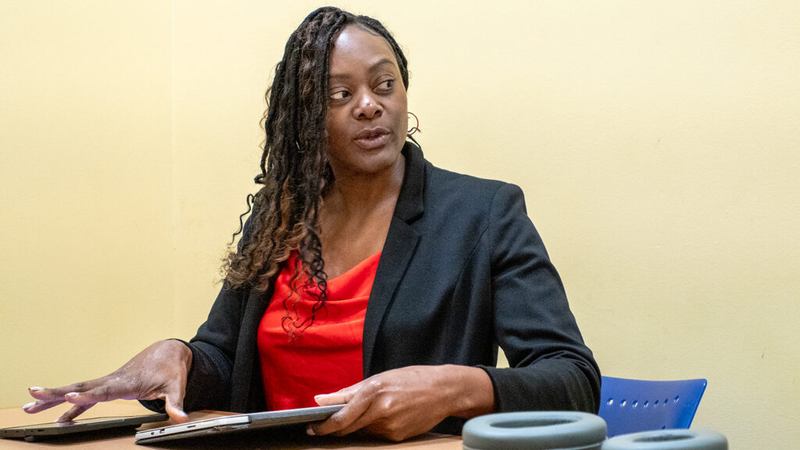
Attorney LaRonna Lassiter Saunders talks to reporters during a Dec. 31, 2024, interview in Overland Park. (Sherman Smith/Kansas Reflector)
Despite video evidence showing Taylor Lowery picking up a wrench and moving away from officers before being shot dozens of times, Shawnee County District Attorney Mike Kagay continues to insist that his initial report is accurate.
This cavalier attitude — none of the agencies involved concede that the initial claims that Lowery threatened officers with a knife were untrue — seems to have permeated this case, in which Topeka police posted a clearly false statement about the October 2022 killing. This attitude suggests that police felt confident that neither the video nor the truth would ever see the light of day.
If this state does not loosen law enforcement’s grip on police body camera footage, these moral and ethical outrages will only continue.
The agencies involved seem unable to admit their errors.
Said Rosie Nichols, public safety communications specialist for Topeka: “This case will be resolved in the court of law, not the court of public opinion. As such, the city will not provide further comment.”
Said Melissa Underwood, communications director for the Kansas Bureau of Investigation: “Your assertion that the KBI was ‘pushing a false narrative when we issued the news release’ is false. In officer-involved shooting investigations, we strive to provide as much information as we can to the public as quickly as possible.”
These same agencies, however, fought the release of these videos for two years.
Underwood continued: “Transparently providing preliminary details based on eyewitness statements is not, ‘pushing a false narrative,’ even if once the full investigation concludes, additional or differing facts become known.”
If they had the videos, and fought to keep them secret, what additional facts are in the offing?
Had police been less certain the public would never see unedited footage, perhaps one of the officers would not have radioed dispatch about an aggravated assault on a law enforcement officer, when the video showed that each time police tried to confront Lowery, Lowery ran from them, not at them.
Perhaps an officer would not have told Lowery’s distraught sister at the scene of the shooting that they had to shoot Lowery because he’d charged police with a knife. The footage shows the knife at the foot of one of the officers as they fired 34 shots at Lowery.
The footage also showed Lowery had picked up a wrench and was moving backward, away from police, when they began firing.
Perhaps they would not have seemingly tried to fabricate a narrative in the shooting’s immediate aftermath. A detective at the scene looked into the body camera and asked if they could confirm that Lowery had a deadly weapon, to which an officer replied: “No. He had a wrench.”
If they had not established that Lowery had a deadly weapon, why were they firing?
The videos also seemed to show a markedly different attitude toward a white suspect with a knife and a Black suspect with a wrench.
One video shows a then-Topeka police officer rolling up to a domestic violence scene and finding a white man walking away from the house. The man volunteered that he had a knife and a joint in his pocket. The officer asked if he could pat the man down then politely called him “bro,” and let him go.
Minutes later, that same officer was firing repeatedly on a Black man holding a wrench.
No wonder they sat on this video and spent taxpayer funds to keep it hidden.
This is why Kansas so desperately needs greater transparency and access to police body camera video. Without it, law enforcement can spin any narrative with impunity. Without it, we will never permeate law enforcement’s cultural membrane that keeps this behavior hidden.
One of the videos showed future Kansas Bureau of Investigation director Tony Mattivi representing one of the officers during the post-shooting interview.
This occurred shortly before Mattivi rose to his directorship, but why put someone with such deep law enforcement sympathies in charge of an organization that’s supposed to hold police behavior in check?
It’s a farce.
This video content suggests that law enforcement — from the officers, to the Kansas Bureau of Investigation, to the District Attorney’s Office — had to have known that claims Lowery charged police with a knife were false.
“It shows the coverup from the very beginning,” said attorney LaRonna Lassiter Saunders, who represents Lowery’s family.
It also shows more, she said.
“Taylor Lowery didn’t have to die that night,” Lassiter Saunders said.
Moments before the shooting, police had nearly surrounded Lowery and were pushing him, an indication that they did not perceive him as a deadly threat. No one thought to tackle him and cuff him, or to use a Taser, she said.
Lowery’s family called police that night fearing Lowery might harm himself. He’d been cutting himself — and again, whenever police confronted him, at his home and at the convenience store, he ran.
“What did he do that night to deserve the death penalty?” Lassiter Saunders said.
This lack of transparency can fuel the unchecked arrogance and bad policing in these videos. But sunlight, as we say in journalism, is the best disinfectant, and our law enforcement infrastructure seems badly infected.
Yes, arrogance.
Back in September, Lassiter Saunders told me that District Attorney Kagay “had put out a misleading report on the shooting.”
Kagay told me then that he believed the report his office generated offered a thorough and accurate summary. He’s still standing on this manifestly incorrect description.
“If the given quote is accurate, we believe a reckless allegation would be a more accurate way to characterize her claim,” Kagay said of Lassiter Saunders last fall. “As an attorney licensed in Kansas, Ms. Saunders should be aware of the consequences of making false statements, which can lead to criminal, civil and disciplinary ramifications.”
Now who should feel concerned about their license, about false statements, about criminal or civil disciplinary ramifications?
But he likely has nothing to fear from this system, which treats grieving families like suspects and criminals. Lassiter Saunders said Topeka police surreptitiously recorded her conversations with fellow lawyer Paeten Denning (the Denning Law Firm is co-counsel in the case) during their initial video viewing session.
Kagay, who produced a January 2023 report clearing the officers, seems confident that anything he’s done wrong will be forgiven were he to appear before any sanctioning board, the same way Topeka police felt confident that their excesses would be forgiven by Kagay and kept out of public view.
Said Lauren Bonds, executive director of the National Police Accountability Project during an interview with Kansas Reflector: “I think that’s how police departments, culturally, are predisposed and trained to act, in a way that defends the officers’ decisions. And if there’s, you know, a couple of scraps of evidence that they can put together to kind of justify the narrative of the officer, they’re going to do it.”
“Why would you ever give them the benefit of the doubt?” Bonds said.
We should not. We should demand even greater access and transparency to all such video evidence.
Kansas Reflector editor Sherman Smith and I posed questions to the mother of her child’s slain father. Da’Mabrius Duncan talked about the emptiness of the holidays and even leaving Lowery a plate of food at the site where police killed him.
As we asked Duncan questions, Lassiter Saunders wiped away tears.
“It makes me sick to my stomach watching all of this unfold,” she said.
Mark McCormick is the former executive director of The Kansas African American Museum, a member of the Kansas African American Affairs Commission and former deputy executive director at the ACLU of Kansas. Through its opinion section, Kansas Reflector works to amplify the voices of people who are affected by public policies or excluded from public debate. Find information, including how to submit your own commentary, here.
Topeka, KS