Wisconsin Supreme Court agrees to hear congressional maps lawsuit
May 29, 2026 | 6:22 pm ET
Description
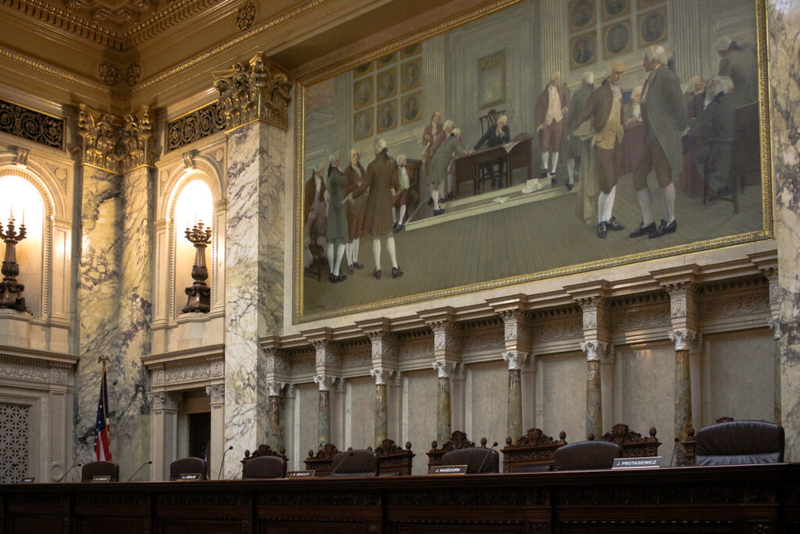
The Wisconsin Supreme Court chambers. (Photo by Henry Redman/Wisconsin Examiner)
The Wisconsin Supreme Court will hear a challenge to the state’s congressional maps on the grounds that they’re an anti-competitive gerrymander, the Court ruled Friday afternoon.
In an order that again showed the Court’s partisan divide spilling out into the public, the Court’s four liberals voted to accept the case while Justices Rebecca Bradley and Annette Ziegler accused the majority of acting as tools of the Democratic party.
The lawsuit against the maps was brought last summer by a bipartisan business group, Wisconsin Business Leaders for Democracy Coalition, represented by the progressive nonprofit Law Forward. Rather than challenging the state’s congressional maps on the grounds that they’re an unconstitutional partisan gerrymander — a tactic that has repeatedly failed — the lawsuit argues the maps purposefully protect incumbents from realistic challenges.
Because of a state law passed by Republicans in 2011, the lawsuit was first heard by a panel of three circuit court judges. In a ruling late last month, the panel dismissed the lawsuit, finding that the claims were essentially the same as those made in a partisan gerrymander challenge and therefore a question for the executive and legislative branches.
The panel’s ruling was immediately appealed to the Supreme Court because the 2011 law states that appeals of these panel rulings can’t be heard by the Court of Appeals.
While accepting the case, the Court denied a request that it be heard on an expedited schedule. With candidates for this fall’s midterm elections required to file ballot access signatures by June 1 and ballots are set to be printed shortly after, it’s unlikely the case will be concluded in time to change the state’s maps before November.
In response to the Court accepting the case, Bradley and Ziegler vehemently objected — arguing that accepting the case is signaling the majority’s intent to redraw the maps.
“An astonishingly activist court will once again revisit precedent it doesn’t like in order to do the bidding of its political masters,” Bradley wrote. “The Democratic Party bought multiple seats on this court to achieve yet another outcome unobtainable democratically. Like last time, the United States Supreme Court will likely reverse the majority’s unlawful ruling and protect our Republic. No kings. No queens either.”
Bradley, who frequently cites sources from a wide range of non-legal texts, also quoted George Orwell’s “1984” in her dissent.
Justice Rebecca Dallet wrote a concurrence to the ruling, defending the majority from the conservative justices’ criticisms and calling them “false, inappropriate, and disingenuous.”
“Deciding to hear a case does not reflect any weighing of the merits of any party’s claims, let alone prejudgment about who will prevail and why,” Dallet wrote. “Instead, we must — as a majority of this court does — stick to our neutral role, and let the parties argue their case before we render judgment. When the time comes to issue our decision, we will follow the law wherever it leads.”
Madison, WI