Wilmington to restrict homeless encampments, open day center
Oct 30, 2025 | 9:00 am ET
Description
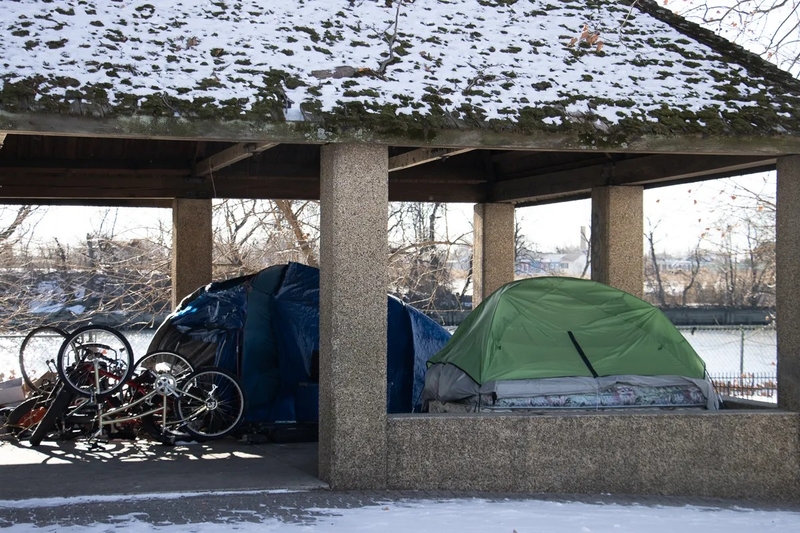
The city-appointed task force has recommended allowing a longtime encampment at Christina Park to remain there for now while new resources are developed, but advocates say it only allows the problem to be hidden. | SPOTLIGHT DELAWARE PHOTO BY NICK STONESIFER
As the city deals with a growing number of homeless people, Wilmington will restrict encampments to an Eastside park that has long been home to one while opening a day center to provide social services to the population, Mayor John Carney announced Wednesday.
Both ideas are among recommendations submitted to the mayor by the city’s Homelessness Task Force, a group he established earlier this year to develop strategies to better serve the unhoused population, engage them in moving toward stable housing, and better coordinate resources and services across the city.
The first initiative involves temporarily designating a part of Christina Park — which sits near Wilmington’s Eastside and has long been occupied by tent encampments — as a city-sanctioned safe space for the homeless.
A new 24-hour restroom facility with clean water will also be installed in the park for public use. Carney added that the city is exploring options to connect a shower unit to the portable restroom.
He also noted there will be some form of security present to monitor the park.
The city has decided to ban camping in other public areas, but city officials say that they will “evaluate whether an additional unhoused site is necessary to meet community needs.”
For the second initiative, the city will partner with the Wilmington Housing Authority and the Ministry of Caring to open a dining hall for the homeless at the WHA’s former operations center.
The property, which is located at 600 E. 4th St., sits about a block from Christina Park.
The dining hall will offer daytime services to the homeless, as many emergency shelters in the city only allow individuals to come in the evening for a meal and stay until early morning.
Carney said the city has secured $600,000 from the state’s bond bill to fund the dining hall, but acknowledged that additional funding will be needed to complete the project. The total cost of the city’s initiatives is still unclear.
Carney said the long-term plan is to expand the dining hall into a full-day center.
Other areas sending homeless to Wilmington
Back in March, Carney established a 12-member task force of nonprofit leaders, law enforcement, and city council members, among others, after vowing to address homelessness as a priority of his first-term mayorship.
Advocates and residents previously criticized the city’s task force for not committing sufficient money and resources to address homelessness across the city, leading them to create their own potential solutions.
Housing advocates urged the city to stop conducting sweeps, encampment bans, unnecessary arrests, or fines; increase the number of emergency shelter beds; establish a city-run Homeless Services Office to coordinate services and programs; and increase access to restrooms, showers, and mobile health clinics to prioritize public health.
Last month, the task force concluded its work and sent the mayor its final recommendations, which included temporarily allowing a tent community in Christina Park until a village of “tiny homes” can be built to replace the tents; opening another day center facility for unhoused individuals; creating a personal item storage facility; and getting local developers to build additional units of affordable housing over the next decade.
As of now, building a “tiny homes” community is not part of the city’s immediate plan. Asked about the recommendation, Carney expressed concerns about where it would be located, but did confirm that Wilmington would be willing to work with a nonprofit such as Springboard Collaborative, the Georgetown-based organization that built the Pallet Village.
Notably, that project has raised concerns from the residents of Georgetown in recent weeks over the growing number of homeless in town.
During Wednesday’s announcement, Carney highlighted that Wilmington’s homeless population has increased, noting that the behavioral health rehab centers in Kent and Sussex are also sending people to the city who are in need of shelter.
Since last year, homelessness has increased by 16% statewide, and New Castle County carries about 60% of that population, according to the Housing Alliance Delaware’s annual Point in Time count.
Carney also attributed the increase in part to a recent initiative in Philadelphia, where the city has purchased $270,000 worth of one-way bus tickets to send unhoused individuals to a location of their choice. He asserted that some have made their way here.
Over the past four years, Philadelphia has funded almost 900 trips out of the city, as reported by NBC Philadelphia.
However, the report says that only eight of those trips were to Wilmington, and five were to Newark.
“The constant influx of people from other cities and towns makes it harder for us to care for our population. Most importantly, it’s unfair to Wilmington residents who live with the consequences of these actions,” Carney said.
Carney did not provide a clear timeline on the city’s short-term plan for homelessness, but said officials will begin with the Christina Park effort and “get busy right away.”

Dover