Who will replace Graham Platner and how will the party decide?
Jul 07, 2026 | 5:48 pm ET

Description
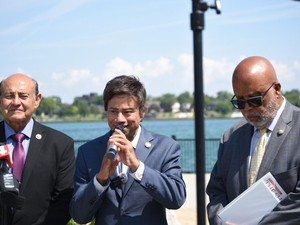
Troy Jackson and Graham Platner in Kittery (Photo by Eesha Pendharkar/Maine Morning Star)
Democrats trying to replace Graham Platner will have to make key decisions on whom to choose as his replacement and how, as pressure builds on the U.S. Senate candidate to drop out after a sexual assault allegation against him.
The allegation by 41-year-old Jenny Racicot, first reported by Politico, didn’t just damage Platner — it effectively ended one of the most watched political movements in the country which had given a voice to working class people disillusioned with establishment politics. That momentum may transfer to another candidate but it will depend on who replaces him and more importantly, how that candidate is chosen. And Democrats have less than two weeks to make those decisions.
“Democrats have to be very careful about the process,” said Mark Brewer, chair of the political science department at the University of Maine.
“The more open, transparent and participatory they are, the greater the chances that Platner supporters not only accept who the replacement nominee is, but also maybe be enthusiastic about that replacement, because they’ll feel like they had a seat at the table.”
Brewer said while it is too late for another primary, the party could convene caucuses at the municipal or county levels to allow registered Democrats and independents to weigh in, or hold another state convention. Both options would allow voters to be heard, which he said is key to maintaining the support Platner had garnered.
Several Maine gubernatorial candidates, as well as former Platner rivals, have already expressed interest in replacing him. Former Senate President Troy Jackson, who campaigned alongside Platner last year and also earned U.S. Sen. Bernie Sanders’ endorsement, has filed paperwork to form an exploratory committee, making him the first potential replacement to take a concrete step toward entering the race.
Although Platner has not formally announced he’s dropping out, he said Monday he’s weighing the best path forward for his campaign. Meanwhile, dozens of prominent party leaders — including his strongest advocate, Sanders — have urged him to end his candidacy. He has also lost the trust of many voters who had stood by him, albeit cautiously, through his previous scandals.
Jackson and former Maine Democratic gubernatorial candidate Nirav Shah, who is also being weighed as the oysterman’s replacement, both told Maine Morning Star they would not vote for him if he stayed in the race.
The closest ideological match: Troy Jackson
Brewer said Jackson is the best candidate to step in to maintain the grassroots support Platner built. But the “it factor” that Platner had that made him into a nationally relevant political figure can’t be replaced, and how much sway that will hold is also unclear.
On Tuesday, he filed with the Federal Election Commission to form a U.S. Senate exploratory committee, a step no other potential replacement has taken.
“You’re not going to come up with a Platner-like candidate from out of nowhere in a time frame like this. It’s just not possible,” Brewer said.
“If the party’s goal is to try and maintain some of that support, I think you have to look for someone who already has an established relationship with Platner and I think that’s Troy Jackson,” he added. “He matches on policy, he’s definitely got the working class angle. He may be the best they can do.”
Jackson agreed with that assessment, saying that the issues Platner spotlighted, including healthcare for all, lowering costs of prescription drugs, workers’ rights, “all these are things I’ve been fighting for my entire life.”
“I think the message is the message, Graham did a great job of talking about it, but … it wasn’t about Graham, it was about the people.”
Jackson has historically not seen support from the Democratic establishment. He openly sparred with Gov. Janet Mills when she vetoed several bills he sponsored throughout his years leading the Maine Senate. However, during this year’s ranked-choice gubernatorial primary, he performed well in several conservative-leaning communities in the 2nd Congressional District, including Aroostook County, where he and Collins are both from.
A measured approach: Nirav Shah
Shah represents a different path for Democrats. Rather than trying to replicate Platner’s populist appeal, the former Maine CDC director is pitching himself as a measured alternative who could unite Democrats after weeks of upheaval.
He was a frontrunner for much of the Democratic gubernatorial primary, losing in the final round of ranked-choice runoffs to nominee Hannah Pingree. He’s hoping that support translates into a potential Senate candidacy, but he’s not sure yet about stepping in.
“I want to make sure that, as any good leader should, we are evaluating it rather than just jumping in blindly,” he said.
Since Monday, he said he’s heard from a lot of supporters he had in common with Platner, who “are feeling a little bit adrift right now.”
“They were all in on Graham, and so these recent allegations, and whenever he decides to drop out are leaving a lot of folks with their heads spinning, and they’re wondering if their vote even matters right now,” he said.
Shah said that underscores the need for an open,transparent process so that “whoever the nominee is has had an opportunity to earn the support of those ardent Graham Platner supporters to make sure that the party is unified.”
Shah said his team has been in touch with the Maine Democratic Party. The party did not respond to Maine Morning Star’s requests for comment.
Former Senate candidates: Jordan Wood and David Costello
Jordan Wood initially ran for the U.S. Senate before pivoting to the U.S. House after Rep. Jared Golden announced he would not seek reelection. He came in third in that primary, but Wood told Maine Morning Star he could run if he was picked by the party.
“What these last few months have shown us is that Mainers are so sick of business as usual, that they gravitated towards someone new, different, not owned by anyone and they pushed past their concerns and misgivings until it was all just too much,” he said. “If my fellow Maine Democrats decide through an open and democratic process that I am the best candidate to defeat Susan Collins, I would be humbled by their trust.”
David Costello stayed in the race, but lost to Platner, only winning 6.9% of the votes. However, he said in a statement on Tuesday, “If Graham Platner is out, then I’m in.” Costello has spent decades working in state governments, from serving as aide to Maine Secretary of State Bill Diamond in the early 1990s to serving as Deputy and Acting Secretary of the Maryland Department of the Environment, but has failed to garner name recognition in his Senate race.
Wood and Costello could transfer the funds they raised during their most recent campaigns to the Senate race, since they were federal campaigns. According to Jonathan Wayne, executive director of the Maine Commission on Governmental Ethics and Election Practices, “Under federal law a federal candidate may not use surplus funds from a campaign for state office in a subsequent campaign for U.S. Congress.”
That means Wood, who raised millions in his race, could move any money left to the Senate bid, but Jackson or Shah can’t redirect their funds directly to a Senate campaign.
Reporter Kaitlyn Budion contributed to this article
Augusta, ME