What’s so special about the special session? A primer
Aug 03, 2026 | 6:24 am ET
Description
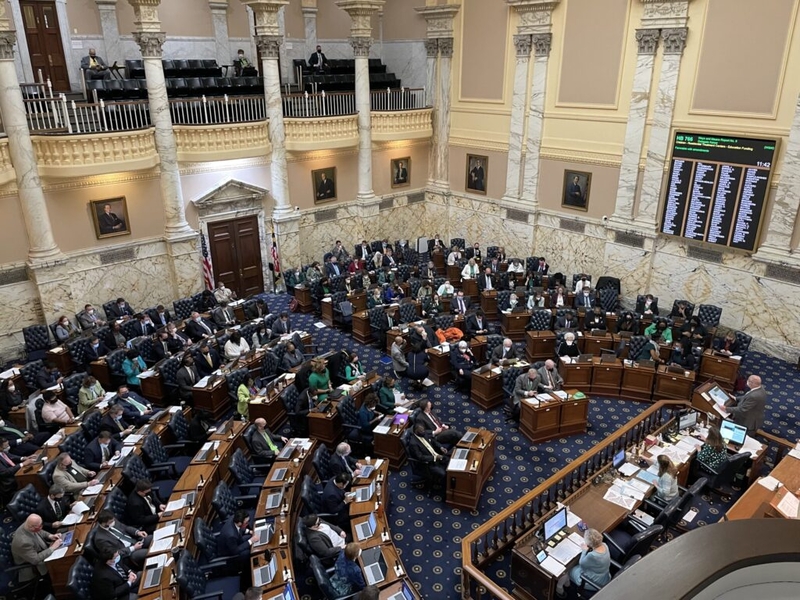
The House of Delegates chamber in regular session in March 2023. (Photo by Bruce DePuyt/Maryland Matters)
The General Assembly returns Monday for a special session for the limited purpose of considering a constitutional amendment on how the state draws boundaries for its congressional districts.
A special session is an official gathering of the legislature outside the annual 90-day session that begins each year on the second Wednesday in January. They are not often called, but they’re not all that special either: There have been eight in this century alone, the most recent in December when the House met to elect a new speaker.
The legislature can be called into session by a proclamation of the governor or by a three-fifths vote of the legislature. Gov. Wes Moore issued an executive order calling this session, which was largely a formality after Senate President Bill Ferguson (D-Baltimore City) and House Speaker Joseline Peña-Melnyk (D-Prince George’s and Anne Arundel) announced last month that the General Assembly would reconvene Aug. 3 for a special session.
Maryland Matters answers your questions about this latest session.
How long will it last?
Special sessions can last up to 30 days, but legislative leaders have been clear that this session is set for Aug. 3-5 and no longer. They are hoping to be done by Tuesday evening, which is National Night Out, an important event for lawmakers to meet and mingle with voters. In a June 16 letter to House members, Peña-Melnyk wrote that she doesn’t expect the session to last more than a couple days.
What can they consider?
In theory, anything. In reality, the agenda for this session, as for most special sessions, will be limited to what leadership wants to focus on.
Ferguson and Peña-Melnyk made that clear in a July 20 letter to sent to delegates and senators that said they were directing the Department of Legislative Services “to accept bill drafting requests for the … special session only if they relate to the purpose for which the General Assembly is being reconvened: consideration of legislation concerning redistricting standards.”
Even if a lawmaker was able to take advantage of a special session to push a pet project, the presiding officers can send those bills to committees where they simply will not get a hearing while the other business of the session proceeds.
The chokehold on legislation has upset Republican lawmakers, among others, who had hoped to debate bills focused on pocketbook issues. But with Democrats in firm control of both chambers, and most lawmakers showing little appetite for an extended session, there’s not much the GOP can do about it.
So what will they consider?
Lawmakers will consider the proposal for a constitutional amendment to change the way congressional districts are drawn, for one, with identical versions already introduced in the House and the Senate.
But both chambers are expected to consider overrides to a handful of the governor’s vetoes of 2026 legislation. They will also take up legislation that will correct a technical problem of their own making. Both the House and Senate passed bills calling for a constitutional amendment that would make collective bargaining disputes for state workers subject to binding arbitration. Unless one of the bills is withdrawn, it would wind up putting the same question on the November ballot twice, which supporters fear could confuse voters.
What’s the schedule?
House and Senate committees that consider elections legislation are scheduled to meet at noon Monday for a joint hearing on the bills in the Joint Hearing Room of the Department of Legislative Services in Annapolis. The House Government, Labor and Elections Committee is expected to hold a voting session immediately after that hearing concludes and the full House could take up the issue later Monday, with Senate action following.
Can I testify?
Not unless you signed up to do so on Friday. Legislative leaders required people who wanted to submit testimony or to testify to do so between 8 a.m. and 6 p.m. on a legislative website Friday. Only 50 people will actually be allowed to testify — in person or virtually — at Monday’s hearing, and they will be limited to two minutes each. If more than 50 signed up to testify, the chairs of the House GLE Committee and the Senate Education, Energy and Environment Committee will choose the 50 speakers.
How many votes will it take?
Any proposed constitutional amendment requires approval of three-fifths of the total elected membership of both the 141-member House of Delegates and 47-member Senate. The means it would need 85 votes in the House and 29 in the Senate. With 102 Democrats in the House and 34 in the Senate, passage would seem to be a done deal. But that assumes all lawmakers show up, never a guarantee for a special session called mid-summer, when members may be traveling or on family vacations or tending to their regular jobs. Counting whob actually shows up may be the only tension in the coming session.
What happens if they pass the redistricting bills?
Very little, for now. The legislation does not create new congressional districts, and even though the governor and other supporters had been hoping for new congressional district maps to consider, they will not be on the table.
The bills under consideration only deal with the way the state draws its congressional districts. That was thrown into disarray in 2022, when Republicans challenged a redistricting map put forward by Democrats and Judge Lynne Battaglia threw the map out because the districts were not compact and contiguous and respective of natural boundaries. Those standards had previously only been applied to drawing the state’s 47 legislative districts, but not its congressional districts.
The bills would ask voters to approve a constitutional amendment making it clear that the legislative rules do not apply to congressional districts. And making it easier, say, to draw a snaking congressional district or one that leaps from the Eastern Shore across the Chesapeake Bay, which might give Democrats an advantage.
So there won’t be redistricting this fall?
Nope. The earliest new congressional district maps could be redrawn is in time for the 2028 elections, and only if lawmakers decide between now and then that it’s worth it. Democrats currently enjoy a 7-1 advantage in the state’s congressional districts, and if the party runs the table in national elections this fall, officials in Maryland may decide it’s not worth the risk or the trouble to redistrict before the next decennial redistricting, for 2032 elections.
Why now?
The call for redistricting in Maryland is part of the nationwide tug-of-war between Democratic and Republican states to win seats in a narrowly divided Congress in this fall’s elections. President Donald Trump urged GOP states to redraw district boundaries now — something traditionally done only after the census every 10 years — and Texas answered the call. That sparked a rush among both Democratic and Republican states, with nine states after Texas adopting new congressional maps through legislation, ballot measures and court rulings. Others have been embroiled in legal or political challenges.
The governor appointed a special redistricting commission last fall, and the House passed a redistricting bill in the regular legislative session this spring, but it went nowhere in the Senate. Ferguson bottled the House bill up, saying the risk of a new map outweighed the potential benefits. Any bill would almost surely be challenged in court and could end up with a court-drawn map less favorable to Democrats than the current 7-1 advantage.
That changed this spring when the U.S. Supreme Court handed down its decision in Louisiana v. Callais, which held that racial considerations in congressional redistricting were unconstitutional. Ferguson said the ruling “gutted the Voting Rights Act,” and that “the rules had changed” in light of the court’s ruling.
What’s all this going to cost?
There’s no free lunch, as the saying goes, and the same goes for the special session. Exact costs won’t be known until after, but a back-of-the-envelope estimate, based on legislative analysis of special sessions in 2012, 2019 and 2021, would put the cost around $39,528.It’s not nothing, but in Maryland’s $27.7 billion budget it amounts to about to 14 cents of every $100,000 spent.
The 47 senators and 141 delegates aren’t paid but are entitled to the normal reimbursements and perks they receive during the regular session. Those include hotel rooms for some, mileage for those who live too close to get the hotel room benefit, and a meal per diem. Legislators are not required to submit receipts.
The meal per diem is $63 per day. If all lawmakers take it for two days of a special session, that’s about $23,688. But it appears not all lawmakers take the full reimbursement, based on past accounting. In 2021, for example, the General Assembly paid out $22,507 for lawmakers’ meals over a five-day session, or $4,501 per day. Based on that average, add $9,003 for the coming two days.
Hotel reimbursements are capped at about $125 per day. The legislature is authorizing one night initially though a small number of lawmakers might get two if they have to come in on Sunday night. Receipts are required.
Based on past usage, about 75% of 188-member legislature could take the hotel reimbursement: In 2018, about 76% of all members got a room, and about 74% did so for the special session of 2021. If 75%, or 141 lawmakers, get a room for one night this week, the bill comes to about $17,625. That number increases if the session requires another overnight stay.
In 2021, the General Assembly paid out $8,689 for mileage and parking for the special session to 49 lawmakers or an average of $183.15 per lawmaker over five days. Based on that average, the 47 lawmakers who didn’t take a hotel room in the earlier estimate would get $35.47 a day in this session. For two days, that would total $3,443. That number is not adjusted for inflation and the breakdown of mileage and parking is not incuded in a Department of Legislative Services analysis.
There are other costs, such as the potential cost of staff overtime. In 2021, special session overtime costs for staff ran about $1,738 per day over the five days. Adjusted for inflation, that same amount would work out to more than $2,081 per day. Factor in a minimum of one day.
A new factor is the cost of livestreaming the session. Those video and audio broadcasts are handled by Maryland Public Television. In 2021, it cost $3,080 per day. Adjusted for inflation, the cost would run about $7,378.52 for two days.
That makes the average cost per day for a two-day special session about $19,764.
Annapolis, MD