Lawmakers convene for what leaders hope is quick work on a redistricting bill
Aug 03, 2026 | 6:01 am ET

Description
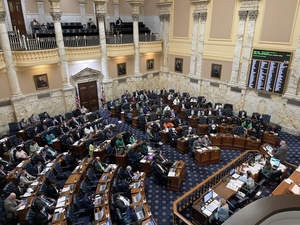
Maryland lawmakers will return to the State House on Aug 3. to begin a short special session. (Photo by William J. Ford/Maryland Matters)
Maryland lawmakers are expected to come out of the special session that starts Monday with legislation asking voters to approve a constitutional amendment affecting the way the state draws its congressional district boundaries. Debate will be tightly controlled and legislative leaders hope to be done before Wednesday.
But that doesn’t mean there won’t be drama along the way.
While Democrats are believed to have the votes to pass the legislation, they would all need to show up, which was still a question last week. And Republicans have long made their displeasure apparent, both at the overall concept of redistricting, which is expected to target the only GOP seat in the state’s congressional delegation, and at what they call the rushed and straitjacketed process.
Senate Minority Whip Justin Ready (R-Frederick and Carroll) called the Democratic leaders’ call for a special session a “rush job,” while Del. Chris Tomlinson (R-Frederick and Carroll), the senior Republican on the House committee that will take up the bill, called the Democrat-led push “a brazen partisan grab that undermines public trust.”
“This legislation is not about strengthening or protecting democracy. In fact, it is precisely the opposite,” Tomlinson said in a two-page statement last week. “It is about dissolving constitutional guardrails so that cynical politicians can choose their voters instead of voters choosing their representatives.”
While some Democrats have privately expressed concerns with the bill, it is expected to easily pass the House, which passed a redistricting bill just three weeks into this year’s legislative session by a comfortable 99-37 margin. But that bill died in the Senate.
The upper chamber is expected to have the votes for passage in special session this week — if enough Democrats show up.
Because the bill proposes a constitutional amendment, it needs a three-fifths vote of each chamber to pass. That means 85 votes in the House and 29 in the Senate, regardless of how many lawmakers are present. If all 34 Senate Democrats show up, they should have the votes to pass the bill, but attendance was still a question last week.
The bill that will be taken up in special session will not actually redraw the state’s congressional districts, as the House bill earlier this year would have done. It would change the way the state draws those districts in the future. The House and Senate have introduced identical versions of the bill.
The measure calls for a change to the state constitution that would clarify that language on the drawing of congressional district boundaries — which are required to be “compact, contiguous and mindful of jurisdictional and geographic boundaries” — does not apply to the drawing of congressional districts.
If approved, the question would essentially overturn a 2022 decision from Senior Judge Lynne A. Battaglia, who applied those standards for the first time to a congressional map drawn by Democrats, and rejected that map. Her ruling has never been challenged — Democrats decided it was safer to reach a compromise with then-Gov. Larry Hogan, a Republican, to get the current map, which has a 7-1 Democratic advantage.
The bill would also let the General Assembly give the Supreme Court of Maryland exclusive jurisdiction over redistricting questions, rather than have them go through lower courts first.
If the Battaglia ruling is overturned, it could make it easier to draw congressional districts that favor one party or another — by jumping the Chesapeake Bay, for example, to lump otherwise separate voters together.
If approved by lawmakers, the question would go to voters on the November ballot. If it passes there, the earliest new districts could go into effect is for the 2028 election.
Despite pressure from House leaders and from the Moore administration, the Senate blocked the redistricting bill earlier this year, arguing that the risks outweighed the benefits in a state where Democrats could only hope to pick up one seat. Reopening the argument over the Battaglia decision could lead to a court-drawn map that benefited Republicans, they said.
That changed after the U.S. Supreme Court ruled in Louisiana v. Callais case that congressional districts drawn to consider race were unconstitutional. The 6-3 decision by the conservative majority came just weeks after the General Assembly ended its 2026 regular session.
Senate President Bill Ferguson (D-Baltimore City) changed his position on redistricting after that ruling was handed down. He said the ruling gutted the Voting Rights Act, and that “the rules had changed.”
“If we pass this constitutional amendment and the voters approve it, it means that in future times we’ll be in a position of strength with options [and] not a position of weakness” for redistricting, Ferguson said in a video posted on social media Thursday night.
Sen. Cheryl Kagan (D-Montgomery) said last week that she supported what Ferguson did earlier this year and supports him now.
“President Ferguson in my opinion has the right perspective and the right strategy, which was go slowly and do it correctly,” she said. “I don’t expect that we will face any obstacles in the court when and if we decide to draw a new map.”
Not all Democrats were happy with the delay in acting on redistricting, and may not be shy about speaking up this week. Sen. Arthur Ellis (D-Charles), the only senator to publicly speak in support of the Senate voting on a redistricting plan earlier this year, said in an interview last week that his job is to obey the constitution and represent his constituents.
“A senate president cannot just tell us stop talking about something,” said Ellis, who will not be returning to Annapolis in January after an unsuccessful bid for the Democratic nomination in the 5th Congressional District in June.
“That’s not who I am, and that’s not who voters send to Annapolis to really represent them – someone just taking orders,” he said.
Ellis is expected to join community leaders and progressive advocates for a rally Monday morning in Annapolis to push for legislators to pass the redistricting constitutional amendment. The event is organized by Meet the Moment Maryland Coalition comprised of groups such as Color of Change, Seed the Vote and other local organizations.
Larry Stafford, executive director of Progressive Maryland, said Friday that he and other advocates are pleased Ferguson “woke up to the threat” that Republican-controlled legislatures in other states are pushing to decimate the Black vote.
“We’re rallying because we do think this is a good step, and we’re encouraged by it,” Stafford said. “We’ve been of the consistent position that this has been in the legislature’s power the entire time. We also believe that there’s urgent action needed to actually pass a map that will help to balance the scales at the local level and the federal level to make more fair composition in the districts here at the state level.”
The House and Senate are scheduled to convene at 10 a.m. Monday, and the House Government, Labor and Elections Committee is scheduled to meet in a joint session with the Senate Education, Energy and Environment Committee at noon. After that hearing — there will be no more than 50 witnesses, who have been limited to two minutes of testimony each — the committees will vote and the full House will take up the bill.
House leaders hope to have the bill out of their chamber and in the Senate by Tuesday. Ideally, legislative leaders hope to be done by Tuesday evening.
If passed, it will be the first step in a monthslong — or yearslong — process.
“This special session is not about the redrawing of maps,” said Sen. Charles Sydnor III (D-Baltimore County). “It’s about clarifying a legal standard that has been clouded because of a legal decision. We are just attempting to make things clearer through this amendment.”
— Maryland Matters reported Danielle J. Brown contributed to this report.
Annapolis, MD