What’s changing for West Virginians who have health insurance through the federal marketplace
Nov 03, 2025 | 6:00 am ET
Description
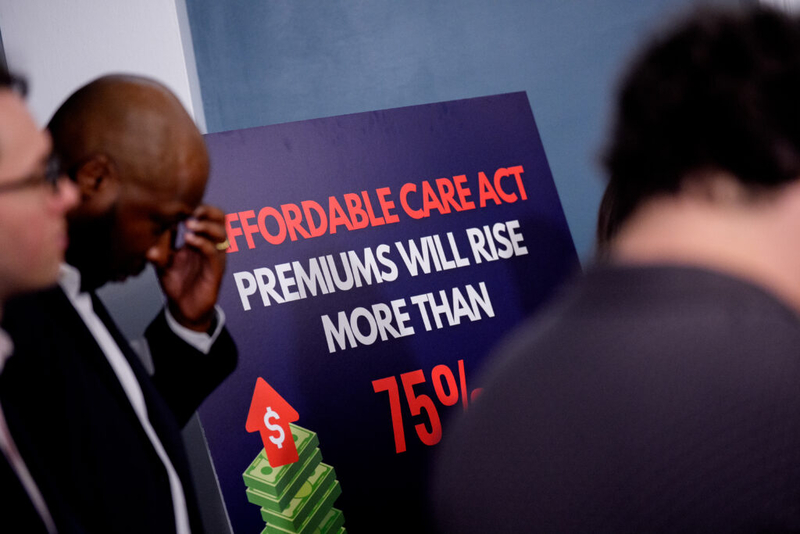
Lester Johnson (left), a restaurant owner in Richmond, Virginia, stands next to a sign that reads "Affordable Care Act Premiums Will Rise More Than 75%" during a news conference to call on Republicans to pass Affordable Care Act tax breaks on Capitol Hill on September 16, 2025 in Washington, DC. (Photo by Andrew Harnik/Getty Images)
West Virginians insured through the federal government’s health insurance marketplace should expect some sticker shock when shopping for 2026 plans, but experts say it’s important they follow what’s happening in Washington.
Open enrollment for 2026 began Nov. 1 and continues through Jan. 15.
West Virginia has the highest rates in the country for insurance plans on healthcare.gov. Highmark Blue Cross Blue Shield and Caresource, the only two West Virginia companies who offer plans there, have been approved for rate increases in 2026 — 13.9% for Highmark and 7.6% for Caresource.
The federal government has been shut down for a month as Congress remains deadlocked over whether to extend enhanced premium tax credits that have made Affordable Care Act plans more affordable. They could still extend the credits. If they don’t, they’ll expire at the end of the year.
West Virginia families of all sizes and incomes will see a spike in their monthly premiums by as much as ten times for the same plan next year, according to an analysis of 2026 plans by the West Virginia Center on Budget and Policy. Without the enhanced premium credits, households in the state will see their premiums increase by 133%, according to the Center on Budget and Policy.
“West Virginia is among the state’s most impacted if Congress fails to extend the enhanced premium tax credits that help make health coverage affordable for about 60,000 West Virginians who don’t get health coverage through their job or Medicare or Medicaid,” said Kelly Allen, director of the Center on Budget and Policy. “We have some of, I think, the highest commercial health care costs in the country, which is why we’re disproportionately impacted.”
As an example, a 60-year-old couple with no kids who earns $85,000 a year in Raleigh County would see their monthly premium jump from $601 per month in 2025 to $4,646 per month in 2026 without the tax credits extended.
A 30-year-old single woman in Raleigh County earning $35,000 per year would see her monthly premiums increase from $95 per month this year to $218 per month next year.
Customers may want to wait and see
Sabrina Corlette, a research professor at the Center on Health Insurance Reform at Georgetown University, said people who buy their health insurance on the marketplace should pay attention to what’s happening with Congress.
“It’s hard to ask people to do that because watching what Congress is doing is like watching two toddlers squabble in the playground,” Corlette said. “But this year it really is important because it will significantly affect your finances if Congress does extend [the enhanced premium tax credits].”
Allen said people should contact their representatives about the importance of extending the enhanced premium tax credits.
Corlette noted that even if Congress does extend the subsidies, it’s unlikely to take effect immediately, she said. This year, it might be worth waiting until a little later into the open enrollment period before shopping for coverage.
“[Don’t wait] too late,” she said. “You have until Dec. 15 to sign up for Jan. 1 coverage. So don’t wait too long, but it probably doesn’t make sense to try to buy something [on] Nov. 1 this year.”
Louise Norris, a health policy analyst with healthinsurance.org, said people may want to log on to healthcare.gov, update their information and familiarize themselves with the plans that are available and what they cover.
“That’s a really good first step, because the actual plans themselves are not up in the air,” Norris said. “All of that is finalized like in terms of what the policies cover, what the deductibles are, the out of pocket, maximums, the provider networks, what drugs are covered, that sort of detail isn’t going to change.”
But there’s no wrong way to enroll, she said. If people pick a plan now and Congress decides to approve the enhanced premium tax credits later, people can go back and pick a different plan, she said.
“Regardless of what you do, just keeping an eye on how this is evolving is important,” Norris said. “So don’t look at it now and decide you can’t afford it, and then forget about it. Definitely stay on top of it. Because the numbers are pretty alarming.”
Less help enrolling available this year
This year, the Trump administration cut a federal program that assists people enrolling in marketplace plans by 90%, from $100 million to $10 million.
“The bottom line is that it’s going to be a lot harder for people to find anyone to help them through the process, which for many families, can be complicated and confusing,” Corlette said. “When you’re applying for, in this case, tax credits, the application can be a little bit confusing.”
In West Virginia, First Choice Services received $125,000 this year to run the state’s Affordable Care Act navigator program, compared to $1.25 million last year, Corlette said.
Jeremy Smith, program director for First Choice Services, said the agency closed four of its five offices around the state and laid off most of the staff because of the budget cut. They plan to do most of their work over the phone instead of in person, he said.
“We won’t be able to travel and meet with people or go around and do the enrollment events and communities like we used to,” he said.
First Choice Services also runs the state’s suicide lifeline, substance abuse treatment helpline and problem gambler helpline, so the agency is set up well to help people by phone, he said.
Last year First Choice staffed 12 full time employees in the navigator program. This year, the federal funding supports one and a half full time workers, Smith said. Together with some funding assistance from state foundations, First Choice Services has five or six people helping with enrollment, Smith said.
“We’re still trying everything we can to help as many people as possible,” Smith said. He added that the agency has partnerships with federally qualified health centers around the state that can help people sign up if navigators aren’t available to help.
Smith added that because of the staffing cuts, First Choice also put more resources this year on its website, wvnavigator.com to help people through the enrollment process.
“So [if] somebody wants more information on how to enroll in a marketplace plan, they can visit our website and kind of follow the prompts and hopefully be able to get enrolled themselves,” he said. “And then if they do need us, we’re still here.”
No coverage for immigrant families
Also new this year, lawfully present immigrant families who are ineligible for Medicaid because they have been in the United States less than five years and earn less than the federal poverty line are no longer eligible for tax subsidies on a marketplace plan. That will make coverage unaffordable for many of them.
About 10,000 Deferred Action for Childhood Arrival recipients were also terminated from coverage beginning in August after the Trump administration reversed a Biden-era policy and stripped them of their eligibility for coverage.
Higher tax penalties possible
This year, marketplace customers may face higher penalties if their actual income turns out to be more than what they project when applying for health coverage. To determine how much financial help in tax credits customers are eligible for, they have to estimate what their income for next year will be.
This year, there will be no limit on the amount low income people are required to pay back to the IRS if they turn out to make more money than they projected.
For a lot of people who don’t get a steady paycheck from a large employer, estimating what they’ll make next year can be a challenge, Corlette said.
“One of the major changes that Congress made this year was to basically say, if you guess wrong what your income is going to be, and you end up getting more premium tax credits than we think you’re entitled to, the IRS can basically come back and ask for that money back,” she said.
Customers would pay the IRS back on their 2027 tax return.
People who realize next year that their income projection is off should contact the marketplace and update that information, so the marketplace can adjust the subsidy in real time, Norris said.
“That way you’re not scrambling to pay back a big amount of money when you file your taxes,” Norris said.
Charleston, WV