‘We are living in reverse’: Fragile HIV funding puts another strain on Kansas City’s safety net
Aug 11, 2026 | 6:50 am ET
Description
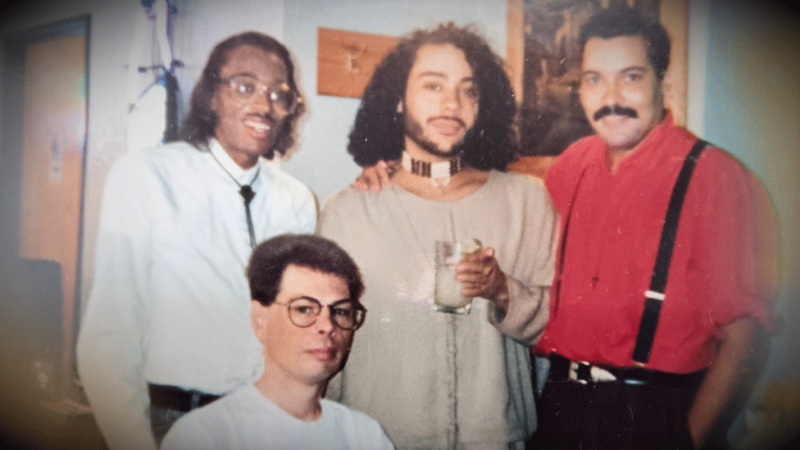
Roberto Archuleta (center), who was diagnosed with HIV in 1991, points to this photo from around that time as an illustration of the damage the virus did. "Everybody in that picture is dead except for me," he said (photo submitted).
Roberto Archuleta was 21 years old in 1991 when he found out he was HIV-positive.
At the time, the only medications available to treat the virus were difficult to tolerate and often ineffective. Being diagnosed was commonly a death sentence — something Archuleta, then a hairstylist in Kansas City, witnessed too often.
An old snapshot of Archuleta with a group of friends reveals the grim truth about what it was like when HIV was the leading cause of death among 25-to-44-year-olds.
“Everybody in that picture is dead except for me,” he said.
Dramatic changes in HIV care and the effectiveness of available medications altered the virus’ trajectory, from 130,400 new infections in 1984 to 38,434 in 2024.
The COVID pandemic and the lack of HIV testing and outreach it caused led to an uptick in new cases in 2024, including in Kansas City’s 11-county HIV region, which saw a 10% jump to 227 new cases that year. (The city has not released 2025 data.) But the big picture has been one of progress in reducing the number of new HIV diagnoses and suppressing the virus in infected patients.
That will change, public health experts warned, if the Trump administration continues to target funding for HIV care, prevention and research in the U.S. and across the globe.
To Archuleta, who for years served on Kansas City’s HIV Prevention and Care Planning Council, it’s starting to feel like sliding backward.
“It’s like all of the progress and all of the work that we have done throughout the years to get HIV to where it is now is being lost,” said Archuleta, who now lives in California and spearheads the Remember Me Campaign, an effort to increase awareness of the virus. “We’re returning, slowly but surely, back to the days when the work we did didn’t even exist.”
Katie Batza, who chairs the women, gender and sexuality studies department at the University of Kansas, said she’s been hearing much the same sentiment from the activists she interviewed for her new book,“AIDS in the Heartland,” a study of LGBTQ politics in the Midwest during the height of the virus.
“A lot of them are feeling infuriated,” she said. “They’re saying, ‘Now we have all these resources but we’re making them unavailable, and we’re going to have to watch it happen again.”
Funding cuts and uncertainty
The Trump administration’s 2027 budget request calls for eliminating $1.6 billion in HIV-related spending, a 35% drop from 2026 funding. If Congress adopts the plan, as it declined to do last year when the administration proposed similar cuts, part of the Ryan White HIV/AIDS Program — a $2.6 billion grant program that funds healthcare for more than half of those in the United States living with HIV — would go away.
The proposed cuts to Ryan White include AIDS Education and Training Centers to support health providers who treat HIV patients, dental programs, and the Minority AIDS initiative, meant to expand services in minority communities that are more heavily affected by the virus.
The administration has already slashed HIV prevention funding at the Centers for Disease Control and Prevention. Just last month it pulled back millions of dollars in grants going to community organizations and sent the money instead to states.
Andrea Weddle, executive director of the HIV Medicine Association, said all the cuts would have consequences on the health of HIV patients and the larger community.
“We would anticipate a dramatic increase in HIV transmission rates” if the funding goes away, she said, “and much higher healthcare costs.”
Maven Lee, a contractor with BlaqOut, a Kansas City nonprofit working to bring sexual healthcare to the city’s Black LGBTQ community, worries about the potential health consequences that will come with the new HIV funding landscape.
But he also fears the return of bigotry that was once so pervasive around HIV. When education and outreach about the virus don’t happen, progress will be lost, he said. People won’t understand how to protect themselves or they’ll be afraid to disclose their status, for fear of the stigma. Worse yet, he said, they won’t test at all because they don’t want to know.
“There was a time when there was more open conversation where you could educate people,” Lee said. “I don’t think those conversations are happening anymore. … We are living in reverse. We are going back.”
Marvia Jones, Kansas City’s health director, said she is concerned about the gaps emerging in the city’s health safety net, from lost HIV and Ryan White funding to coming changes to Medicaid, which could leave vulnerable people in the city without access to healthcare.
People living with HIV will be impacted, she said, and “when their treatment suffers, we know it makes the city as a whole more vulnerable.”
Jones said the city should be working to plug some of those holes, perhaps with funds from its health levy fund.
“There have been some fairly severe cuts already,” she said, “and it would be great if the health levy were to stand in the gap for folks who are vulnerable.”
The Kansas City Health Commission, which is studying how some funds raised through the health levy will be allocated next year, is expected to take up the issue of HIV funding at its Aug. 31 meeting, a city spokesperson said.
Waiting to see what happens
Bob Walker, a regional vice president for Vivent Health, said his organization’s St. Louis arm is already absorbing losses in federal funding and he expects to see the same thing in Kansas City, where the organization treats about 600 HIV patients.
As with other organizations providing HIV care, the question has become less whether the cuts will happen and much more when they will happen.
“Unfortunately, I might get an email tomorrow saying (a grant) is going to end in 30, 60 or 90 days, or it’s already ended,” Walker said. “It’s a surprise to everybody and then we have to do a pivot quickly to figure out how we’re going to navigate through that loss of funding.”
Kansas City organizations that provide HIV care have lost some resources already. For example, the Missouri Department of Health and Senior Services suspended funding in April to KC Care for a peer navigator program that helped people diagnosed with HIV connect to treatment.
The state, facing budget constraints in its own Ryan White-funded programs, also suspended other HIV-related funding around the state to trim $1.9 million from its budget. Those cuts included a mental health program that served 42 people, an emergency financial assistance program that served 172 people and a dental program in St. Louis that served 1,400 people.
And in June the state limited which drugs it will pay for through its Ryan White AIDS Drug Assistance Program, known as ADAP. Now the program only covers HIV medications, but no drugs for other conditions, such as high blood pressure or mental illness.
ADAP efforts provide free medications to HIV patients who aren’t eligible for Medicaid or other financial assistance, and in many cases the programs purchase health insurance for participants to access drugs. Missouri received nearly $10 million for ADAP in fiscal year 2025.
Like other states, Missouri was dealing with higher costs of drugs and insurance, and it faced major declines in drug company rebates, which have historically subsidized the drug assistance programs.
As more HIV patients transitioned to Medicaid coverage after Missouri expanded eligibility under the Affordable Care Act, it purchased fewer drugs and, therefore, collected fewer rebates. Last year, Missouri pulled in $27 million in drug rebates, compared to $41 million in 2021, said Alicia Jenkins, deputy director of community and public health with the Missouri Department of Health and Senior Services.
Jenkins said the rebate decline is the major reason the state’s Ryan White program has had to tighten its belt. The changes were made to ensure the state could afford HIV medication for every participant, she said.
“None of it feels good,” she said, “but in order that we can ensure that we are positioned to cover medication, we did what we needed to do.”
Kansas also reportedly lowered income eligibility requirements for its ADAP efforts, but the state could not be reached to answer questions about the change. In fiscal year 2025, Kansas received $2.6 million in ADAP funding.
Rashaan Gilmore, the founder and CEO of BlaqOut, said the loss of access to non-HIV medications through ADAP is a serious problem for many people living with HIV.
“What does that do to a person who’s trying to manage multiple comorbidities and they can’t get their medication covered?” Gilmore said. “That’s going to mean people making choices about what medications they do pay for, and I think it’s going to lead to people falling out of care because what used to be a one-stop shop is now even more fragmented.”
A finite amount of money
It’s not just a problem for HIV care providers if funding is cut. As providers work to absorb the higher cost of medication and other medical care, it’s also a problem if federal HIV funding remains flat, which has happened for more than a decade. Meanwhile, enrollment in the program has increased by at least 20% since 2016, according to the Ryan White Medical Providers Coalition.
“Ryan White is a finite amount of money, and the pot doesn’t really change,” said Wil Franklin, CEO of KC Care Clinic. “We have more HIV patients than we’ve ever had — not because there’s a bunch of new cases … but people with HIV are now living longer, healthier lives.”
Ryan White Program funding in Missouri and Kansas — fiscal year 2025
| Part A | Part B (Including ADAP) | Part C | Part D | Ending the HIV Epidemic | Total | |
| MO | $10.9 million | $15.9 million | $2.2 million | $1.8 million | $2.4 million | $33.2 million |
| KS | N/A | $5.4 million | $830,000 | $473,618 | N/A | $6.7 million |
Source: Ryan White Medical Providers Coalition
Providers used to treat patients until they died. Now they are managing a chronic condition. But the funding hasn’t expanded to meet the growing number of HIV patients or the added expenses of a lifetime of medication.
Missouri’s expansion of Medicaid did offer some relief, Franklin said. HIV patients were able to roll off of Ryan White programs and enroll in Medicaid, which helped stretch the program’s limited funds.
Now, in states like Missouri that adopted Medicaid expansion, six in 10 Medicaid recipients diagnosed with HIV are included in that expansion group.
That’s why a new Medicaid requirement for most people in the expansion group to document 80 hours of work, school or volunteer hours is another big worry in the HIV care community. The new work requirement and more frequent eligibility checks are expected to cause people to lose coverage. People with HIV won’t be automatically eligible for a medical exemption, which means the safety-net program could let some fall through.
At the same time, more people are dropping Affordable Care Act health insurance due to higher costs, which could also leave some HIV patients without health insurance.
“It’s a perfect storm of public health harm for sure,” Gilmore said.
This article first appeared on Beacon: Kansas City and is republished here under a Creative Commons Attribution-NoDerivatives 4.0 International License.


Jefferson City, MO