What is more American than standing up for the marginalized?
Jul 01, 2026 | 2:22 pm ET
Description
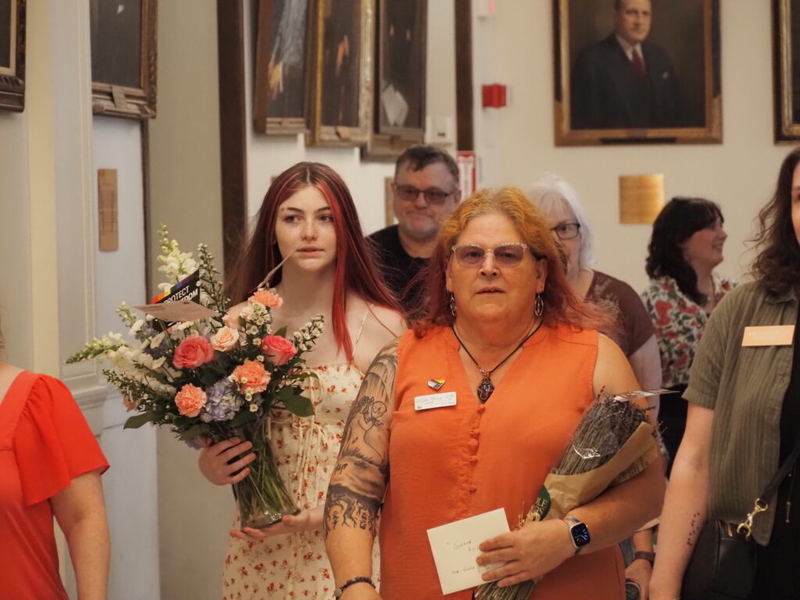
At the New Hampshire State House on Tuesday, June 16, advocates for LGBTQ+ rights deliver flowers and postcards to Gov. Kelly Ayotte's office, imploring her to veto the anti-trans Senate Bill 552, which she did. Pictured are Parker Tirrell (left) and Willow Young (center). (Photo by Molly Rains, New Hampshire Bulletin)
In New Hampshire, as in the United States, about 1% of the population identifies as transgender. Data compiled by the Williams Institute at the UCLA School of Law puts the total transgender population in the state at about 13,500, including 2,800 teenagers. Of those 2,800, about a third identify as trans girls, a third as trans boys, and a third as nonbinary, the data suggests. Of the 930 or so trans girls in New Hampshire, the Williams Institute estimates that about 40% play at least one sport.
That means that according to one of the best general estimates we have, based on available data, about 370 trans girls want to play youth sports in New Hampshire. I suspect the real number, especially in a hostile political climate where adults organize protests against kids seeking only to join their peers on fields of play, is a very small fraction of that.
You’d hardly know it, however, based on the volume of responses from state Republicans following the U.S. Supreme Court’s ruling Tuesday upholding bans on transgender athletes. Within moments of the decision, jubilant statements came in from Gov. Kelly Ayotte, U.S. Senate candidate John Sununu, Senate President Sharon Carson, and House Speaker Sherman Packard.
“New Hampshire took action to preserve fairness in athletic competition,” Packard said, “and I am pleased the Court has upheld our state’s ability to enforce that law as intended.” Whether that proves to be the case for New Hampshire’s ban specifically, with a lawsuit still pending, remains to be seen.
But a fifth press release, from New Hampshire House Republicans, clarifies that there’s a lot more to all of this than girls’ sports.
“Following today’s U.S. Supreme Court decision affirming states’ authority to recognize sex-based distinctions in public policy,” the statement reads, “a group of female members of the New Hampshire House of Representatives is calling on Governor Kelly Ayotte to sign HB 1442.”
House Bill 1442 is the same bathroom bill that has already been vetoed multiple times by two Republican governors, including by Ayotte just last month. The bill, like all those that came before it, strips transgender people of protections granted to them under New Hampshire’s Law Against Discrimination.
History teaches us that 250 years of progress has been consistently derailed by a corrupted sense of liberty, in which rights are denied to some so others can feel freer by comparison.
I applaud the vetoes of Ayotte and her predecessor, Chris Sununu, and appreciate that they see it for the deeply flawed legislation that it is. But I do wonder, as the group of House Republican women seem to, what the difference is between banning trans girls from youth sports, which Ayotte and Sununu support, and allowing trans women to be banned from restrooms, locker rooms, and other spaces.
My confusion isn’t related to the legal differences, such as the privacy concerns the bathroom bill creates, but rather the distinct philosophical and political similarities.
Each ban exists along the same arc of American exclusion that connects 1776 to 2026. All that changes, century to century and decade to decade, is the who: from Native Americans to poor people to women to Black people to immigrants (Irish, Japanese, Haitian — only the nation of origin changes) to gay people to trans people and on it goes.
History teaches us that 250 years of progress has been consistently derailed by a corrupted sense of liberty, in which rights are denied to some so others can feel freer by comparison. Free to be intolerant, free to hate, free to choose, by force of law or force of violence, who is to be culled from this grand experiment.
To demand more and better in this land where all are said to be created equal is neither threat nor treason. It is the essence of patriotism, in which the people undertake the perpetual refinement of a divinely inspired project of unimaginable scope.
By plenty of metrics the United States has prospered in ways that have surely exceeded even the Founding Fathers’ hopes. In 1776, the total population of the 13 original colonies was 2.8 million. Today, America is home to nearly 350 million across 50 states and five inhabited territories, or about 125 people for every one person around to witness the birth of a new nation. Yet our collective progress has been repeatedly undermined by a throughline of bigotry that’s often carried out to its most extreme edges. In every instance the foundational pursuits of this nation are degraded, we the people are degraded.
And that’s something that a lot of New Hampshire Republicans can’t seem to understand. To stand up and defend trans rights, or immigrant rights, or the rights of any other marginalized group, is not to choose one over others but to choose them, too. All of them, because that has been our ultimate charge since the beginning.
To me, that truth is not only self-evident but paramount and entirely incorruptible. And it is a truth worth celebrating.

Concord, NH