What to expect from a Weiser administration in Colorado
Jul 02, 2026 | 4:25 pm ET
Description
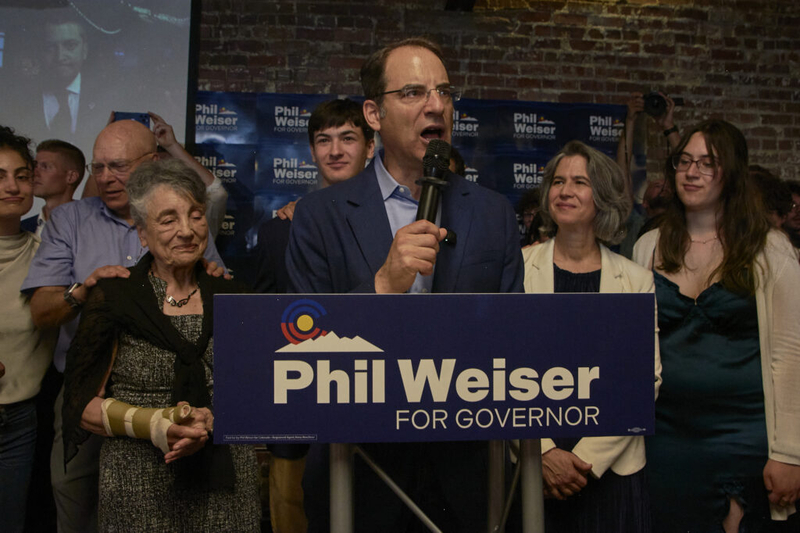
Phil Weiser, the Colorado attorney general, speaks to supporters during his primary election night watch party for his campaign for governor, in Denver at Ace Eat Serve on Tuesday. (Photo by Andrew Fraieli/Colorado Newsline)
Phil Weiser, the Colorado attorney general, on Tuesday won the Democratic primary election for Colorado governor. That means, barring some extraordinary event, he will be the next Colorado governor. Only one Republican has been elected governor in the state in more than 50 years.
What does that mean for Colorado?
In the run-up to the primary, the story that emerged about the race between Weiser and his opponent, U.S. Sen. Michael Bennet, was that the two candidates were essentially the same. They didn’t have policy differences to speak of. They’re both Democratic white men around 60 who made resistance to the Trump administration and affordability central to their campaigns. It was hard for voters to make a choice based on ideology, and the vote mostly came down to vibes.
But the vibes all broke for Weiser. A focus group of Colorado voters organized by Sarah Longwell of the Bulwark captured common sentiments about the race. Bennet should stay in the Senate but also he has become too “establishment” and entitled during his time in the chamber, and he voted to confirm too many of President Donald Trump’s cabinet nominees, focus group members said.
Weiser is not a DSA-style progressive like those who are toppling establishment figures across the country, including 29-year-old newcomer Melat Kiros of Denver, who unseated longtime U.S. Rep. Diana DeGette on Tuesday. But by contrast, he seemed at least more sympathetic to left-wing fury over fascist outrages in Washington, untenable costs of living, threats to civil rights and other concerns that animate the insurgent faction of the Democratic base.
“It just feels like someone who is actually interested in fighting back, as opposed to Bennet, who just feels like he just wants to sit there and get what he thinks is coming to him,” one of the focus group participants told Longwell.
In the governor’s office, this would translate to a welcome pivot away from the style of the current occupant, the term-limited Jared Polis, who despite being a Democrat in too many cases has aligned himself with the MAGA agenda.
Though policy wasn’t decisive in the primary race, Weiser has released a policy document that offers a window on a future Weiser administration. In it he signals solidarity with renters and other Coloradans who struggle to afford homes, and he wants to increase “attainable owner-occupied homes by 40,000,” though that goal comes with scant specifics. On healthcare, he promises to establish what he calls “primary care for all,” not to be confused with the progressive imperative of Medicare for All. It would be a “systemwide mandate to move us from our current ‘sick care’ system to a true ‘health care’ system.”
Weiser beats Bennet in Democratic primary for Colorado governor, Kirkmeyer in lead
Notable is that the first set of Weiser promises concerns the Trump administration and threats to democracy. Weiser has sued the administration almost 70 times, and there’s little doubt about his sincerity when he talks about resistance to illegal federal policies. As governor he promises to protect Colorado elections, reproductive and LGBTQ+ rights, public lands and “fair representation.”
That last one is about efforts to answer the Trump-initiated rash of mid-cycle gerrymandering in Republican-led states. Weiser was early to support an emergency redistricting plan in Colorado, an endorsement Bennet followed much later but that was opposed by Polis.
However, there is some uncomfortable Weiser-Polis overlap. When last year Polis tried to force a state employee to hand over sensitive resident information to federal immigration agents, despite a state law that restricts such information-sharing, Weiser’s office appears to have signed off on Polis’ pro-ICE position, according to court testimony.
Polis’ legislative record is partly defined by his two vetoes of bills, known as the Worker Protection Act, which would have eased the process to form a union in Colorado and was central to the progressive Democrat and labor agenda. Weiser has said he also would not support the Worker Protection Act.
For all the admiration he deserves for his lawsuits against the Trump administration, Weiser’s reliance on the law to resist boundlessly corrupt, dishonest and cruel federal officials could be a handicap. Before he became attorney general in 2019, he was a clerk for U.S. Supreme Court Justice Ruth Bader Ginsburg, served in Obama’s Department of Justice and was dean of the University of Colorado School of Law. He lives the law and reveres the law. But he’ll be a lawyer governor in a lawless land.
The times call for democracy defenders who understand that the norms and rules they might previously have extolled have been obliterated. Even the U.S. Supreme Court, the citadel of American law, rejects fidelity to the Constitution, as when it gave presidents monarch-like immunity from criminal prosecution, or when, just this week, four justices in the minority rejected the black-letter constitutional right of birthright citizenship, which though it stands for now is vulnerable.
Lower-court judges so distrust Department of Justice lawyers that the historical “presumption of regularity,” the court’s assumption that government attorneys act in good faith, has vanished, and Trump has transformed the department from an impartial institution of law enforcement into a tool of personal grievance.
When the law means nothing to one side and everything to the other, advantage goes to the lawless. It’s not that a Gov. Weiser should disregard the law, but the moment requires its limits to be tested in ways that would not come easy to a law dean.
Would Weiser join an interstate compact to hold federal taxes in trust, a plausible but legally risky response to wholesale misuse of taxpayer money? Would he call it quits amid legal setbacks to a ballot initiative that would allow Colorado to draw new congressional maps in response to extreme GOP gerrymandering, or would he meet bad-faith aggression with the gloves-off urgency the situation demands? How far would he be willing to go to protect Coloradans against occupying federal troops or resist Washington through “uncooperative federalism” and “soft” secession?
There’s little doubt Weiser is better prepared than Bennet for the existential challenge of MAGA. But even a Weiser administration could find itself outmatched by the dark forces tearing the country apart.
Denver, CO