What a four-way Republican race in Weber County says about Utah primary politics
May 26, 2026 | 3:18 pm ET
Description
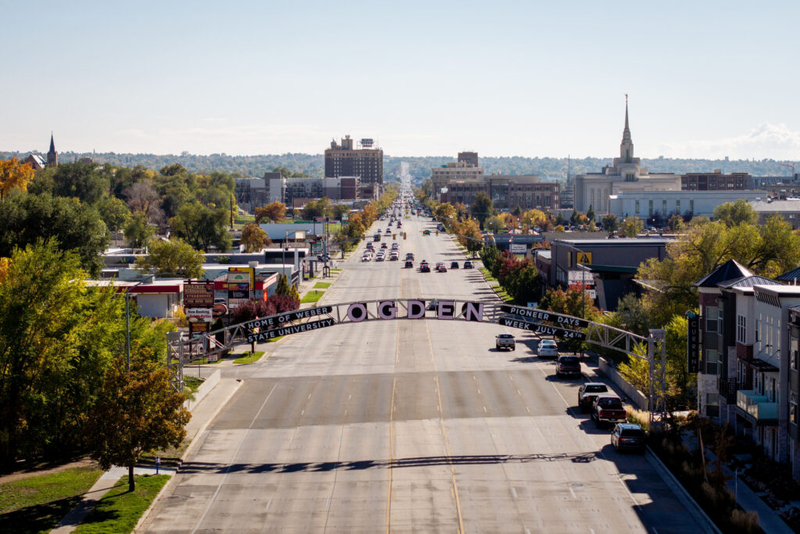
Ogden is pictured on Thursday, Oct. 23, 2025. (Photo by Spenser Heaps for Utah News Dispatch)
In this year’s primary election, registered Republican voters will be asked to choose between four candidates competing to become the party’s nominee for Weber County Commission seat A.
Several things make this particular race notable, including: the number of candidates, who they are, how they got there, and how much campaign cash has already been spent.
The race in a growing county and underscored with some intrigue is also representative of the dynamics of Utah primary politics, where a more-than-decade-old law that creates two routes to the primary ballot still irks Republicans and strong GOP majorities mean the winners of most races are determined long before the general election comes.
Ballots will arrive by mail in early June — about three weeks ahead of the June 23 primary election day.
Who’s running?
Alphabetically by last name, the GOP candidates in the commission A primary are:
James Ebert: Farr West resident who served as a Weber County commissioner from January 2015 to January 2019. He has served as CEO of the Boys & Girls Club of Weber-Davis since 2019.
Katrina Gibson: Wife of former Weber County Commissioner Kerry Gibson who served from January 2011 to January 2018. They own a dairy farm in western Weber County, and Katrina manages a cozy diner called the Korner Fix.
Richard Hyer: Northeast Ogden resident who is finishing his third term on the Ogden City Council where he currently serves as chair. He spent his career as a goldsmith/jeweler, and his hobbies have included beekeeping.
Duane Kearsley: Warren resident (west Weber County) and first-time candidate who manages the Golden Spike Event Center. He loves coaching youth sports and enjoys running ultra marathons.
How did they get here?
Hyer and Kearsley survived three rounds of delegate voting during Weber’s April 11 GOP Convention, with Kearsley as top vote-getter receiving 285 votes and Hyer next in line with 202. Neither cleared the 60% threshold needed to nail the party’s nomination.
Ebert and Gibson, eliminated in the first and second rounds of delegate voting, had collected signatures to secure spots on June’s ballot, regardless of the convention’s outcome.
The roots of this two-fold path to the primary date back to 2010 when it became apparent that GOP delegates differed from the broader electorate in how they valued candidates. Delegates ousted moderate incumbent Sen. Bob Bennett that year in favor of the deeply conservative Mike Lee, who still holds the seat.
At that time, Utah’s dismal voter participation gave rise to the Count My Vote movement and a 2013 ballot initiative aimed at replacing the convention/caucus system with direct primaries.
In response, state lawmakers passed compromise legislation in 2014 to preserve the caucus/convention system while establishing the signature-gathering alternative to also get on the primary ballot.
While voter turnout improved, the divide between delegate-preferred candidates and those who gather signatures endures, underscoring the difference between the hard-wired Republican party core (which still opposes the law) and the broader electorate.
Case in point — at the 2024 state GOP convention, delegates booed Gov. Spencer Cox and gave him only 32.5% of their votes compared to Rep. Phil Lyman’s 67.5%. But Cox — who gathered signatures — easily sailed to victory when more moderate primary voters weighed in.
But over the past decade, signature-gathering companies emerged as a lucrative cottage industry, making campaign cash a vital resource for those who aim to win primaries and move on to November.
Staggering campaign costs
Katrina Gibson’s pre-convention campaign finance report indicated $28,900 paid to Gathering, Inc. for collecting signatures from registered voters across the county. Her expenditures on the April 3 report totaled $39,873, with signature gathering consuming 72.5% of her pre-convention campaign costs.
Ebert’s report showed that he shelled out $50,000 to a Salt Lake City-based company called Empower Public Affairs to gather signatures. His pre-convention spending totaled $52,917 with signature gathering consuming 94% of his pre-convention campaign costs.Ebert said local signature-gathering companies had already signed on for another candidate in the Commission seat A race by the time he approached them about working for him. That meant he had to hire a company outside the county and pay them more to accomplish the task in less time.
Weber County Clerk Auditor Ricky Hatch said that each GOP Commission candidate had to collect 1,933 verified signatures to get on the ballot. In practice they needed to submit well over that number in case some signatures failed to qualify.
A bit more background
This is Katrina Gibson’s first run for elected office. Many know her as the wife of former Weber County Commissioner Kerry Gibson, who filled that seat from January 2011 until January 2018 when he resigned to become deputy director of Utah Department of Natural Resources.
That DNR appointment got delayed due to a criminal investigation into alleged misconduct during his time as county commissioner, a probe that began in late 2017 and concluded in May 2018 without charges due to insufficient evidence.
Gibson’s time with Utah’s DNR proved brief — June 2018 to April 2019 — before he shifted over to serve as commissioner of Utah’s Department of Agriculture and Food. There, whistleblower complaints of mismanagement led to a state audit citing questionable travel expenses, conflict of interest issues, poor judgment in hiring and overseeing employees, and concerns about how UDAF awarded Utah’s first medical cannabis licenses.
For her part, Katrina Gibson emphasized that she is the candidate in this race, not her husband.
“I answer for myself, and the decisions that I make and the things I speak — they are me, they are not my spouse ” she said.
Smokescreen or smoking gun?
One day before the Weber County Republican Convention, Katrina Gibson filed a complaint with both the state and county elections offices regarding Ebert, his wife Steffani and “conflict of interest and serious election integrity concerns.”
A government records request revealed the contents of that complaint along with the county’s response.
“It has come to my attention that this candidate actively participated in the collection of petition signatures for ballot access, while his spouse is employed within the Clerk/Auditor’s Office, specifically in a role connected to the elections process, including the verification and validation of candidate signatures,” Katrina Gibson wrote in her April 10 email, noting that “activities on the final day of signature submission appeared irregular and lacked transparency.”
She also included concerns about the couple’s ability to avoid conflicts of interest since commissioners are involved in making so many budget decisions.
Steffani Ebert works as chief deputy for Weber County Clerk/Auditor Ricky Hatch, where she handles budget, accounting and taxation issues. Weber County elections also fall under Hatch’s purview.
Hatch’s April 24 reply to Katrina Gibson detailed discussions with his elections team, the county’s HR director and also the attorney’s office.
According to county elections staff, Steffani Ebert had no involvement in “any elections-related matter at all this year,” right down to not being able to access the PIN-controlled elections office and ballot processing centers, Hatch said in his response.
“The employee’s position as chief deputy has not and does not include supervision of the elections office,” Hatch continued. “The elections director reports directly to me, not to the chief deputy. This has been the situation for at least 14 years, and was also in place with the prior chief deputy.”
The elections team also reviewed processing of signature packets, Hatch said, and found no deviations from state statute and county policy.
Hatch also wrote that a formal review of the candidate and employee conflict-of-interest disclosures revealed that they had been submitted in a timely manner and complied with statute and policy.
Rethinking county government
Counting newly incorporated Ogden Valley City, Weber County is home to 16 cities and a handful of unincorporated areas that span approximately 611 square miles.
The Weber County Commission consists of three elected officials who function as both the legislative and executive branch. They come up for reelection every four years — seats A and B this year, and seat C in 2028.
Ogden, with nearly 90,000 residents crowded into about 27 square miles, serves as county seat.
According to transparent.utah.gov, the current seat A commissioner collects an annual salary of $178,537 plus $53,929 in benefits — totaling $232,465.
Considering Weber’s growth, we asked each of the four candidates whether they would support a commission resolution to consider expanding the county’s governing body to a five- or seven-member council with either an elected mayor or county manager.
Here’s how they responded (edited for space):
James Ebert: I support a thoughtful review of Weber County’s form of government to determine what would best serve residents. That review could lead to keeping the current structure, adopting a county manager model, or moving to a part-time commission with additional commissioners. I believe it is important to fully study the options before making assumptions about which form of government is best.
Katrina Gibson: I’m open to discussing any idea that improves accountability and representation, but those decisions should ultimately be driven by the people of Weber County. Before restructuring government, we should first focus on improving transparency, efficiency, and public trust within the current system.
Rich Hyer: I believe larger counties should have larger commissions – and those commissioners should be elected by districts to ensure that every area of the county is represented. I am not in favor of an unelected manager controlling the budget process, and I am cautious about concentrating so much power into a single individual – especially in our size of County. That said, I will look at anything and weigh the benefits in an open and transparent way to ensure our residents have their voices heard. It is their money, after all, and managing their tax dollars is a sacred trust.
Duane Kearsley: I would maybe consider a five- or seven-member commission, but only if that’s what the people want. I’m here to serve the community and represent their wishes. I would not support or vote for something that doesn’t reflect the will of the people.
What next?
This November, the Republican winner for seat A faces off against Democrat Alvin Thurgood and Forward Party of Utah candidate Gary New.
Weber County Commission seat B will also be on the ballot, with incumbent Sharon Bolos — a former West Haven mayor — seeking reelection.
Delegates chose Plain City Mayor Jon Beesley at April’s GOP convention with 281 votes (62%) compared to 115 for Bolos (26%). Bolos gathered signatures to secure her spot in the primary.
No other political parties had candidates file for seat B, so the winner in the Republican primary race will assume the post in January.
Salt Lake City, UT