Congressional Black Caucus calls for corporate leaders to speak out for voting rights
May 26, 2026 | 2:45 pm ET
Description
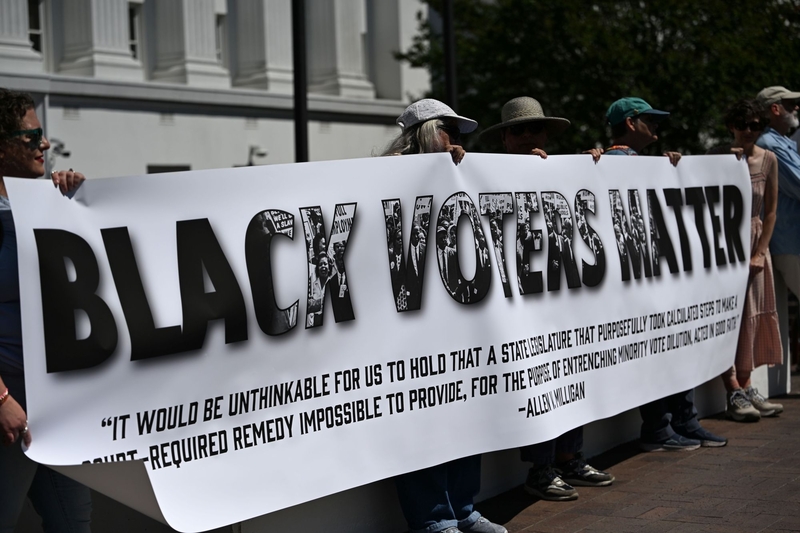
A group of protestors hold a banner saying “Black Voters Matter” with a quote from Allen v. Milligan, a 2023 case that required Alabama to draw a second congressional district to give Black voters an opportunity to elect their preferred leaders, on May 4, 2026 at the Alabama Statehouse in Montgomery, Alabama. (Photo by Brian Lyman/Alabama Reflector)
The Congressional Black Caucus on Tuesday urged American corporations to condemn efforts to dilute Black voting strength, as Southern states eliminate congressional districts where most residents are Black.
The CBC’s attempt to mobilize the business community comes as Black representation in Congress potentially faces its most severe threat since the end of Reconstruction following the Civil War. But some business leaders have taken a friendlier tone with President Donald Trump, who backs the gerrymandering.
A U.S. Supreme Court decision in April, in a case called Louisiana v. Callais, sharply weakened the federal Voting Rights Act, which had blocked states from breaking apart majority-minority districts. It limited the use of race in redistricting, prompting several Southern states to advance new maps targeting these districts, which are mostly held by Black Democrats.
“These actions are not routine political exercises,” the letter reads. “They are coordinated efforts to silence Black voices at the ballot box and strip communities of representation in American democracy.”
The message is addressed to more than 200 corporations and business groups that signed on to a 2021 letter in support of voting rights, as well as an unnamed number of other corporate leaders. Among the signatories were Amazon, Apple, Cisco, Facebook, Intel, Microsoft, Nike, PepsiCo, Starbucks, Target, Tesla and Unilever USA.
That letter called on Congress to update the Voting Rights Act, including changes that would restore the federal government’s ability to review changes to election and voting laws in states and local governments with a history of discrimination, a practice called preclearance that the Supreme Court effectively halted in 2013.
On Tuesday, the CBC said those companies should issue individual or joint public statements opposing efforts to dilute Black voting strength and dismantle protections in the Voting Rights Act.
The lawmakers also want companies to report on corporate political spending and relationships connected to attacks on voting rights and “discriminatory redistricting schemes.” Companies should accept an invitation to participate in a national gathering alongside civil rights leaders and advocates to discuss voting rights and Black political power, the lawmakers wrote.
The letter asks businesses to respond by June 9.
“Five years ago, corporations across America publicly affirmed that democracy, racial equity, and voting rights matter. Today, in the wake of the Supreme Court’s Callais decision, those commitments are being tested in real time,” Rep. Yvette Clarke, a New York Democrat who chairs the CBC, said in a statement.
“Corporations that have profited from Black consumers, relied on Black workers, and benefited from Black communities cannot remain silent while Black political representation is dismantled in plain sight,” Clarke said. “Silence in this moment is not neutrality — it is complicity.”
Corporate leaders warm to Trump
But political attitudes in parts of corporate America, especially among tech firms, have shifted since 2021.
When businesses signed the July 2021 letter, they were acting after the May 2020 murder of George Floyd, a Black man, by a white police officer in Minneapolis, and the Jan. 6, 2021, storming of the Capitol by Trump supporters. Six years later, some titans of American business have taken a more conciliatory approach to Trump and the Make America Great Again movement.
Elon Musk, who leads Tesla, spearheaded the Department of Governmental Efficiency, or DOGE, initiative in 2025 that resulted in the firings and layoffs of thousands of federal workers. Facebook founder Mark Zuckerberg has spoken positively about the president. Jeff Bezos, Amazon’s CEO, called Trump “more mature” in his second term.
Trump has also led a push against diversity, equity and inclusion efforts. In March, the president signed an executive order targeting DEI practices by federal contractors. The directive followed another anti-DEI order in January 2025 that encouraged the private sector to “end illegal DEI discrimination and preferences.”
Since the Supreme Court’s decision in Callais, some Republicans have portrayed eliminating majority-minority districts as a constitutional imperative. The current districts should be tossed because they were drawn with their racial makeup in mind, they say.
“I don’t think race should be used to help a person because of his race, and I don’t think race should be used to harm a person because of his or her race,” Sen. John Kennedy, a Louisiania Republican, said at a Senate hearing on racial gerrymandering last week.
Rapid remaps
Since the release of the Callais decision on April 29, Florida and Tennessee have changed their maps and Louisiana is expected to follow soon. South Carolina lawmakers tried but failed to advance a new map and Alabama has taken steps to implement a 2023 gerrymander after the Supreme Court lifted a lower court order that had blocked it.
A panel of three federal judges on Tuesday issued a new order halting the Alabama map, which would likely force out one of the state’s two Black Democratic members of Congress if enacted. The judges found that the map was racially discriminatory, even in light of Callais.
Alabama has appealed the decision to the Supreme Court.
"I applaud the three-judge panel for upholding the rule of law and reaffirming that racial discrimination has no place in our redistricting process,” Rep. Terri Sewell, an Alabama Democrat who also signed Tuesday’s CBC letter, said in a statement.
“While we know that this legal battle is far from over, today’s ruling sends a clear message: Black voters in Alabama cannot and will not be silenced.”
All States Newsroom content is free to republish. Read our republishing policy for more information.