Records show Oklahoma parole board pay raise bill stalled after lawmaker pressure in murder case
May 26, 2026 | 3:18 pm ET
Description
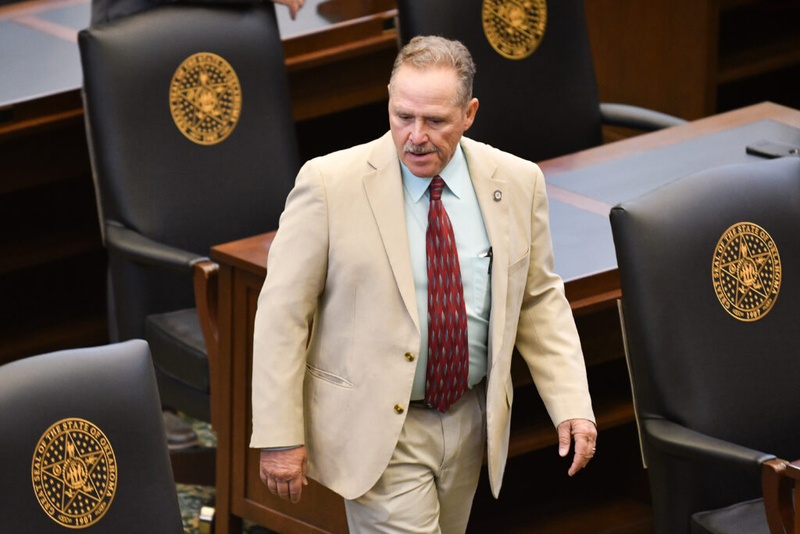
Rep. Danny Sterling attends a special session of the state House at the Oklahoma Capitol on Oct. 3, 2023. (Photo by Kyle Phillips/For Oklahoma Voice)
OKLAHOMA CITY – A bill that would have nearly doubled the pay of the state’s Pardon and Parole Board failed after a lawmaker didn’t get the response he sought for a man serving life for murder.
Emails and video from a public budget hearing show Rep. Danny Sterling, R-Tecumseh, pressed the board to parole a convicted murderer as the budget committee he chaired was tasked with considering the salary increase for the five-members panel.
Emails obtained by Oklahoma Voice through the state open records law show Sterling or his assistant sent multiple communications using House email or letterhead to board staff to advocate for the parole of Kenny Ray Meyer, who is serving a life sentence after being convicted of second-degree murder in the 1995 killing of Brenda Sue Sandmann. The 34-year-old woman died outside a bar near Wanette.
The records give a glimpse into how legislative politics may have played a role in the decision for a board that has seen heavy scrutiny in recent years and that, ironically, is designed to be devoid of politics.
What the records show
In an Oct. 27, 2025, letter to the Pardon and Parole Board, Sterling wrote that Meyer had been a firearms instructor for the Department of Corrections and “unintentionally fired a reloaded weapon he believed to be empty.” Meyer, the representative said, had no “intent to kill.”
But after the board unanimously rejected Meyer’s request for parole on Nov. 3, 2025, Sterling began demanding specific answers about why.
About two months after the denial, Sterling publicly questioned the Pardon and Parole Board Executive Director Kyle Counts about the case during the agency’s budget hearing before the House Appropriations and Budget Judiciary Subcommittee, which he chairs.
In an effort to increase retention and better align compensation levels with the amount of work required to vet cases, the agency was seeking to increase the pay for members to $42,000 from $22,800 and the board chair’s salary to $46,000 from $24,800.
Sterling prefaced his line of questioning by saying, “I’ll make sure I’m getting a good bang for my buck here as a legislator representing some constituents.”
He also asked Counts whether the board “honored” a lawmaker’s letter of support for someone who is imprisoned.
“I can’t say that’s always followed, though, but they certainly give it great weight,” Counts responded.
Emails from his office after that hearing show that Sterling then demanded that the part-time board, which considers thousands of parole requests each year, provide him “a formal response… addressing the contents” of his Oct. 27 letter and explaining why Meyer’s parole was denied.
At some point, emails show that Counts was made aware that some House members had concerns that the Pardon and Parole Board was not responding to phone calls, and on March 30 queried House leadership, including House Appropriations and Budget Committee chairman Trey Caldwell, R-Faxon.
Caldwell, in response, told Counts to contact Sterling.
Sterling was granted an in-person meeting with Counts, records show.
How the bill ended up in the House
Then in May, the House’s judiciary budget committee, which Sterling chaired, did not consider Senate Bill 1330, which would have allowed the board’s pay to nearly double. Despite funding being budgeted and approved to pay for the raise, both chambers had to approve a separate bill allowing for the salary adjustments.
While advancing unanimously through the Senate, the bill never received a hearing before the full House, though it did receive 21 votes of approval from the chamber’s top appropriations and budget committee. Sterling, who is a member of that committee as well, was among four lawmakers who opposed it, legislative records show.
Sterling was contacted for comment several times beginning Thursday. On Tuesday, his office said he didn’t have time to do an interview.
A House leadership spokesperson said chamber rules did not prohibit Sterling from using legislative resources to advocate for Meyer’s release.
Tom Bates, a former Pardon and Parole Board executive director for five years whose retirement was effective Nov. 30, said it is not uncommon for a lawmaker to inquire about a case or send a letter supporting an inmate.
But Sterling’s apparent mission was unusual.
“I can’t recall a legislator ever demanding from the Board a written explanation of the case beyond the information recorded on the ballot,” Bates said.
The parole ballot contains information about how members voted and provides them an option for listing reasons.
“Board members may give some verbal insight into their thinking about a case during a meeting but are not required to give any explanation of their individual votes,” Bates said.
In Meyer’s case, the board wrote that it denied parole because “the aggravating factors associated with the original crime, including any DA (district attorney) or victim protests, currently outweigh any mitigating factors in support of parole at this time,” according to the parole records, which were obtained by Oklahoma Voice.
Politics and the Pardon and Parole Board
The parole board has seen high turnover in recent years and is responsible for vetting clemency, commutation and parole requests in Oklahoma, which has one of the nation’s highest incarceration rates.
The chair and vice chair of the Pardon and Parole Board and Counts, the executive director, declined to comment, referring instead to a May 18 press release, something rarely issued by the agency.
“Oklahoma’s Constitution forbids the Pardon and Parole Board from considering its business in a political context, and the Board will respectfully reiterate this request with the hope of receiving full consideration in 2027,” the statement said.
The board has faced pressure from lawmakers and others in high-profile cases, such as those involving former death row inmates Julius Jones and Richard Glossip. Both men were sentenced to death for different murders and maintained their innocence.
Gov. Kevin Stitt ultimately granted the board’s recommendation for clemency for Jones to life without parole. Glossip failed to get a clemency recommendation from the board, but the U.S. Supreme Court tossed out his 2004 conviction. He’s currently free on bond while awaiting retrial.
Rep. Carl Newton, R-Cherokee, and Sen. Darcy Jech, R-Kingfisher, were the authors of the pay raise bill.
Jech said it was his understanding there was some “pushback” against the agency on the House side, but he had no specific details.
The total cost of the pay raise bill was less than $100,000, which Jech said is “not a big deal at all.”
The Pardon and Parole Board’s appropriated budget is slightly more than $2.5 million. The state budget for fiscal year 2027 is $12.8 billion.
Jech said the bill was a product of an interim study, adding that he also attended some board meetings and believed members needed a raise.
Newton said “it wasn’t Danny Sterling holding it up.”
He said some House members were concerned that the agency was not being responsive to the Legislature and questioned whether the members actually needed a raise.
“It is something we will look at again next year,” Newton said.
Oklahoma City, OK