West Virginia needs a data center moratorium to safeguard our future
Apr 01, 2026 | 5:55 am ET
Description
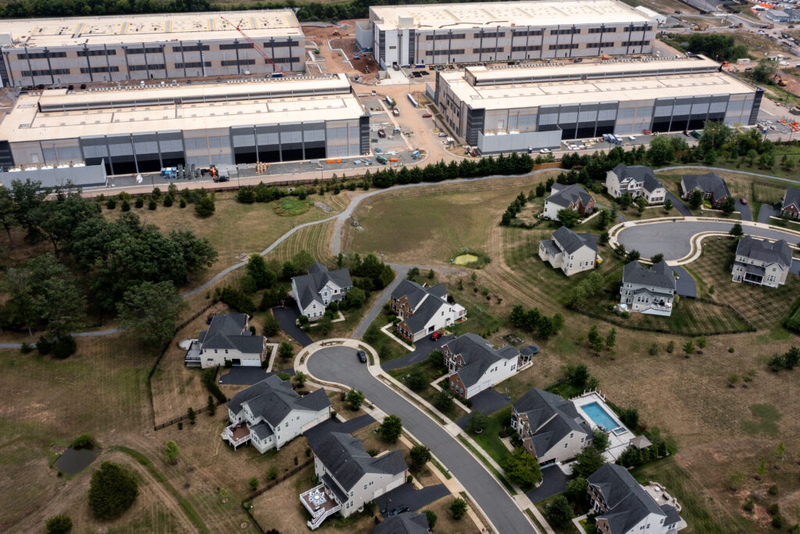
In an aerial view, an Amazon Web Services data center is shown situated near single-family homes on July 17, 2024 in Stone Ridge, Virginia. Northern Virginia is the largest data center market in the world, according to a report this year cited in published accounts, but is facing headwinds from availability of land and electric power. (Photo by Nathan Howard/Getty Images)
West Virginia’s myopic governor and Legislature are foisting data centers on West Virginia. One of the most contentious locations is ecological treasure Canaan Valley around the Monongahela National Forest. But other locations are proliferating, too.
Data centers are like summer ticks — invisible until engorged. This is because the lack of transparency, enshrined in law, robs the public of any way to voice their thoughts.
Organized opposition is mounting locally and nationally. And West Virginia is on the frontlines.
National polling shows less than half of Americans would support a data center being built near them. This ranks far below solar, wind, natural gas, nuclear and geothermal support.
Sen. Bernie Sanders, I-Vt., recently called for a national moratorium on data center construction.
A pause provides the chance to ensure good land use planning and to maximize community benefit. That’s the point, right? To put West Virginia first? That’s what we’ve been told anyway.
But the opposition is bipartisan and growing. States are lining up behind Sanders’ moratorium idea. As of February, at least 54 local communities in the U.S. are considering moratoriums according to the American Enterprise Institute.
Eleven states are considering a pause. Some include Georgia, Virginia, Oklahoma, South Carolina and Maryland. That said, no state has successfully passed a statewide moratorium as of March.
First, a definition: data centers are leviathans. They store information on everything from medical records and online banking, to streaming video services.
Virginia provides a cautionary tale of what West Virginia could look like down the road if we don’t change course. They have the most industrial data storage facilities in the world (soon there will be 400.)
Here’s the thing: that part of Virginia has already given up on that area. They realize when there are data centers in a place, the land is good for nothing else. So they call it Data Center Alley — and that’s all it will ever be.
That’s a good reason some flee and move to West Virginia. It’s horrifying. Northern Virginia has become a tech catastrophe. Our governor and Legislature want us to become another Data Center Capital of the World like Virginia. No. I’ll take a hard pass.
Another fear is safety. Some politicians say data centers will increase national energy security. But it actually brings danger to West Virginia’s doorstep.
The Guardian recently reported that “in the US-Israel war on Iran, data centers are a new frontier in warfare.” Iran bombed at least two data centers in the Persian Gulf to destabilize military communications.
We are putting a bull’s-eye on the safest most bucolic place in America.
We put ourselves in a dangerous situation. Accepting unlimited data centers could strain our own access to resources like water. Goodness knows we don’t need higher utility rates.
Large data centers use upwards of 5 million gallons of water each day according to the Environmental and Energy Study Institute.
That’s equivalent to the needs of 50,000 people according to the Brookings Institute. As you likely know, that’s larger than Charleston and Huntington, our two largest cities.
Big data is changing our relationship to jobs, each other and self. Demis Hassabis is the head of DeepMind, Google’s AI laboratory. In The Guardian he stated that the AI revolution will be 10 times bigger than the industrial revolution and 10 times faster. This is all the more reason to slow down and consider the pros and cons.
Morrisey’s biggest spiel is about job creation. That’s a myth. Data centers actually assist in displacing jobs.
According to Forbes Magazine, by 2040 AI will likely automate or transform 50%-60% of jobs with complete dominance (80% and higher) by 2050. West Virginia could become complicit in this job purging.
Data centers are an economic gambit. West Virginia’s acreage will always be in demand, now and in 20 years. We have the upper hand and it behooves us to wait and deliberate.
The Mountain State is one of the five poorest states in America. Poverty is not an invitation to be stomped on. Period. We must not become serfs to the digital economy.
As Sanders said, “We need to make sure that AI and robotics work for all of us, not just a handful of billionaires.”
West Virginia is at an inflection point. We have a chance to change course and turn this ship around. We must. Our future depends on it.
Charleston, WV