West Virginia, America: Reject deflection
Jul 15, 2026 | 5:55 am ET
Description
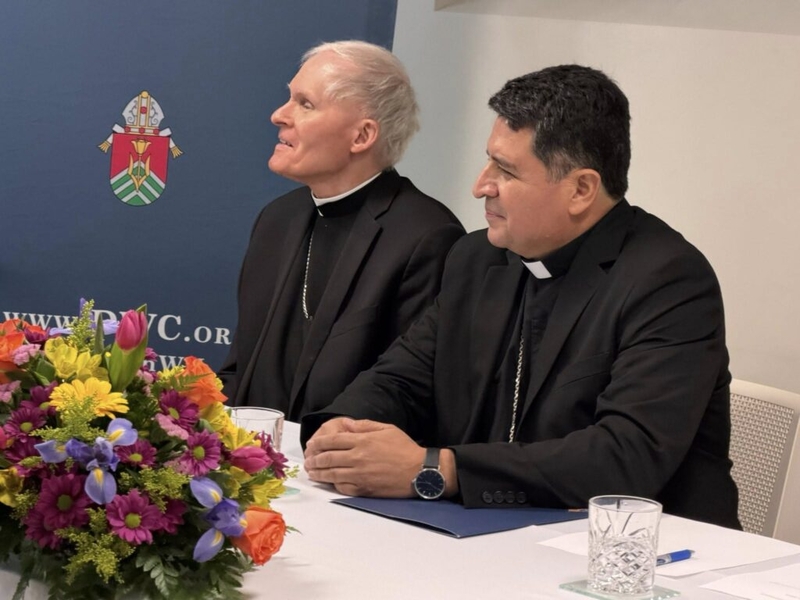
The Rev. Evelio Menjivar-Ayala (right) sits next to the Rev. Mark Brennan during an announcement Friday that Menjivar-Ayala will succeed Brennen as the next bishop of the Diocese of Wheeling-Charleston. (Photo courtesy Diocese of Wheeling-Charleston)
A friend recently asked me if I thought they were narcissistic. I replied that in my research, if you have to ask then you’re not. He breathed a sigh of relief as I added that I thought that each of us has a bit of narcissism — after all, we’re human.
And this is what trickles down from those who sit in powerful positions on a state level and on a national platform. We wrongly believe that their actions, their deep character flaws do not reach to those of us who comprise the average Joes and Janes that are, without question, representative of what makes America truly great.
What I’m finding unsettling on an unfamiliar level is that the core of every vital message that affects West Virginians, Americans throughout this great, vast land is failing to, well, land. Instead, we’re inundated with untruths, deflection, leaving us shaking our heads, furrowing our brows, wondering how very elementary language, sentence structure can be so manipulated to represent the exact opposite of its crystal clear message. If the receiver (who clearly has chosen to not listen but instead to change the trajectory of the conversation to suit themselves, not the majority) intentionally turns away from the core message, we end up accomplishing very little, if anything at all, of substance. And, unfortunately, these instances are not isolated.
Case in point: a recent commentary that I penned addressed the appointment of the new bishop, Evelio Menjivar-Ayala, for the Diocese of Wheeling-Charleston After 30 years of writing opinions, I have never received such a vitriolic reception as I received from that single piece. What was most unsettling was that most of it came with the accusations that I was unsupportive of the new bishop (which I’m not), unsupportive of West Virginia (which I’m not), and that I needed to be more positive in my thinking (I’ll always choose realism).
While I always welcome feedback on my work, it was incredulous that each missed the core of my message, which was my concern that the new bishop, being from “outside” might not have the full comprehension of the challenges faced by so many West Virginians — a core in itself that is vital to not only understanding those challenges but in offering solutions to them. Too, I felt that the appointment had blurred the line between the separation of church and state; that it appeared to me and to others with whom I spoke, a political appointment.
What ensued was the receipt of an email from Max Saltman, a CNN reporter from Atlanta, asking to interview me after having read my opinion. Naturally, I was humbled. We arranged a time, talking at length about this appointment and what it might mean for the faithful in West Virginia. As a Cradle Catholic who attended Catholic schools, taught at Catholic schools, and led Bible study programs in my childhood parish, I was more than qualified to offer an opinion on the appointment.
My spiritual memoir will be released by year-end. Earlier this summer, I issued it as a religious tract, because a number of publishers offered to publish it in book form IF I divulged names of parishes and priests. I declined their offers because the requests were irrelevant. They had nothing to do with the work’s core message. Nothing.
And so, as I sit in my car eating my lunch at the riverbank, sweltering in the heat and humidity on this Fourth of July holiday, the eerie stillness all around me, I look to the pale blue skies and pray for the return of their brightness, of America’s brightness, without deflection, never veering from its certain core.
And if you listen closely, you will hear the collective voices of West Virginians, Americans, saying, “What now?”
Charleston, WV