Court sanctions should give Daines, Sheehy pause about Blanche’s confirmation
Jul 15, 2026 | 6:53 am ET
Description
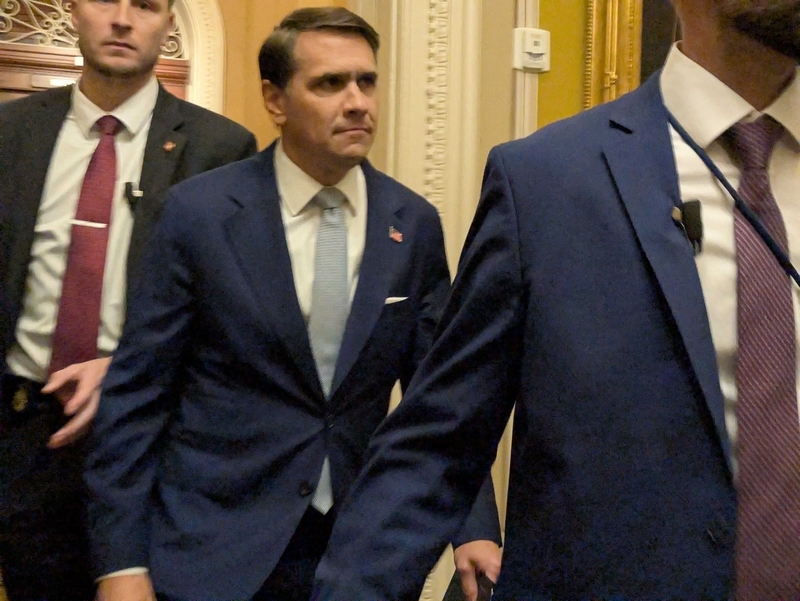
Acting Attorney General Todd Blanche at the U.S. Capitol on May 21, 2026. (Photo by Ashley Murray/States Newsroom)
Judges don’t like to impose sanctions.
Sanctions are rare. Sanctions can alter or end careers.Sometimes they should.
A recent federal court decision should preclude the confirmation of Todd Blanche as United States Attorney General.
The court didn’t directly sanction Blanche, but the stink of this corruption is all over him.
On July 13, a United States District Court judge imposed sanctions upon Donald J. Trump, Donald J. Trump, Jr., Eric Trump, and The Trump Organization, LLC, and two of their attorneys, Alejandro Brito and Daniel Z. Epstein.
Saying that this was rare and unprecedented is an understatement. Law professors will be talking about this for generations. It is historic. Everyone had a bad day in court, and some will end up paying financially.
Why does it matter?
Because Acting Attorney General Todd Blanche played a central role in this fraud. And, he is waiting to be confirmed as Attorney General — with U.S. Sens. Tim Sheehy and Steve Daines from Montana holding key votes.
Consider the facts.
On Sept. 29, 2023, the Department of Justice (under President Joe Biden) charged Charles Edward Littlejohn with violating federal law by disclosing tax information of Donald J. Trump and others. Mr. Littlejohn pled guilty and was sentenced to 60 months in jail.
Trump was represented by attorney Alina Habba at the plea agreement hearing. She told the court that she was at the hearing on behalf of President Trump, “who was a victim.”
Federal law gives people the right to sue when their tax returns are improperly disclosed. They have two years from the date of discovery of the disclosure to file a lawsuit.
On Jan. 29, 2026, Trump filed a civil complaint suing the IRS and the Treasury Department. Trump asked for at least $10 billion. This was two years and three months after Trump’s attorney explained that Trump “was a victim.”
Oops. It looks like someone blew the statute of limitations.
The IRS and the Treasury Department had a great defense. But, no one raised that defense. No attorney ever appeared in the lawsuit for the IRS and the Treasury Department. None.
Instead, after 109 days, the attorneys representing the Trumps filed a voluntary notice of dismissal. There was a settlement.
Under the “settlement,” an “Anti-Weaponization Fund” was to be created to hear and redress claims from those who suffered weaponization and “lawfare.” (Think Jan. 6th defendants). The fund would receive $1.776 billion to pay to claimants.
Then, Acting Attorney General Todd Blanche issued an order (known as the “release order”), that released President Trump, his relatives, companies, and affiliates from “any and all claims, counterclaims [and] causes of action” that “have been or could have been asserted against the Trump Plaintiffs for various matters, including any matters pending or that could be pending (including tax returns filed before the effective date before the defendants or other agencies or departments.”
The release order was signed by Todd Blanche. Only Todd Blanche.
Then, on June 2, Blanche testified before Congress that they were not moving forward with the “Anti-Weaponization Fund.” The release order remained.
Objections were filed to the dismissal of the Trump case. The court took a closer look.
The result? Sanctions.
The court found that this lawsuit was brought in “bad faith” and for an “improper purpose” which was to “gain the imprimatur of judicial legitimacy for a ‘settlement’ that had no viable basis in law or fact.”
The court noted: “This case is part of Mr. Trump’s pattern of misusing the courts to serve political purposes.”
There was never a real dispute. For there to be a case, there must be a “justiciable controversy,” meaning that there has to be a definite and concrete basis for the claims against adverse parties. Parties are not “adverse” when one party controls the other party.
Trump was a plaintiff in the case. But, he controlled the defendants, the IRS, and the Treasury Department. The Constitution vests the executive power in the President. That means the President controls the IRS, the Treasury Department, and the people appointed to run them. The IRS and the Treasury Department are part of the executive branch and ultimately answer to the President. Essentially, the IRS and the Treasury Department are the alter egos of the President.
Trump was suing himself to fleece the public ($1.776 billion) and to obtain a release that would shield him from future civil claims.
It didn’t work.
The court referred the lawyers to their respective bar associations for disciplinary action. The court also issued an order that prohibits Trump, Donald, Jr., Eric, and company from “referring to the purported ‘settlement agreement,’ or using, offering, admitting, or citing any of its provisions in any judicial, administrative, regulatory, arbitration, or any other official proceeding as evidence of a ‘settlement’ reached in this matter.” Trump’s immunity release is gone.
Sanctions are rare. Here they were justified.
So now we ask: Will Daines and Sheehy vote to confirm Todd Blanche as Attorney General? They shouldn’t.
If integrity matters, they won’t.
Helena, MT