WA lawmaker’s attempt to get ethics charges dismissed is rejected
May 23, 2026 | 4:40 pm ET
Description
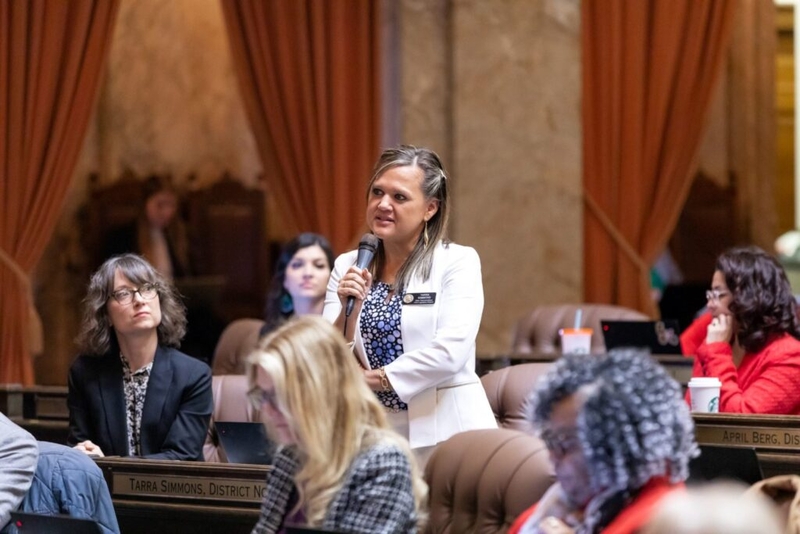
State Rep. Tarra Simmons, D-Bremerton, sought to have an ethics complaint dismissed this week. The Legislative Ethics Board denied her request and will hold a public hearing on the allegations next month. (Photo courtesy of Legislative Support Services)
A state ethics board has declined to dismiss an ethics complaint against Washington state Rep. Tarra Simmons, setting the stage for the wide-ranging allegations to be contested in a public hearing next month.
Simmons, a Democrat, had filed a motion asking the Legislative Ethics Board to dismiss the complaint. She contended at a hearing Wednesday that the conflict of interest charges arising from her interactions with two nonprofits were unsubstantiated.
In a one-line ruling released Saturday, the board denied the motion.
The board will proceed with a formal trial-like hearing on June 8 and 9. If Simmons is found to have breached ethics rules, she could be fined up to $5,000 per violation and ordered to pay the state’s costs.
Such hearings before the ethics board are rare. The last occurred a decade ago, and involved a House member’s posting of state-produced photos and videos on her campaign Facebook page.
Simmons, of Bremerton, won a House seat in 2020 and has been re-elected twice. She represents the 23rd Legislative District in Kitsap County that includes the communities of Hansville, Kingston, Poulsbo, Bremerton and Bainbridge Island.
The complaint that incited the ethics investigation was filed in February 2025.
On Oct. 15, the board concluded reasonable cause existed that Simmons violated the Ethics Act. Simmons and the board discussed a possible settlement throughout the fall, but the lawmaker declined to sign a proposed stipulated agreement. She said she objected because the agreement contained mistruths.
Allegations stem from Simmons’ interactions with two nonprofit organizations, the American Equity and Justice Group and the Equity in Education Coalition.
She is said to have improperly leveraged her position as a lawmaker and a $10,000 donation of surplus campaign funds to help get a friend a job with the American Equity and Justice Group.
According to the investigation, the leader of the justice group said Simmons provided the money to hire her friend. Simmons denied putting any conditions on use of the donation.
Another charge arises from Simmons’ role in securing state grant funding in 2024 to support an expansion of a public dashboard of criminal justice data created by the American Equity and Justice Group.
As part of the grant, a subcontract was issued to the Equity in Education Coalition, where Simmons worked at the time, to compile information on factors affecting education outcomes in disadvantaged communities. Simmons is accused of improperly using her legislative position to influence how the money would be used by her employer.
Doug McKinley, Simmons’ attorney, argued that because the legislator did not benefit directly from any of those actions, there was no violation of conflict of interest and special privilege statutes.
The board, in its past opinions and advice to members, has said, “it is okay to fund your employer. What’s not okay is to do so in a way that benefits you,” McKinley said Wednesday. If the board now finds Simmons guilty of doing that, it’s not fair, he added.
“You’re changing the rules in the middle of the game and you are holding Representative Simmons accountable in a way that no legislator has ever been held accountable for merely providing funding for your employer,” McKinley said.
Assistant Attorney General Julia Eisentrout countered at the hearing that because of her involvement with the coalition, Simmons “had an interest, financial or otherwise, direct or indirect, that was in conflict with the proper discharge of her duties.”
Eisentrout argued the board should reject the motion to dismiss the complaint and proceed with next month’s hearing because “there are disputed issues of material facts.”
Olympia, WA