Virginia’s disability services gap persists despite progress, leaves young adults vulnerable
Jul 30, 2026 | 5:27 am ET
Description
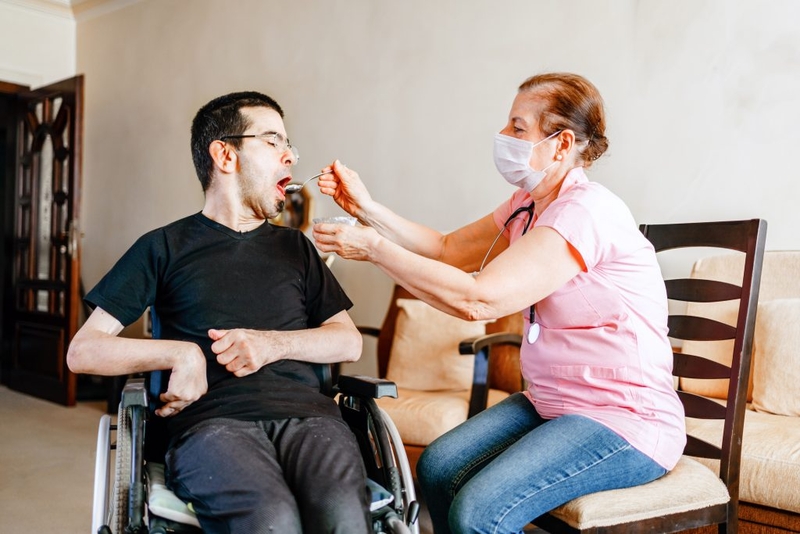
A caregiver feeds a disabled man in a wheelchair. (Photo by Getty Images)
Medicaid waiver slots have increased in Virginia, expanding services for people with intellectual and developmental disabilities who have lost school-based special education services.
Even so, thousands of disabled Virginians are still waiting, because demand continues to outpace available slots.
When people with certain disabilities graduate or reach age 22, they face a “services cliff,” as they lose school support but do not automatically transfer to adult services like in-home supports, personal care, respite for caregivers, or job coaching. Waivers help them live more independently at home and in communities instead of institutions.
On Monday, advocates highlighted the issue at a summit sponsored by Specially Adapted Resource Centers (SPARC) at George Washington University, focused on advancing inclusion for adults with disabilities who have significant support needs.
There, parents said supervised opportunities can disappear and be replaced by low-quality, unsafe adult programs once their children age out.
“My daughter was attacked … her arm was broken,” said Mark Coles, a Fairfax County father to a daughter who needs one-on-one support.
In another case, Coles said his daughter was left at a bus stop by the company assuming she would get home.
“That was the last day of her employment with that organization,” he said.
Eventually, Coles said his family found SPARC, a “safety net” offering social connection, life skills and community outings to disabled people. Still, they are seeking integrated employment support, reflecting how challenging it is for these Virginia families to find services and work opportunities.
For nearly 18 years, Virginia has worked to address the services cliff, after an investigation and settlement with the U.S. Department of Justice. The federal agency and court relaxed oversight as the state made progress.
Judge John Gibney, Jr. and DOJ counsel Kyle Smiddie acknowledged Virginia has made strides to address the services gap but noted substantial work remains, according to a Jan. 15, 2025 hearing transcript.
“What the commonwealth did, and what the consent decree has done, is to reverse a battleship and turn it around so it is going in a different direction,” Gibney said.
He later added that, “(The commonwealth) still has some shortages in terms of hiring or getting people to perform services for families with disabled people.”
The services cliff
Hannah Irsfeld, SPARC board vice president, said when students with disabilities age out of school, they have no guaranteed right to equivalent community or social programs as under IDEA.
Families can wait years, and unless they have private resources, may have to leave work, pay for support for their adult child themselves, or risk their young adult becoming isolated.
She said the biggest problem is that Medicaid was designed to pay for medical care, not for social integration.
“The cliff is falling into an (adult) system that wasn’t designed to meet the social needs of the very population it is attempting to help,” Irsfeld said, “not because anybody’s trying to be mean or trying to screw it up, but because it just wasn’t set up for that; that was an offshoot.”

Background: Virginia’s federal ADA investigation and settlement
In 2008, Virginia was investigated by the DOJ for its compliance with the Americans with Disabilities Act and the Olmsted decision. Both laws protect the rights of people with disabilities to live, work and participate in their communities — and prevent them from being unnecessarily separated or excluded because of their disabilities.
Then in 2011, the DOJ found that the commonwealth kept too many people with intellectual or developmental disabilities in institutions when many could have lived in regular community settings with the right support, as required by disability rights law.
A year later, Virginia settled on an agreement that, in part, required the commonwealth to meet certain obligations, including addressing the services cliff and helping more disabled people transition to adult services in the commonwealth.
Where the state stands now
State data show Virginia closed four of five state-run training centers for adults with disabilities and shifted to community-based services. One center in Chesapeake remains open, downsized and redesigned for those needing intensive support.
In addition, Virginia funded 1,720 new Medicaid waiver slots in fiscal year 2025 and 1,720 in fiscal year 2026, dropping the number of people on the waiting list from about 15,500 to 14,300 as of November 2025, according to data collected by the Virginia Department of Behavioral Health and Developmental Services.
Virginia has met about 86% of its 2012 settlement requirements, as of 2024.
In January 2025, the Justice Department and Virginia agreed to end the consent decree, replacing it with a narrower injunction after substantial progress. Some requirements, like crisis services and dental care, remain unmet.
A June consultant report found Virginia achieved compliance with four more conditions of the agreement and sustained compliance with two others, but 10 terms remain “not achieved” and 10 “deferred.”
The report said the commonwealth deserves “commendation for its considerable efforts,” but added “more work remains until the commonwealth can accomplish its unachieved goals.”
Local leaders — including Fairfax County Supervisor Walter Alcorn, who represents one of the wealthiest counties in Virginia h — said the services cliff impacts the entire state. Alcorn said the issue is pervasive and remains unresolved.
“We all have these needs, and they have not been fully addressed anywhere in the commonwealth — or, as far as I’m aware, anywhere in the country,” Alcorn said. “This is a new frontier for inclusion and for conversations about inclusion. Much of this work hasn’t happened, in large part because of the potential costs involved.”
Richmond, VA