Virginia General Assembly approves Spanberger’s budget amendments, ending monthslong impasse
Jun 29, 2026 | 4:29 pm ET
Description
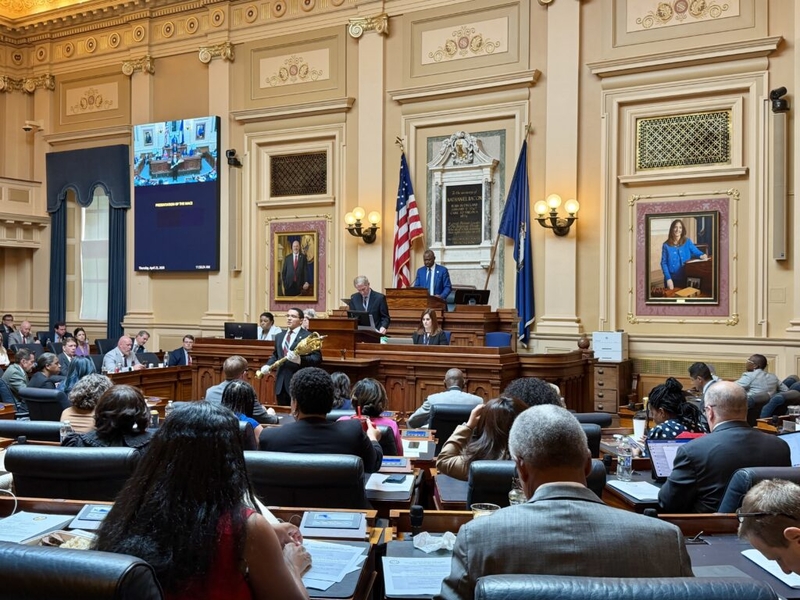
Members of the Virginia House of Delegates returned to Richmond Monday to vote on Gov. Abigail Spanberger’s amendments to the state budget, formally ending a months-long impasse days before the start of the new fiscal year. (Photo by Markus Schmidt/Virginia Mercury)
With less than 48 hours remaining before the start of Virginia’s new fiscal year, the General Assembly on Monday approved a package of amendments proposed by Gov. Abigail Spanberger to the state’s two-year budget, formally ending a budget fight among the Democratic majority that had dragged on for months.
The House of Delegates and state Senate reconvened in Richmond to take on 14 amendments Spanberger submitted Friday evening to the spending plan lawmakers passed one week ago after weeks of negotiations and a special session that stretched far into June.
The changes largely made technical corrections and policy revisions to the now roughly $207 billion biennial budget, including changes involving data centers, utility rebates tied to the Regional Greenhouse Gas initiative, police facial-covering rules and gun legislation.
In a statement released Monday afternoon, Spanberger described the budget as a response to rising costs facing Virginia families and what she called the economic fallout from policies enacted in Washington, including federal healthcare cuts under President Donald Trump.
“This budget reflects our shared commitment to strengthening Virginia schools, expanding economic opportunity, and addressing the affordability crisis,” Spanberger said.
The governor also pointed to the budget’s new electricity-consumption tax on large data centers, calling it a first-of-its-kind statewide policy that ensures the industry contributes more toward the energy demands created by its rapid growth in Virginia.
“Virginia has a responsibility to make sure the data center industry is paying their fair share for the energy they use,” she said.
The governor additionally praised lawmakers for accepting her amendments involving firefighter cancer screenings, utility credits for rural electric cooperative customers and earlier pay increases for home care workers.
She also highlighted funding for a new digital services team aimed at modernizing state government systems and improving public services.
Because lawmakers accepted all of Spanberger’s amendments, the budget bill now becomes law without requiring the governor’s signature.
House Speaker Don Scott, D-Portsmouth, said the final agreement showed Virginia lawmakers could still govern despite sharp political divisions nationally.
“At a time when too many people believe government cannot work, the commonwealth of Virginia has shown what responsible leadership looks like,” Scott said in a statement.
Scott said the finalized budget includes investments in education, housing and healthcare while preserving what Democrats described as Virginia’s economic competitiveness.
He also pointed to 4% teacher pay raises, tax rebates and what he called “the largest investment in public education in Virginia history.”
Senate Majority Leader Scott Surovell, D-Fairfax, also defended the agreement, arguing the drawn out negotiations ultimately produced a stronger budget and secured more revenue from the growing data center industry.
Speaking with reporters after the Senate approved Spanberger’s amendments Monday afternoon, Surovell said lawmakers intentionally set aside hundreds of millions of dollars in reserves as Virginia braces for financial uncertainty amid federal policy changes and broader economic concerns.
He also referred specifically to what Democrats expect could become a major Medicaid funding challenge connected to actions taken by Congress and the Trump administration last year.
“I think we have a lot of economic uncertainty in the state right now,” Surovell said, adding lawmakers wanted to prepare for possible future budget shortfalls “if our economy starts to teeter even more than it already has.”
Despite the months-long impasse and tensions among Virginia Democrats over data center taxes and spending priorities, Surovell said the final outcome justified the difficult negotiations.
“I think it was worth it to go through what we went through,” he said. “And I’m glad we got it done on time, as we always do in our state.”
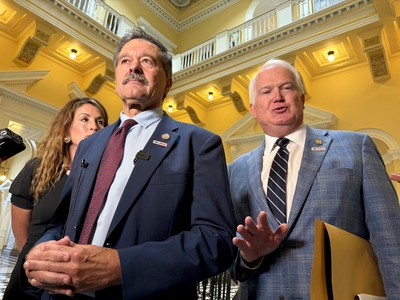
Republicans, while supporting portions of the budget, criticized how long the budget battle stretched into the summer and warned the delays had left local governments scrambling to finalize their own budget before July 1.
House Minority Leader Terry Kilgore, R-Scott, said lawmakers should have finished the spending plan weeks earlier.
“We finally passed the budget and got it moving finally today, 100 days late,” Kilgore told reporters Monday.
Kilgore also criticized provisions tied to Virginia’s renewed participation in the Regional Greenhouse Gas Initiative and cautioned against using the budget process to handle major policy fights such as standing up a legal adult-use cannabis retail market in the commonwealth.
Still, he acknowledged the budget bill included priorities Republicans supported, including teacher pay raises.
“But this is not the way we need to do a budget from now on,” Kilgore said.
Republicans focus on guns and policing amendments
The House moved through many of Spanberger’s amendments quickly Monday afternoon, though Republicans repeatedly voiced their opposition to provisions tied to firearms, policing and public safety.
Del. Tom Garrett, R-Buckingham, argued against new restrictions to firearm possession, including Virginia’s new ban on assault-style weapons, which he said reflected broader constitutional concerns involving self-defense rights, particularly in rural parts of Virginia where police response times are often far longer than in urban areas.
“We see where private citizens are forced to litigate for their God-given freedoms with their government,” Garrett said, adding that lawmakers in Richmond often overlook the realities facing rural sheriff’s departments covering large geographic areas with limited staffing.
Republicans also debated an amendment proposed by Spanberger which clarifies exemptions allowing certain law enforcement officers to continue wearing facial coverings while carrying out undercover, tactical, surveillance and executive-protection assignments.
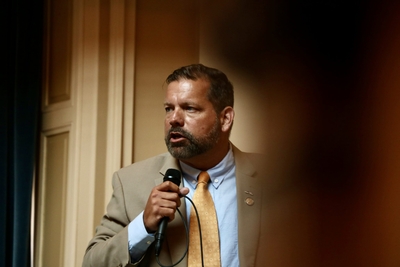
Del. Eric Zehr, R-Campbell, said lawmakers earlier approved facial-covering restrictions without fully accounting for the operational needs of specialized law enforcement units.
“These are not academic questions, these are operational questions,” Zehr said. “And if we get them wrong, people get hurt.”
Zehr said the amendment protects undercover officers, narcotics investigators, SWAT teams and other law enforcement personnel whose identities could otherwise be exposed.
Data centers dominated negotiations
Much of this year’s budget fight centered on how aggressively Virginia should tax and regulate the booming data center industry, one of the fastest growing sectors in the state’s economy.
At dispute was Virginia’s long-standing sales and use tax exemption for data centers, an incentive business groups credit with helping the commonwealth become the largest data center market in the world.
House Democrats and industry advocates warned that ending the tax break prematurely could damage Virginia’s business reputation and drive future projects into competing states.
Spanberger also defended preserving the tax exemption, arguing that local governments across the commonwealth now rely heavily on revenue generated by the industry.
“When you have localities with nearly half their local revenues coming in from data centers, there’s some localities that are saying, wait, why are you going to pull up the ladder behind you?” Spanberger said in a recent interview with The Mercury.
The governor argued lawmakers needed to balance concerns over energy demand and infrastructure strain with the financial realities facing local governments that have built budgets around continued data center expansion.
“You all have benefited for years and years and years from this additional local revenue,” she said in the interview.
Spanberger also suggested that rolling back the incentive could create new fiscal pressures for the state if localities lose a major revenue source for schools, infrastructure and other public services.
But Senate Democrats and environmental groups argued the rapid expansion of data centers has brought mounting costs tied to electricity demand, transmission infrastructure and long-term pressure on the state’s power grid.
Senate Finance Chair Louise Lucas, D-Portsmouth, has emerged as one of leading voices pushing first for an end to data centers’ sales and use tax exemption and then for a broader tax structure aimed at the industry. Lucas and her allies argued data centers should contribute more toward the infrastructure and costs associated with their growth.
The final budget agreement left the existing sales and use tax exemption in place but created a temporary energy-consumption tax aimed at the state’s largest data center facilities. The tax will apply to operations exceeding certain electricity-use thresholds, with revenue directed toward energy-related costs and other state priorities.
Surovell said the money will help fund teacher raises, state employee pay increases and reserve funds for potential economic downturns.
“At the end of the day, data centers are going to contribute about $1.1 to $1.2 billion for the biennium to help fund our government, just like every other taxpayer in our state,” Surovell said.
Scott said Monday that many Virginians increasingly associate data centers with rising utility costs and growing development pressures near neighborhoods and schools.
“I think the public wants them to pay their fair share,” Scott told reporters.
He said lawmakers will likely continue debating how Virginia handles future data center growth, particularly in areas where residents have objected to projects proposed near residential communities.
Final amendments add policy tweaks
The budget package also included funding for transportation, education and healthcare programs, along with money for flood mitigation and local infrastructure projects.
Lawmakers additionally approved a provision tied to Virginia’s reentry into RGGI that is expected to provide Dominion Energy customers with an estimated $3 monthly rebate funded through proceeds from the carbon-reduction program.
The legislature also backed amendments dealing with Atlantic menhaden research, paid sick leave definitions and new water-conservation requirements for data centers operating in groundwater management areas.
In a rare bipartisan moment, the House unanimously advanced a Spanberger amendment that establishes a grant program to help fund cancer screenings for career firefighters.
Del. Israel O’Quinn, R-Washington, said he supported the proposal but urged lawmakers to eventually expand the program, particularly in rural communities.
“The volunteer firefighters are also exposed to the same chemicals, the same toxins,” O’Quinn said. “I would hope that going forward, that we could figure out a way to possibly expand this to volunteer firefighters as well.”
Virginia Mercury reporter Shannon Heckt contributed to this story.


Richmond, VA