Utah lawmakers want a higher bar for ballot initiatives that raise taxes. Will voters sign off?
Sep 28, 2026 | 4:17 pm ET
Description
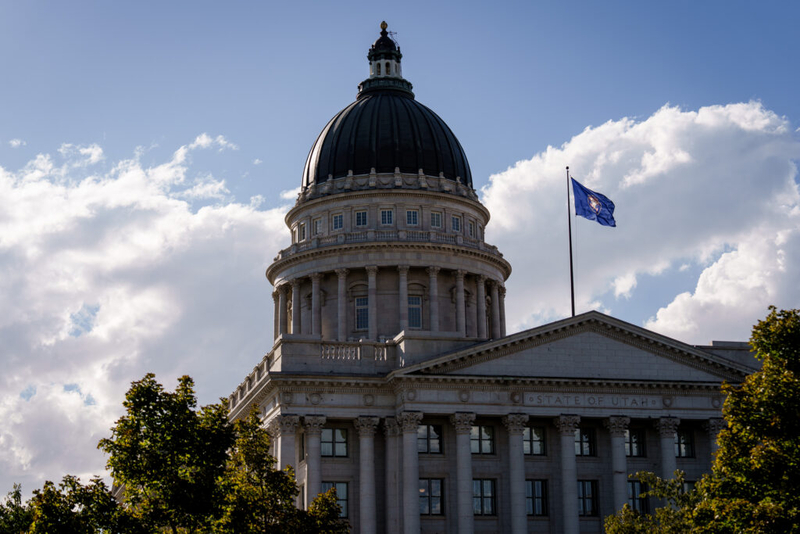
The Capitol in Salt Lake City is pictured on Wednesday, Sept. 16, 2026. (Photo by Spenser Heaps for Utah News Dispatch)
A political issues committee launched a campaign on Monday urging Utah voters to reject a proposed constitutional amendment on their Nov. 3 ballot that would set a higher bar for ballot initiatives that raise taxes.
Utah lawmakers earlier this year approved a resolution to put the proposed amendment to the Utah Constitution before voters, which will appear as Amendment B on Utahns’ ballots when they start hitting mailboxes in about two weeks.
If voters approve Amendment B, it would change the Utah Constitution to require some ballot initiatives to pass not just by a simple majority, but get at least 60% voter support.
Utah lawmaker wants to ask voters to set higher bar for ballot initiatives that raise taxes
That requirement would apply if the new law enacted by ballot initiative would entail the imposition of a new tax, the expansion or increase of an existing tax or, “for a property tax, a change to the tax rate that causes the tax rate to decrease less than it would under current law.”
In 2018, when Utah most recently saw a flurry of ballot initiative efforts, none received more than 60% of the vote. That year, voters approved an initiative for full Medicaid expansion with 53.3% of the vote. An initiative to legalize medical marijuana passed with 52.7%. And a Better Boundaries’ initiative to create an independent redistricting commission passed by a slim 50.3%.
The Medicaid expansion and medical marijuana initiatives both created new tax revenue streams to pay for themselves, so if they were subject to the new 60% threshold in Amendment B, neither would have passed.
Proponents — including the Utah Taxpayers Association — have argued the change would help protect taxpayer money. The question’s sponsor, Sen. Lincoln Fillmore, R-South Jordan, argued during this year’s legislative session that voters should decide whether to set the higher threshold or not.
“The question here is very simple. Do the people of Utah want 50.1% of the people in the state to be able to raise taxes on the other 49.9%? Or, when it comes to this type of a question, should there be a broader consensus?” Fillmore said in January when arguing in favor of putting the question on the ballot. “I don’t know what the people will decide … but I’m certainly not afraid to ask.”
In a prepared statement issued Monday, Fillmore and the question’s House sponsor, Huntsville Republican Rep. Jason Kyle, argued Amendment B “protects the initiative process while recognizing a simple principle: if you want to raise your neighbors’ taxes, you should have broad support from your neighbors.”
“Utah voters will still decide,” Fillmore and Kyle said. “Amendment B leaves the decision with Utah voters while requiring broader agreement before a statewide initiative can raise taxes on Utah families.”
But to critics, including the group Utahns Protecting Our Constitution, the change to the Utah Constitution would be an “unnecessary and permanent rewrite of Utah’s founding document that would weaken one of the most important tools citizens have to hold government accountable,” the political issues committee said in a news release issued Monday.
Elizabeth Rasmussen, executive director of Utahns Protecting Our Constitution, is also executive director of the anti-gerrymandering group Better Boundaries — which successfully pursued a 2018 ballot initiative to ban partisan gerrymandering and create an independent redistricting process.
“The initiative process belongs to the people of Utah, not to the politicians it was designed to check,” Rasmussen said in a prepared statement. “Amendment B changes that balance, making it harder for Utah voters to exercise that power.”
Utahns Protecting Our Constitution argues that the Utah Constitution should only be changed when absolutely necessary.
“Amendment B makes an unnecessary, permanent change to our Constitution, taking power away from citizens and giving politicians more control over the rules,” Rasmussen said.
In coming weeks, the political issues committee will start spreading its “vote no” message through TV ads, mail, canvassing, and digital outreach. It has also launched a website.
The group has a sizable amount of money to spend on its opposition campaign. According to financial campaign finance disclosures, Utahns Protecting Our Constitution has collected about $593,000 in contributions as of this month.
Utah legislative leaders express regret over Amendment D’s ‘misleading’ ballot language
However, the group may face an uphill battle to bring voters to their side. According to a poll released by Noble Predictive Insights last week, about 50% of Utah voters support the proposed constitutional amendment, while 21% oppose it. However, 23% are unsure. The poll was conducted of 602 registered voters from Sept. 8-12. It has a margin of error of plus or minus 3.99 percentage points.
Amendment B is one of two proposed constitutional amendments Utah lawmakers have decided to put on Utahns’ ballot this year.
The other, Amendment A, would change the Utah Constitution to remove its explicit requirement that state officials publish proposed constitutional amendments in “at least one newspaper in every county of the state, where a newspaper is published for two months” immediately before the election. Instead, that Constitution would require they be published “in a manner provided by statute, for 60 calendar days” immediately before the election.
Utah lawmakers proposed the change after two proposed constitutional amendments were voided from the 2024 ballot amid lawsuits, in part because the courts determined state leaders failed to meet the constitutional publication requirements.
Proponents have argued that in the digital age, newspapers are becoming more scarce and not the primary way most Utahns get their information anymore.
Utahns Protecting Our Constitution has not taken a position on Amendment A, Rasmussen said in a text message to Utah News Dispatch on Monday.
Salt Lake City, UT