Can new owners turn around struggling Roger Williams and Fatima hospitals? Neronha is not convinced.
Sep 28, 2026 | 3:32 pm ET
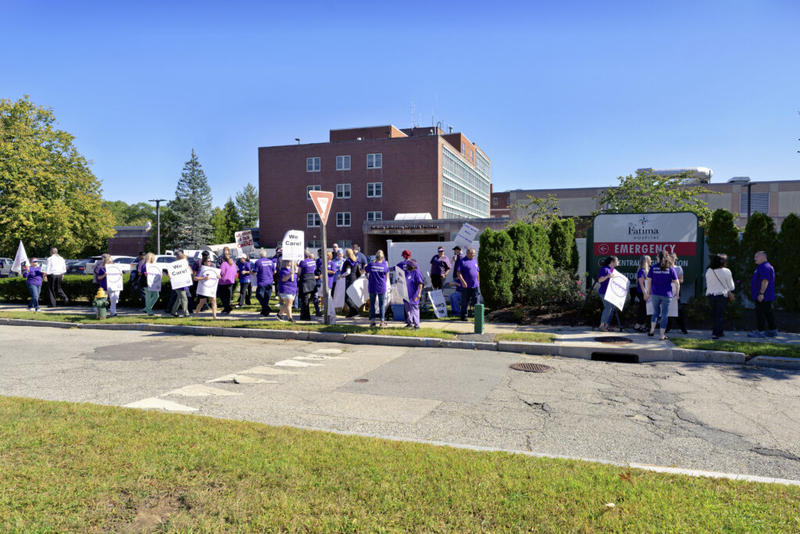
Description
Members of United Nurses & Allied Professionals hold an informational picket outside Our Lady of Fatima Hospital in North Providence on Sept. 15, 2026. (Photo by Michael Salerno/Rhode Island Current)
Attorney General Peter Neronha’s office has rejected a turnaround plan by the new owners of Roger Williams Medical Center and Our Lady of Fatima Hospital, determining it was insufficient to keep them afloat.
“The runway, if they don’t get it turned around quickly, it’s not extensive,” Neronha said in an interview Monday morning. “I think everybody should be concerned.”
In a late Friday afternoon email to attorneys for CharterCARE Health of Rhode Island, the local subsidiary for owner The Centurion Foundation, Neronha said the initial plan submitted “relies on unrealistic and unsupported assumptions.” Neronha gave CharterCARE until Friday, Oct. 2, to turn in a revised plan.
A copy of Neronha’s two-page email was released with several redacted sentences.
Neronha declined to comment on specifics about the initial proposal plan, which hospital owners submitted on Sept. 15, the deadline set by his office soon after the sale closed in March. A long-term strategic plan was one of 85 requirements imposed by state regulators as part of the 2024 conditional approval for the hospital sale.
Neronha hinted that the short-term cash flow is a top concern, even after an $85 million cash injection required by his office when the sale closed in March.
Asked why the upfront cash infusion wouldn’t provide immediate relief to the hospitals’ balance sheets, Neronha replied, “It depends how quickly you’re burning through cash.”
Otis Brown, a spokesperson for CharterCARE, declined to comment on the letter sent by Neronha’s office.
Neronha later confirmed that the hospitals have more than 40 days of cash on hand. But based on the draft strategic plan and monthly financial reports submitted to Neronha’s office since late March — none of which are public — he fears the hospitals could be in danger of closing by the end of the year. Neronha, who is term-limited, will leave office in January.
Hospital owners and labor unions have been locked in negotiations over new contracts for five months, with no resolution in sight.
“What I am most concerned about is not just implementing measures they need to implement, it’s that they’re not operating at all,” Neronha said. “The contract negotiations will be irrelevant if there are no hospitals for workers to go to and no hospitals for patients to go to.”
What I am most concerned about is not just implementing measures they need to implement, it’s that they’re not operating at all. The contract negotiations will be irrelevant if there are no hospitals for workers to go to and no hospitals for patients to go to.
The sale of the struggling hospitals to The Centurion Foundation was touted as a new beginning, returning them to nonprofit status and local control after more than a decade of mismanagement by former, private equity-backed owner Prospect Medical Holdings. It was also the only solution — no other qualified buyer emerged during the years-long process to sell the hospitals, a process which grew more dire after Prospect filed for Chapter 11 bankruptcy in January 2025 and threatened to close the hospitals.
Neronha, whose office along with the Rhode Island Department of Health, reviewed and imposed conditions on the sale, repeatedly described Centurion as the only option, rather than the best. Unionized workers with the United Nurses and Allied Professionals also expressed initial concern with Centurion, because it had never run a hospital before and relied on private bonds to finance the deal. But workers later rallied behind the new ownership, urging lawmakers to set aside an $18 million taxpayer-funded reserve to help Centurion close the deal.
Unrealistic expectations?
The same underlying conditions that diminished the safety net hospitals’ balance sheets — large shares of Medicaid and Medicare patients, staffing shortages, deteriorating facilities and uncompetitive state reimbursement rates — didn’t change under new owners.
“They don’t have a magic wand to waive to create a turnaround plan that’s going to undo years of financial challenges,” said Robert Hackey, a health sciences professor at Providence College. “I understand the attorney general’s frustration. But I don’t know to what extent any of this is within their control.”
Hospitals nationwide, including in Rhode Island, are projecting major losses as federal budget cuts under the One Big Beautiful Bill Act, also known as H.R. 1, take hold. New Medicaid eligibility requirements are expected to push more than 30,000 Rhode Islanders off subsidized health insurance, leading to a rise in uncompensated care. Meanwhile, new limits on federal subsidies for healthcare providers that treat Medicaid patients are simultaneously cutting off millions in hospital funding that state governments cannot replenish.
“H.R. 1 is kind of an earthquake here,” Hackey said.
Neither the federal spending cuts, nor the presidential election had taken place when state regulators set their list of conditions for Centurion in June 2024.
Given the shifting sand, Hackey said a six-month deadline for a turnaround plan, coupled with other conditions that ban staffing reductions and other cost-saving measures, was “unreasonable.”
“It’s like buying a car with a lot of miles on it,” he said. “You need it to get around, but now, you’re going to need to pay for some serious maintenance.”
The conditions set by regulators might be too tough, Hackey said. But they are important to prevent closure, a fate with consequences for the entire state. The two hospitals account for 500 beds, 2,400 workers and 50,000 annual emergency room visits between them.
Equally undesirable would be court-appointed receivership, which puts the burden on the state to operate and fund the hospitals.
“They’re like this toxic asset,” Hackey said. “No one wants them. Yet we can’t afford to lose them.”

Contract breakdown
The united front between workers and executives began to fray the month after the sale closed, when contract negotiations began for the 1,200 union hospital workers. Six months later, bargaining continues, and is “not going well,” said Chris Callaci, general counsel for the union.
Union workers allege that CharterCARE closed its home healthcare service line — violating conditions set by state regulators to keep all essential services intact after the sale. Brown said previously that the home health operation was already shut down before the sale.
Neronha’s office concurred with CharterCARE’s account of the home health dispute. But if the hospital owners fail to submit a revised turnaround plan to his office by Oct. 2, then it will have violated a different condition set by his office.
Which means, potentially, petitioning a judge to order the owners to comply with the mandated plan.
“I don’t want to bring them to court,” Neronha said. “What we have in front of us isn’t sufficient.”
Neronha hoped his letter could spur action without legal intervention, noting a “lack of urgency” with the overhaul more broadly.
“Our analysis tells us that what they’re projecting is unrealistic,” Neronha said. “We’re concerned not just about the long-term, but the immediate term.”
The plan relies on input from the mandatory financial consultant SOLIC Capital Advisors, which CharterCARE brought on in March with Neronha’s approval.
Callaci had not seen the strategic plan or financial reports. But he said the shortcomings represent a broader problem with the new ownership.
“We’re six months into closing, and whether it’s timely production of a strategic plan that is legitimate or managing labor relations, there are problems in paradise with these guys,” Callaci said.
Neronha confirmed that the financial projections have not yet affected patient care or daily operations at either hospital.
But, “if you can’t meet your financials, you can’t deliver care,” he said.
The state health department did not include a strategic plan and turnaround consultant in its own, separate set of conditions. Instead, it required a chief restructuring officer, reporting to the hospital’s board of directors, to “identify restructuring and/or strategic opportunities.” Information on whether the restructuring officer had been hired and met with state health department requirements thus far was not immediately available.

Providence, RI