US Supreme Court rules Trump administration can end legal protections for 350,000 Haitians
Jun 25, 2026 | 11:05 am ET
Updated:
Jun 25, 2026 | 2:47 pm ET
Description
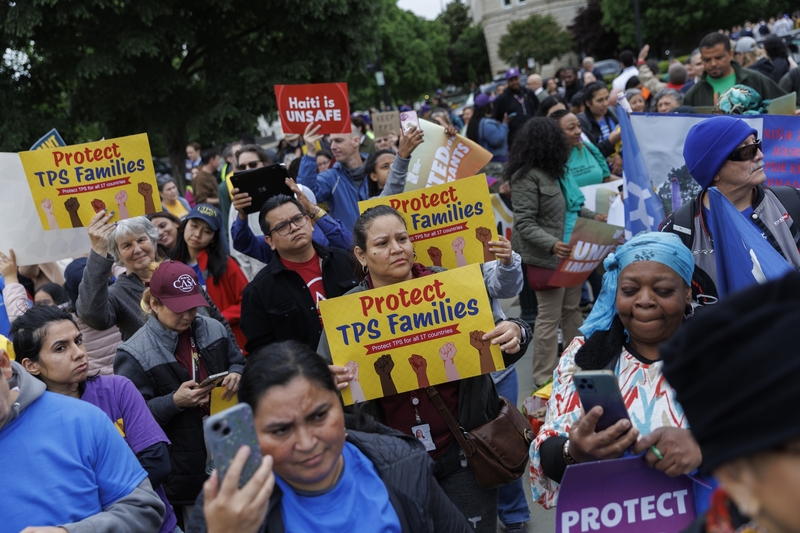
Demonstrators chant and hold signs outside U.S. Supreme Court on April 29, 2026 in Washington, DC. The court heard arguments challenging the government's termination of Temporary Protected Status for immigrants. (Photo by Tom Brenner/Getty Images)
WASHINGTON — The U.S. Supreme Court Thursday allowed the Trump administration to move forward with its plans to strip temporary legal status from 350,000 Haitians and 6,000 Syrians, a move that opens them up to deportation.
The 6-3 conservative court ruled that the Haitian and Syrian immigrants are not "entitled" to orders postponing an end to their temporary protections while litigation is pending, arguing those are non-constitutional claims. It means their work permits and deportation protections are stripped, but the ruling won’t go in effect for 32 days.
It was one of two favorable decisions Thursday for the Trump administration’s policy goals to curtail legal immigration and humanitarian protections for its mass deportation campaign. The high court also ruled that immigration officials could turn away asylum seekers on Mexico’s side of the U.S. border.
The two rulings greatly expand the president’s executive power to curtail migration at the
Southern border and strip deportation protections for hundreds of thousands of immigrants in the interior of the country.
The final immigration-related case before the Supreme Court – the highly anticipated decision on the president's efforts to redefine birthright citizenship – is expected by late June or early July.
Conservative Justice Samuel Alito, who wrote for the majority, said that the Haitians' arguments — that their equal protection claim that their Temporary Protected Status was terminated on a racial bias — are unlikely to prevail in court.
“None of the cited statements by either the President or the Secretary was overtly racial, and in substance all expressed policy views that could rest on race-neutral justifications,” Alito wrote.
The liberal justices, Sonia Sotomayor, Elena Kagan and Ketanji Brown Jackson, joined in a dissent that argued the president made clear racial comments about Haitians for the purpose of terminating protections.
“Haitians are Black. The references—of filth, disease, and primitiveness—are shot through with racial stereotypes and tropes,” they wrote. “It is hard to imagine the statements being made today of any White community.”
Protections ended for Venezuelans earlier
This is not the first time the high court has allowed the Trump administration to strip TPS protections for immigrants.
Last year, the conservative justices allowed for the government to end deportation protections for more than half a million Venezuelans. Coupled with Thursday’s decision on Haitians and Syrians, it brings the total loss of legal protections to nearly 1 million immigrants amid the president's mass deportation efforts.
James Percival, the Department of Homeland Security’s general counsel, praised the decision.
“The T in TPS stands for TEMPORARY, yet many of these designations became de facto amnesty,” he said in a statement. “This is a win for the rule of law and common sense."
The architect of the White House’s immigration crackdown, Stephen Miller, said the Trump administration would move to deport any immigrants who lose their TPS status.
“Of course,” he said late Thursday, outside the White House. “If you no longer have status in this country you’re supposed to be deported.”
The decision is likely to impact multiple lawsuits across the country in which federal judges have halted President Donald Trump’s efforts to strip legal protections granted to more than 1.3 million immigrants with TPS because they hail from countries the U.S. initially deemed too dangerous for return.
It also opens hundreds of thousands of immigrants with TPS up to deportation, part of the president’s broader efforts to curtail immigration and strip legal status from immigrants.
‘The saddest day in my life’
TPS holders and lawyers who argued before the high court said the decision will have devastating consequences not only for TPS holders but their families.
“We don’t know what’s going to happen,” said Jose Palma, a TPS recipient from El Salvador whose protections are set to expire in September, at a press conference.
Viles Dorsainvil, a Haitian TPS holder and one of the plaintiffs in the case, said the decision was “shocking news.”
“It’s the saddest day in my life,” Dorsainvil, of Springfield, Ohio, said during the press conference.
While on the campaign trail in 2024, Trump, along with his running mate Vice President JD Vance, falsely accused Haitian immigrants of eating people’s pets, and vowed to end TPS for Haiti. The three liberal justices point to those comments as evidence that the president has racial animosity toward Haitians.
Ahilan Arulanantham, who represented the Syrians, said during the press conference that the justices in their majority opinion did not wade into the legal argument over whether the Homeland Security secretary, at the time Kristi Noem, took the proper administrative procedures to consult with the State Department on country conditions before making a decision to end or extend TPS protections.
Congress created TPS in 1990, and since then a country receives a TPS designation after the Homeland Security secretary consults with the State Department to determine if the country meets certain conditions to qualify for the status.
A TPS designation is made if it’s too dangerous to return to the country based on violence, natural disasters or other extraordinary conditions. Protections can last from six to 18 months unless renewed.
“The court doesn’t say that what the Trump administration has done in TPS decision-making is lawful. It doesn’t say that these decisions comply with the TPS statute,” Arulanantham said of ending TPS for Haiti and Syria. “Instead, what it says is that the statute doesn't give the courts any power to correct illegal decisions made under the TPS statute.”
That includes determining whether the Department of Homeland Security actually consulted with the State Department in reviewing country conditions. The State Department advises against any travel to Haiti and Syria.
“Instead they say the courts have no role to play in reviewing whether or not the decisions are lawful,” Arulanantham said.
He said the decision “hands to the administration and to the far right wing of the anti-immigrant movement an important victory that they have struggled with for a number of years.”
Democrats decry Trump, high court
Congressional Democrats condemned the decision.
Senate Minority Leader Chuck Schumer called the ruling “cruel and inhumane.”
“TPS exists for exactly this reason: to protect people when returning home is unsafe,” the New York Democrat said in a statement. “Haiti and Syria remain unsafe today. Instead of showing basic humanity, Donald Trump and this Court have chosen fear, chaos, and cruelty.”
Congress has tried to extend legal protections for Haitians. In April, the House in a rare bipartisan move passed a bill to extend TPS for Haiti for three years, but it’s unlikely to overcome the 60-vote threshold in the GOP-controlled Senate.
During a press conference following the decision, Massachusetts Democratic Rep. Ayanna Pressley, who pushed for that bill’s passage in the House, said “this fight is not over.”
“Ending TPS for Haitians, ending TPS for Syrians, in this ruling endangers all TPS holders,” she said. “Todays ruling is lawless, unjust and should not stand.”
She said the Senate should take up her bill that passed the House "immediately, and save lives.”
Debate over race as a factor
Alito noted that while the plaintiffs can still move forward on the arguments of equal protections, charging that the decisions to end TPS were based on racial animus, those arguments were unlikely to succeed.
He argued that there is evidence that Noem’s decision to end the designation was not based on race and instead “simply opposes the TPS program.”
“For example, one may oppose TPS and favor tighter restrictions on immigration for economic or other reasons that have nothing to do with race,” Alito said. “And a person without racial bias can provide a harshly unfavorable description of living conditions in some of the countries with TPS designations. The criteria for TPS designations guarantee that many, if not most, designated countries have such characteristics.”
He argued that “Haiti is no exception,” and that many Americans would describe its condition as “intolerable.”
Trump has frequently described Haiti as a “sh*thole country.”
Kagan noted that language in her dissent and criticized the majority for not considering those comments as “overtly racial,” but also refusing to acknowledge some of them. So she made a list.
She referenced Trump's comments on how Haitians were “poisoning the blood” of the U.S.; how they “probably have AIDS;” and how Haitian immigration is “like a death wish for our country.”
“The statements fairly shout, in their racial undertones and overtones alike, that race entered into the President’s resolve to remove Haitians from this country,” she wrote. “And here, the President’s own statements show that race did enter in — that, within what was surely a multi-cause decision, it was a motivating factor.”
All States Newsroom content is free to republish. Read our republishing policy for more information.