Supreme Court sides with Trump administration’s efforts to curb asylum claims at southern border
Description
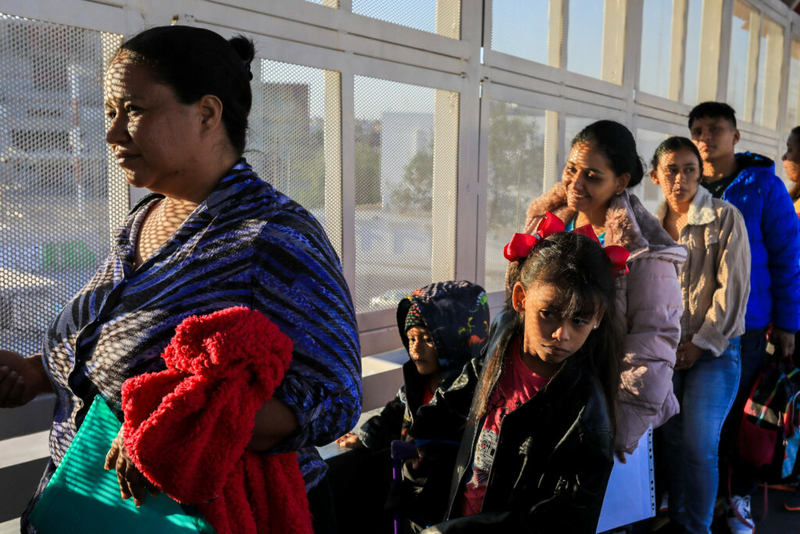
A family waits in line to apply for asylum at the southern border between El Paso, Texas, and Ciudad Juárez, Mexico, in 2023. (Photo by Corrie Boudreaux for Source NM)
WASHINGTON — The U.S. Supreme Court sided Thursday with the Trump administration’s request to turn away asylum seekers who present themselves at ports of entry at the U.S.-Mexico border.
The question the justices considered was whether migrants have to fully cross into the United States in order to have the right to apply for asylum and be processed, or if they can apply for asylum when they appear at a port of entry while on Mexico’s side of the border.
In a 6-3 decision, the conservative justices agreed with the Trump administration that a noncitizen who is standing in Mexico doesn’t arrive in the U.S. “by attempting, and failing, to set foot in this country.”
The justices held that a noncitizen only arrives in the U.S. “when he crosses the border,” and that the Immigration Nationality Act does not entitle that noncitizen who is standing on Mexico’s side of the border who wants to apply for asylum to be inspected by an immigration officer.
James Percival, the Department of Homeland Security’s general counsel, said in a statement that the Supreme Court’s “decision opens up an important tool to continue securing our southern border.”
Justice Samuel Alito, who wrote for the majority, said the case before the justices presented a “straightforward question.”
“The phrase ‘arrives in the United States’ … carries its ordinary meaning: A person arrives in a geographic location only when he enters it,” he wrote. “A person arrives in a destination when he enters within its area—not before—and that conclusion does not change because someone or something blocks entry. Everyday examples of how people ordinarily use the phrase ‘arrives in’ confirm this understanding.”
The policy requiring a full crossing, known as metering, is defunct, but Vivek Suri, assistant to the U.S. solicitor general, argued before the high court that it was a policy the federal government should be allowed to have in its toolbox for future uses at the Southern border.
Liberal Justice Sonia Sotomayor wrote a scathing 35-page dissent saying the ruling will allow the Trump administration to turn away asylum seekers, a policy she said violates Congress’ refugee law.
“Because the Court today blesses the Executive Branch’s decision to slam the door shut on all who are fleeing persecution, despite the detailed inspection and asylum system that Congress enacted and commands, I respectfully dissent,” she wrote.
During oral arguments in March, the justices seemed ideologically split, with the six conservative justices agreeing with the Trump administration. The three liberals of the Supreme Court — Sotomayor and Justices Elena Kagan and Ketanji Brown Jackson — questioned whether the policy violated federal law protecting refugees.
‘More people will die’
Sotomayor argued that Congress specifically passed the Refugee Act of 1980 to not repeat the “mistakes of the past,” where the M.S. St. Louis, a ship carrying more than 900 Jewish refugees during World War II, was prevented entry to the U.S. and turned back to Europe.
While some passengers were able to find refuge in other countries, 254 died in the Holocaust.
Sotomayor said based on the majority’s ruling, if those passengers on the St. Louis “were to walk up to a port of entry on our southern border today, the majority’s interpretation would allow immigration officers to refuse even to consider their asylum applications by physically blocking them from stepping foot onto U.S. soil.”
“The majority’s interpretation permits the Government to do that even if the refugees complied with all applicable laws and regulations, even if the port had ample capacity to inspect them, and even if turning them back would result in the very persecution from which they narrowly escaped,” she wrote.
Sotomayor said the consequences of the ruling will be predictable.
“More people will die. More people will attempt to cross the border illegally, and some will make it while others will not,” she said. “More people will be forced to walk along the U. S.-Mexico border in dangerous conditions, trying to find a port that will inspect them. More people will turn back and be subjected to violence because of something they cannot or should not have to change about themselves, such as their race, religion, nationality, or political opinion.”
Jackson wrote a separate dissent, arguing that the case should have never been brought to the justices because the Trump administration is not even using the policy.
“The absence of a current metering policy has plainly infected the Court’s ultimate analysis, too,” she wrote. “No one knows how, if at all, the reasoning drawn from these metaphors will map on to the realities of a future metering policy. All we can do now is guess.
“But the Court is not a law student puzzling through a difficult cold call,” she continued. “When we issue opinions, we create legal rules with real-world impact. It is for this very reason that our precedents require ‘a concrete factual context conducive to a realistic appreciation of the consequences of judicial action.’ Because we so obviously lack that context here, we should not have decided this case.”
A blow to asylum seekers
Nicole Ramos, the co-founder of the immigrant legal aid and humanitarian group Al Otro Lado that challenged the Trump administration, said during a press conference that she was not surprised by the decision, “but quite devastated.”
“This is not the first time the Supreme Court has gotten something wrong,” she said. “I do believe the pendulum will swing back in the direction of justice.”
Melissa Crow, an attorney who first brought the challenge in 2017, said the decision “deals a devastating blow to the rights of people seeking asylum.”
Crow, who now leads the Center for Gender & Refugee Studies, said that many migrants who were turned back “died in the process,” such as from heat stroke or drowning in the Rio Grande.
“They don’t have a Plan B, so when we turn them away, we put them in even greater danger,” she said.
Illinois Democratic Rep. Delia Ramirez said during the press conference that Congress needs to pass legislation to reaffirm U.S. asylum and refugee law.
“I know today is a dark day,” she said. “But it is also a moment for Congress to exert its authority. We cannot go into despair.”
All States Newsroom content is free to republish. Read our republishing policy for more information.