US House passes bipartisan bill to make daylight saving time permanent
Jul 14, 2026 | 6:35 pm ET
Description
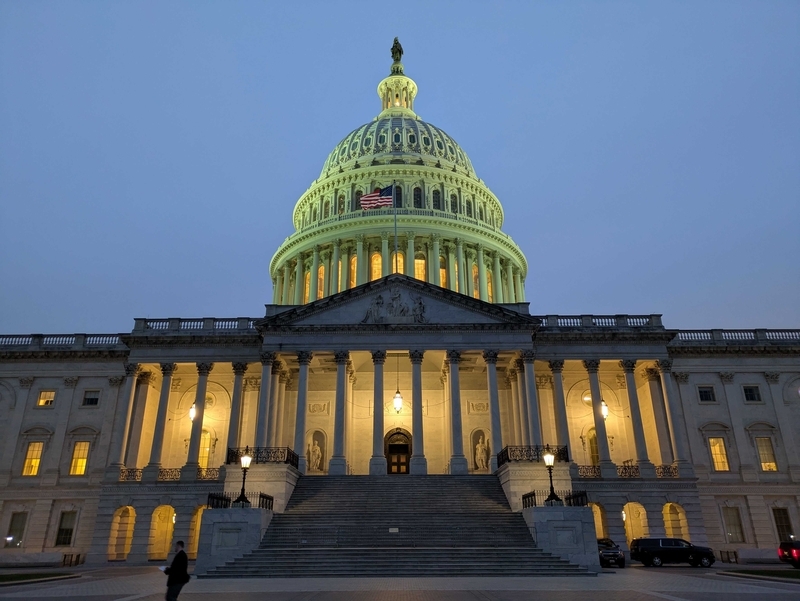
The U.S. Capitol on the evening of Sept. 30, 2025. (Photo by Ashley Murray/States Newsroom)
WASHINGTON — The U.S. House voted Tuesday to make daylight saving time permanent nationwide in a bipartisan move that pushes the country one step closer to ending the long-contested ritual of semiannual clock changes.
The House passed the measure, called the Sunshine Protection Act, 308-117. Its future in the Senate is uncertain.
Introduced by Republican Rep. Vern Buchanan of Florida, the Sunshine Protection Act passed the House Energy and Commerce Committee 48-1 in May and carries strong support from President Donald Trump.
“This bipartisan legislation represents a popular, common-sense reform and would benefit Americans by protecting precious daylight during the evening, when people are most likely to be awake and active,” the White House said in a statement Tuesday. “If (the bill) were presented to the President in its current form, his advisors would recommend that he sign it into law.”
Year-round daylight saving time
Permanent daylight saving time would mean keeping the clocks shifted forward one hour all year, eliminating the need to “spring forward” every March and “fall back” each November. The adjustment would extend more daylight into the evening, creating later sunrises and sunsets compared to standard time.
“Establishing permanent daylight saving time would provide families with more usable daylight hours in the evening, giving people additional opportunities to spend time outdoors,” Republican Rep. Gus M. Bilirakis of Florida said during House debates Tuesday.
Many other representatives from Florida voiced their support for the bill Tuesday, saying later daylight hours would help boost the Sunshine State’s economy.
Rep. Frank Pallone Jr., a New Jersey Democrat, agreed.
In his remarks supporting the permanent daylight saving time, he also pointed to the harmful effects that switching the clocks twice a year can have on people’s health, as well as young children and pets’ quality of sleep.
Under the bill, states that do not observe daylight saving time before enactment would have the choice to remain on permanent standard time.
The provision would only affect two states, Hawaii and Arizona outside Navajo Nation, that already do not observe daylight saving time. Those states instead go by standard time, the hours the rest of the country follows from November to March, year-round. Other states wishing to opt out would have to enact a law one day before the federal bill becomes law.
Is standard time better?
Many health experts say standard time is better for humans because it increases the amount of daylight received in the morning, which is beneficial for body rhythms and helps improve sleep, The Hill reports.
Democratic Rep. Madeleine Dean of Pennsylvania, the only representative to speak in opposition to the bill during Tuesday’s floor debate, cited the benefits tied to standard time as one of her main reasons for going against the bill.
Though she too expressed frustration with the practice of changing clocks, she said dozens of medical associations show “if we stop the clock, permanent standard time is a healthier choice.”
Dean also pointed to events that occurred the last time the U.S. briefly attempted to follow permanent daylight saving time in 1974. Some children lost their lives while walking to school in the dark, she said.
“We aren’t voting on bills right now that would reduce the sky-high costs of food, fuel, healthcare or addressing the president’s war in Iran,” Dean said. “Instead we’re considering a bill that was deadly and dangerous in the past.”
Daylight saving time’s past and future
Daylight saving time was first introduced in the early 20th century as an energy-conserving wartime measure, according to the academic journal Science. The U.S. has observed short periods of permanent daylight saving over the years, but the federal government has each time reverted to the practice of changing clocks.
Lawmakers have also made attempts in recent years to enact permanent daylight saving time. In 2022, the U.S. Senate unanimously approved an earlier version of the bill, sponsored by Sens. Patty Murray, a Washington Democrat, and Rick Scott, a Florida Republican, only for the measure to stall in the House.
In a statement Tuesday, Murray called on Senate Majority Leader John Thune to bring the House-passed bill for a vote in the Senate.
“My state, where it is often dark earlier than 4pm in the winter, has made it abundantly clear we want permanent Daylight Saving Time,” Murray wrote. “Americans from Seattle to Miami believe it’s way past time to lock the clock—I am calling on Leader Thune to bring this bill to a vote as soon as possible.”
If the Senate considers the bill this year, some opposition is likely to come up, including from Sen. Tom Cotton, an Arkansas Republican.
All States Newsroom content is free to republish. Read our republishing policy for more information.