University of North Dakota seeks to scale up critical mineral refining
May 27, 2026 | 6:00 am ET
Description
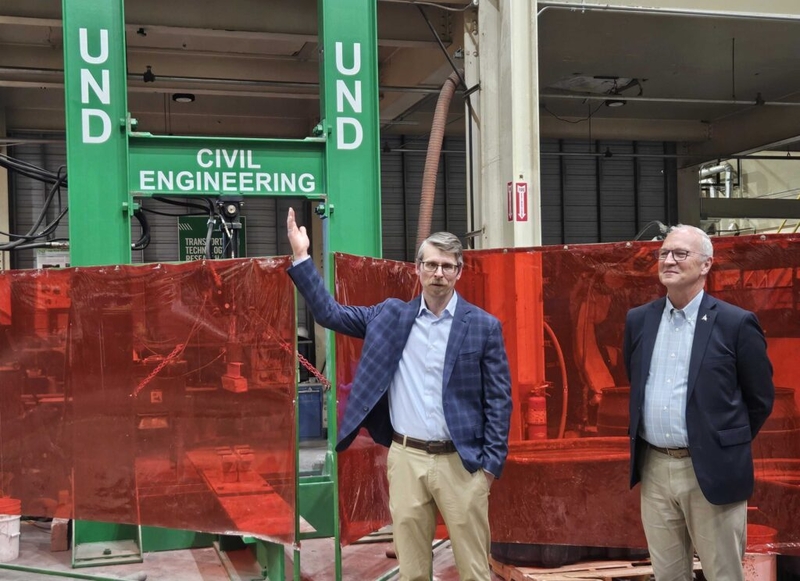
Dan Laudal, left, of the University of North Dakota College of Engineering and Mines, gives a tour of a pilot rare earth research facility in Grand Forks, North Dakota, on May 26, 2026. At right is Sen. Kevin Cramer, R-N.D. (Photo by Jeff Beach/North Dakota Monitor)
GRAND FORKS, N.D. — The University of North Dakota is looking to expand its ability to pull minerals needed for electronics by building a refining facility at a coal mine.
University officials are seeking a $50 million grant from the U.S. Department of Energy to build a facility at the Falkirk coal mine near Underwood, north of Bismarck.
The project has a total estimated cost of about $100 million, Dan Laudal, executive director and research professor with the UND College of Engineering and Mines said Tuesday during a tour of its pilot extraction facility in Grand Forks.
The tour provided UND the opportunity to show off its work to Under Secretary of Defense for Acquisition and Sustainment Michael Duffey and Sen. Kevin Cramer, R-N.D.
Cramer, a member of the Senate Armed Services Committee, said the United States needs to develop domestic sources of the critical minerals needed for electronics and the development of artificial intelligence to compete with China.
Duffey said maintaining a technological advantage is key to national security and the department has a need for high-value critical minerals.
“I’ve got a team of folks that know this industry like the back of their hand, know what’s emerging in terms of capability,” Duffey said. “I’m going to make sure that I go back and tell them what I saw here, and that we’ve got awareness of North Dakota, what North Dakota can offer for the department and the nation.”
UND is operating its rare earth pilot plant in what was a coal-fired power plant that served the city of Grand Forks.
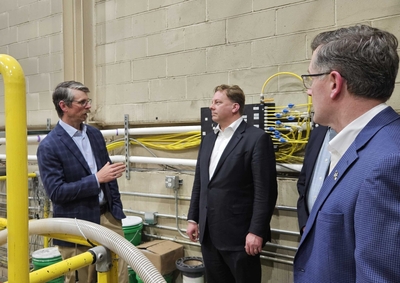
Laudal said it brings in about 10 tons of lignite coal per day from western North Dakota. Critical and rare earth minerals are often found bound to coal.
“Ten tons a day of coal on the back end, we maybe get a few kilograms per week of concentrated product,” Laudal said.
That product is a mix of 17 different critical minerals that could be sold to be further separated into individual minerals and then used in electronics.
Laudal said the pilot plant is about 2% the size of a full-scale commercial operation. The proposed commercial demonstration site at the Falkirk mine would be about 10% the size of a full-scale facility.
The Department of Energy grant would help secure other investment, which likely would include state support.
David Straley of North American Coal was on the tour and said the state’s coal industry is on board.
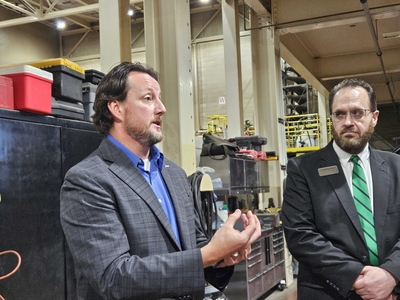
“Lignite is one of the best possible resources for this type of project,” he said.
Using North Dakota’s existing coal mines cuts the cost of developing critical minerals.
He said the coal that remains after removing critical minerals makes an even better fuel.
If UND obtains the grant, Laudal said it may take 18 to 24 months for design and construction and it could be operating and making money by 2029.
Laudal estimated it would take 20 to 30 workers to operate the facility.
In addition to being successful commercially, he said a goal would be to create a model that could be replicated elsewhere.
Cramer and Duffey will visit Minot on Wednesday. Grand Forks and Minot are both home to Air Force bases.
But Cramer said the critical minerals plant tour was the most important stop of the trip.
“The adversary has a supply chain,” Cramer said of China’s critical mineral development. “At this point, we are in a hurry as a nation, rightfully so, to bring more, more rare earth elements, and everything that’s connected to that, domestically.”
Reach North Dakota Monitor deputy editor Jeff Beach at [email protected].
Bismarck, ND