Trump’s war on immigrants
Jun 08, 2026 | 6:48 pm ET
Description
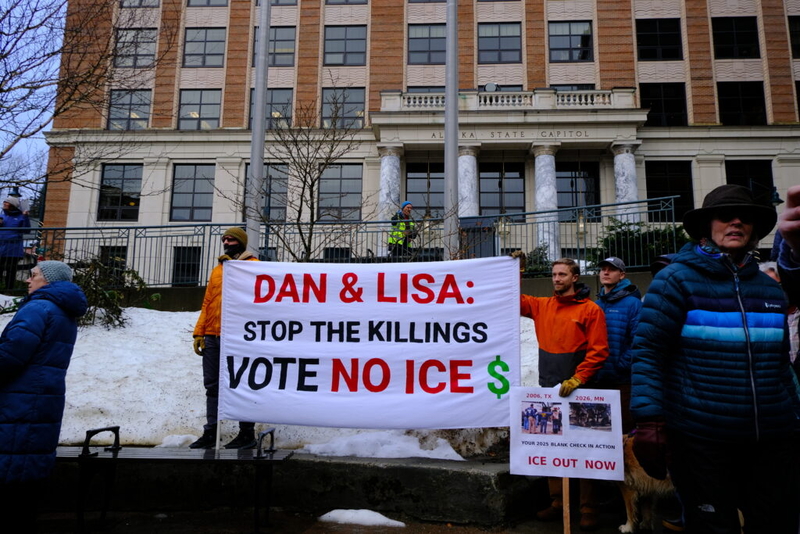
Protesters rally at the Alaska State Capitol in Juneau on Jan. 29, 2026 to condemn U.S. Immigration and Customs Enforcement, the killings of Minneapolis residents Alex Pretti and Renee Good, and other deaths in ICE custody, and call on the Alaska congressional delegation to vote against further federal funding for the agency. (Photo by Corinne Smith/Alaska Beacon)
Our country has gone through several convulsions against immigrants, none having left a legacy of honor and some having made their imprint on Alaska’s own history: enforcement of the Chinese Exclusion Act and the internment of Japanese and Japanese-Americans immediately come to mind. The Trump Administration is unabashedly adding itself to this legacy. Future generations will ask how we permitted his systematic purging of millions from the United States to happen.
In Alaska, our Haitian community was one of the first targets of the Trump administration’s efforts to strip immigrants of Temporary Protected Status, known as TPS. In February Secretary of Homeland Security Kristi Noem determined that Haiti no longer qualified and initially gave Haitians weeks to leave the country. Immigration authorities sent text messages directing them to leave immediately or face the consequences. Lower federal courts ultimately blocked her order and it now awaits a decision from the Supreme Court.
For a majority of our country’s history there were no admission requirements other than health for individuals immigrating to our shores. Systematic registration was first introduced following World War I. In this light, the argument that “they” should do it like our ancestors did” is not quite so persuasive. Nor have the motivations to immigrate changed. A Guatemalan’s desire to escape violence or hunger or seek economic opportunity and political freedom today would resonate with an Irish immigrant of the nineteenth century.
There is no doubt that disruptions, particularly in the Americas, overwhelmed the nation’s borders in the last several years, causing a collapse of capacity to serve the incoming masses of humanity, especially among border states. There was a genuine need to re-establish order, a fact that President Biden recognized late in his administration.
Donald Trump capitalized on the widespread anger at the failure of the federal government to control the border by demonizing the “invasion” of “rapists and murderers” and later attributing his electoral loss in 2020 to false claims of millions of undocumented voters. These two themes have been the twin engines for Trump’s systematic assault on immigrants, the full extent of which is only now becoming clear.
Americans overwhelmingly support Trump’s stated goal of removing the “worst of the worst” from the country. Yet that rhetoric has not matched the administration’s actions. Immigration and Customs Enforcement evolved from detaining individuals to indiscriminate, sometimes violent, and highly publicized roundups in largely Democratic-led cities, joined by Customs and Border Protection agents whose traditional remit limited its activities to securing the border and its entry points. Most of those taken into custody had no criminal record whatsoever and the toll on the immigrant community was incalculable. Deaths of two American citizens dampened the tactic, though the new secretary of Homeland Security reassures us that it is still in the toolbox.
These mass arrests and others, frequently in courthouses where asylum applicants have appeared for scheduled hearings—only to be detained while exiting the courtroom—has led the Trump administration to build detention centers only equaled in scope by World War II’s internment camps.
Simultaneously, the Trump administration has sought to limit or eliminate temporary protected status, commonly called TPS, held by hundreds of thousands of foreign nationals coming from countries experiencing armed conflict, natural disasters or some other extraordinary circumstance. TPS authorizes the individual to work, though it is not a path to citizenship. The irony in the administration’s efforts to terminate the status for Haitians is that the State Department itself warns Americans to avoid Haiti at all costs because of the instability that is the very basis of TPS. Similar terminations face citizens of 10 other countries including Somalia and Afghanistan.
These widely publicized efforts have given way to much more low-profile, but highly effective ways to drive down and drive away immigrants. Several of the strategies involve depriving people of their ability to work. Start by delaying the processing of asylum applications and renewals of employment authorization documents—a precondition of employment for foreigners in the US. Establish new fee structures that make re-application prohibitively expensive for a typical immigrant family. Set the amount for visa applicants with expertise at an amount beyond the reach of any but the largest enterprises—no Alaskan school district can afford to pay the $100,000 visa fee for a qualified teacher, despite the universally recognized shortage of educators in rural Alaska. Bar previously qualified airport workers from their jobs by reclassifying clearance requirements for employment; revoke commercial drivers licenses for some 200,000 TPS holders, asylum seekers and green card applicants.
Further indignities include the denial of the ability to seek government-backed business loans or public housing or receive health or child care.
The Trump administration has turned its attention to green card holders who are “lawful permanent residents”, foreign nationals who have been granted official authorization to live, work, and study anywhere in the United States on a permanent basis. Green card status is a prerequisite to citizenship. Trump has directed U.S. Immigration and Citizenship Services to systematically review previously vetted green card holders for fraud and possible expulsion from the country. Nor are naturalized citizens safe from the purge. The White House has set a monthly quota for the number of persons whose citizenship should be stripped from them.
The administration has shut down immigrant visa processing for some 75 countries. In late May it announced that most individuals living in the United States with pending green card applications must return to their country of origin. Trump has eliminated the lottery for green cards, an avenue that permitted some 50,000 admissions annually. On the other hand, he has increased the quota for one group: white South Africans. Trump’s racial animus is well known. It is now government policy.
I believe in Martin Luther King Jr.’s observation that “the arc of the moral universe is long, but it bends toward justice.” It doesn’t bend by itself. What will we answer, when our children ask: “What did you do to stop this madness?”
Juneau