Wisconsin’s election was held without a hitch, but Dems have plans for reform
Nov 06, 2026 | 4:45 am ET
Description
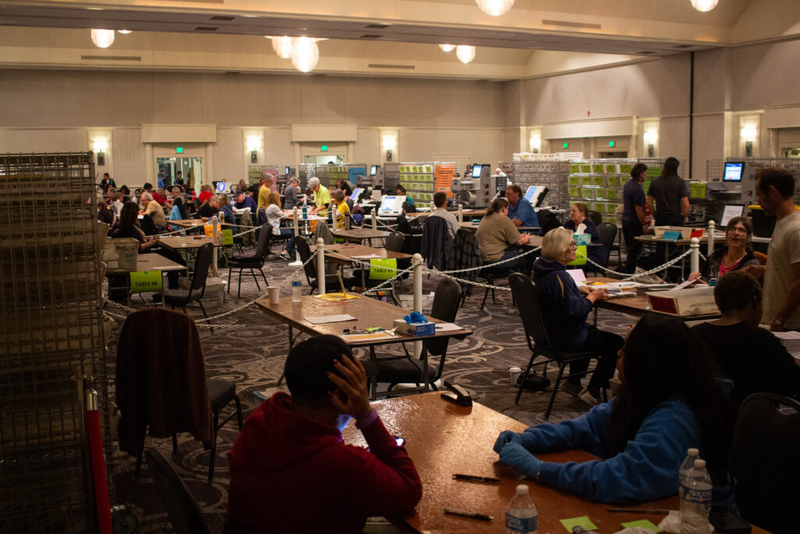
Election workers count absentee ballots at Milwaukee's central count for the 2026 midterm election. (Photo by Henry Redman/Wisconsin Examiner)
After months of Democratic anxiety and planning by election officials in case the Trump administration interfered with voters casting their ballots or officials counting them, Tuesday’s election in Wisconsin went off without a hitch.
The state’s prominent election deniers, including former state Rep. Janel Brandtjen, left Milwaukee’s central count facility on Tuesday long before the city was finished counting as it became clear that Democrats had swept into trifecta control of state government, even before Milwaukee made its final vote tally. The Wisconsin Elections Commission announced Wednesday that the election was held with only minor glitches at the more than 3,600 polling sites across the state.
“This election is a testament to months of preparation and the professionalism of Wisconsin’s election officials,” Meagan Wolfe, the administrator of the Wisconsin Elections Commission, said in a statement. “Election officials stepped up to serve their communities and came together to run a fair, safe, and transparent election. Their hard work was evident every step of the way.”
A Trump administration official told CNN that Tuesday’s results were “too big to rig,” implying that a closer result could have led to 2020-style interference. Ahead of the election, the Trump administration had sued Wisconsin for access to the private information included in the state’s voter registration database. In other states over the past few years, federal agents had seized ballots and arrested people accused of registering to vote as non-citizens.
Jeff Mandell, general counsel of the voting rights focused firm Law Forward, said that lawyers and advocates spent two years preparing and planning for the threat of election meddling by Trump.
“I think that it shows how well and thoroughly the pro-democracy community had thought through all of the possibilities and prepared,” he told the Examiner. “You know, some of it might be that we thought of things, and just by thinking about them and talking about them and preparing, we foreclosed the administration doing those things. The other reality is that it looks like the will of the voters was so strong that those kinds of shenanigans were not going to move the needle, and it’s possible that the administration recognized that.”
Trump has often questioned the results of elections and the fact that his administration did not undertake any “shenanigans” doesn’t mean that the risk of them doing so was zero.
“The fact that it didn’t happen is something that we should all be celebrating as a democracy matter,” Mandell said. “This is good, but that doesn’t mean that there was no possibility it would happen, and it doesn’t mean we shouldn’t be taking it seriously, and it doesn’t mean that it’s not to the benefit, long-term, for our democracy that we prepared.”
Ann Jacobs, a Democrat on the elections commission, said that pro-democracy organizations did a good job communicating their plans and discussions and the possible risks while not discouraging turnout.
“While people talked about the fears that they had about something like that happening, I think there was a lot of thoughtfulness about how to talk to people about it,” Jacobs told the Wisconsin Examiner. “So it didn’t depress turnout. It didn’t convince people not to go vote, and that was a conversation I was having with lots of people at the time, and I think is a good reminder of the importance of being level-headed and keeping in mind that while there are risks of bad things happening, the important part about it is planning and reassurance.”
Proposed democracy and voting reforms
With the election now in the rearview mirror and Democrats in Wisconsin preparing for the start of the legislative session in January, among the issues competing for priority attention are reforms to Wisconsin’s democracy and voting system after 15 years of GOP control in which campaign finance laws were eased, restrictions on voting were advanced and the maps were skewed to benefit Republicans.
In a statement celebrating Democrats winning control of Wisconsin’s government, former U.S. Attorney General Eric Holder said it’s important they use that power to undertake some structural reforms.
“In the face of grave, ongoing threats to our democracy, now is not the time for Democrats to sit on the sidelines. Voters are demanding that their leaders take bold action to meet the moment, and now is the time to use the power entrusted to elected leaders to level the playing field and protect the voting power of the American people,” Holder said.
Jacobs said she’s “so excited about the idea of being able to have those discussions with the Legislature,” and that she has a list of “straightforward” proposals for making voting easier.
First on the list, she said, is finally passing a bill that would allow election officials to begin processing absentee ballots on the Monday before an election. She also said that she understands a large majority of Democratic voters support some level of voter ID requirements, but that Wisconsin does not have to have the strictest ID law in the nation. To make voting less burdensome, she suggested helping college students get IDs for voting without so much “rigmarole.” Current law requires that student IDs used to vote have a signature, an expiration date and an issuance date, which many do not.
Also on Jacobs’ list are expanding the period for early in-person absentee voting again. Republicans limited it to just two weeks under former Gov. Scott Walker. She added that WEC should be able to provide grants to smaller communities without the manpower or money to pay to hold in-person early voting.
“There’s a lot of things we can do that would make voting better, that isn’t a huge lift, that we could do right away. I would love to see some of these things happen promptly,” she said.
Mandell named some of the same priorities as Jacobs while also suggesting Democrats could take bolder action to make the state’s democracy stronger.
“I think there’s a lot of room in this state and a lot of need in this state to strengthen our democracy and make it more robust, and some of that is about addressing limits and constraints that were improperly put on our democracy during the gerrymander period, and some of that is just updating and bringing new thinking and new ideas, and I think there’s room for both of those things,” he said.
He said Democrats should advance a nonpartisan, independent system for drawing congressional and legislative maps — a proposal that is likely going to put elected Democrats squarely between their voters, who spent years fighting for fair maps against the Republican gerrymander, and the national Democratic party, which has been in a federal tit-for-tat with Republicans on a series of mid-decade redistricting efforts.
Ahead of the election, Wisconsin Democrats’ potential trifecta control of both houses of the Legislature and the governor’s office was often brought up in national discussions of states where Democrats could draw new maps to eke out a few more seats in the U.S. House of Representatives.
Mandell noted that Law Forward’s lawsuit against the congressional maps is still pending at the state Supreme Court. He also suggested that the best way to enact a new map-drawing process is through a constitutional amendment, which would have to pass in two legislative sessions before going to voters. That means in order to be enacted by the time the current maps expire in 2030, that process needs to start now.
“I do understand that there may well be pressure from D.C. and from others that maybe we should be careful to lock Wisconsin in on congressional maps,” Mandell said. “We’ve seen states around the country that have tried to walk away from some of their independent redistricting commitments in response to the White House’s unprecedented effort at mid-decade opportunistic redistricting in red states, and that’s something that’s at least worth considering.”
“But,” he added, “fundamentally gerrymandering is bad for voters, and that’s sort of the original sin of gerrymandering. It’s bad for voters. It undermines the value of the right to vote. So I’m not a political campaign consultant, and it’s harder for me to get into the details because I’m not as well steeped in them about the tit-for-tat of state here and state there. But you know we’re in this for voters, and gerrymandering is bad for voters. So I think we should stop gerrymandering.”
On Thursday, Sens. Kelda Roys (D-Madison) and Mark Spreitzer (D-Beloit) expressed a commitment to a fair maps process.
“Having fair maps that make sure that the party that gets the most votes gets control is of the utmost importance to me, and I think to Wisconsinites, because we never want to be in a situation again where right-wing politicians essentially silence the voters and insulate themselves from any political consequence,” Roys told the Examiner. “Because we have seen how devastating that is for Wisconsin: The real harm that has been caused to our public education system, the way it’s caused our property taxes to skyrocket, the harm to farmers and small businesses. You know, it has been really devastating to have a Legislature that felt like it could do whatever it wanted, no matter how extreme and how opposed the majority of Wisconsinites were to what they were doing.”
Spreitzer echoed Mandell’s call for the maps to be handled through the constitutional amendment process and added that he hoped Tuesday’s landslide win for Democrats would discourage more mid-decade redistricting.
“The only way to get ourselves fully out of the equation is to amend the constitution, and the only way to keep a future Legislature of either party from changing it when they happen to find themselves in power after the census is to put it in the constitution,” he told the Examiner. “And we are in a position now where if we initiate a constitutional amendment this session and then hold our majorities in 2028, we could actually get a constitutional amendment on the ballot ahead of the 2030 census, and so that is going to be my goal to figure out how to do that.”
Mandell also said campaign finance reform should be a priority, pointing to the massive amounts of money that flowed into this year’s race for governor and recent campaigns for the state Supreme Court.
“When we have a governor’s race that just shattered all records, it feels like ordinary Wisconsinites are left out of this process, or left out in the sense of influence, but then sort of bear the consequences under the deluge of negative ads and mail that we all experience every election cycle,” he said. “And so I think it would be a good thing for the Legislature to take a really careful look and think about what kinds of campaign finance do we want in this state.”
Spreitzer and Roys said that voting and structural reforms are important, but with campaign promises on affordability to answer to and a state budget that will need to be passed, the timeline is up in the air.
“Obviously, our first priority as Democrats is to restore faith in democracy by delivering for people on affordability and the economy,” Roys said. “I think that voters delivered a clear rejection of the Trump agenda, both the high costs, but also the corruption and assaults on democracy and authoritarianism. So I feel confident that my colleagues and I are going to be able to deliver for people on affordability and make a tangible difference in people’s lives and pocketbooks, and that’s going to be our very first priority to tackle in January.”
“At the same time,” she added. “I think voters are really hungry for a government that is actually responsive — and, I would say, puts what people need rather than special interests and big corporations first. So pro-democracy reforms are absolutely on the agenda. Everything from getting rid of the Walker and Vos era voter suppression laws, tackling corruption with campaign finance reform and good government measures, things that enhance the ability of people to influence their government, like national popular vote and voting rights measures, and things like fair maps.”
Roys was the co-author of a 2023 bill that would add Wisconsin to the national popular vote interstate compact, an agreement among a number of states that have pledged to assign their Electoral College votes to the winner of the national popular vote. Since 2006, 19 states have signed on to the agreement, totaling 222 of the 270 Electoral College votes a candidate needs to win the presidency.
On Tuesday, Democrats took trifecta control of state governments in Pennsylvania, Michigan, Arizona, Wisconsin, and Nevada. If all five states vote to join, that pushes the agreement to 283 Electoral College votes.
Roys said that on Wednesday she posted online asking constituents what they want her to start working on in the new session and “hundreds” of comments and direct messages were pushing for Wisconsin to join the agreement.
Spreitzer, who has been one of the leading Democrats on voting issues during his time in both the Assembly and Senate, said that he thinks the Legislature can tackle “low-hanging fruit” such as the Monday processing bill early in the session and then return to the broader reforms next fall after the budget is signed.
“The two years goes very quick, and we’re going to have to do a lot,” Spreitzer said. “Obviously, that’s why we’ve been trying to prepare and get bills ready and have caucus conversations on a lot of these topics”
With so many new members, he added, it takes time to get everyone on the same page.
“But I think if I had to guess,” he said, “some of the easier things that are already fully drafted, like Monday processing, we could probably do in the first 100 days … and then some of the more complicated, more system change kinds of things probably get more attention in the fall, post budget.”
Madison, WI