The tricky calculus of designing a ballot with nine questions
Jul 10, 2026 | 9:23 am ET
Description
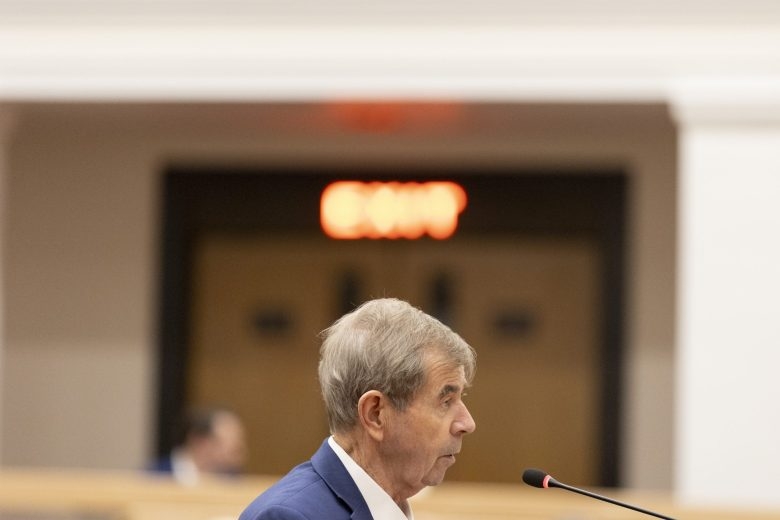
Secretary of State William Galvin speaks at a budget hearing on February 11, 2026.
SOMETIME IN THE COMING WEEKS, Secretary of State William Galvin’s office will announce what number each of the big field of ballot questions will be assigned for the November ballot. That number will assume a prominent place in the campaigns, ads, and debates urging voters to support or oppose a measure.
So how is it determined which issue becomes Question 1, or Question 5, or Question 9?
It’s all in Galvin’s hands. And it turns out the answer draws more on the skills of a magazine or newspaper layout designer than those associated with someone charged with overseeing state elections and election law.
Galvin said the overarching goal he employs in determining the order of questions is having each one remain entirely on one side of the paper ballot and not spill over to the next side or to the next page of multipage ballots. That sometimes involves a bit of trial and error.
“When I’ve done it, that’s the main thing,” Galvin told CommonWealth Beacon. “We do a mock-up sometimes to see, especially where you have lengthy translations, ‘Where will the question appear? How many questions can we fit on this side of the ballot or on this card?’”
This time around, however, the job will not fall to the Brighton Democrat who has overseen every state election since 1995. Galvin is, in addition to his work as secretary, also the chief architect of a ballot question that would allow voters to register on Election Day, one of the nine set to go before voters.
To avoid the appearance of favoritism or any other conflict, Galvin will delegate the job of choosing which question receives which number to Michelle Tassinari, a top deputy who leads his office’s elections division. She’ll approach it with the same goal, according to Galvin: picking an order that’s easiest for a voter to comprehend, and avoiding any measure’s text from being split between multiple pages of the paper ballots now used statewide.
The freewheeling approach isa far cry from the way the ballot will be laid out for the remainder of the decisions voters make. State law dictates the order in which candidates’ names appear, with incumbents first, followed by major-party contenders listed alphabetically by last name, and then third-party hopefuls, also alphabetized at the bottom of the list. In presidential primaries, candidates appear in random order, chosen ceremoniously by drawing names blindly from a rotating basket.
The order of offices is set partly by law, too, with bigger offices up top. Galvin does get some discretion to decide county and district offices lower on the ballot than state representative, though the secretary’s office said it follows the same pattern every year.
The full field is not quite official yet. Nine questions are in the mix, which would tie the record set in 1994, but a controversial measure seeking to repeal recreational marijuana legalization faces an eleventh-hour challenge contending its final round of voter signatures were collected through “fraudulent means.”
The slate could have been even larger had the state’s highest court not directly or indirectly forced three other proposals out of contention.
Galvin said with nine questions, every ballot across the state would likely require two separate pages, which officials “try to avoid usually” because it becomes easy for voters to misplace or skip a page. In some communities, federal requirements to print ballots in multiple languages could push the total package to three pages. If any communities have their own local ballot questions on top of the statewide elections, that might swell the layout, too.
“When you’re operating an election, you’re operating with an army of temporary workers who have to be retrained all the time,” Galvin said. “Municipal poll workers at precincts have to understand that they’re going to be giving every voter more than one card, having to explain to voters that should they choose to — which we hope they don’t — they could only [submit] one card.”
On top of the sizable field this cycle, elections officials must also juggle growing multilingual requirements. The federal Voting Rights Act requires jurisdictions with a sizable concentration of voters who rely on a language other than English to provide bilingual voting materials.
As the state’s population becomes more diverse, those needs have increased. Following the 2000 decennial Census, only six Massachusetts cities had to provide elections materials in a second language, all in Spanish. After the 2020 Census, 19 communities need to offer ballots and other elections-related documents in at least two languages other than English, and Lowell needs to make both Spanish and Khmer translations available. (Boston is only required to provide election materials in Spanish, but also offers Chinese and Vietnamese.)
“That alone adds not just cost, but a lot of work into getting it right,” Galvin said.
The information book that Galvin’s office mails to voters is also set to be gargantuan. Galvin expects it to total more than 80 pages.
Unlike the ballot, that document also prints the entire text of the laws proposed by ballot questions, not just the question text and summary. One measure seeks to repeal a 2024 gun law, which means the information book needs to print the entirety of that lengthy statute.
So if voters are likely to be inundated with papers to juggle and complex decisions to weigh, will campaigns behind the questions want their proposals to appear in the first available slot instead of on the back of the ballot or even on a separate second or third page? It depends who you ask.
In Galvin’s experience, the ballot position doesn’t matter to a question’s electoral chances, especially because the order should be set in the coming weeks and voters will get more than three months of ads, articles, debates, and informational booklets hammering home by repetition which topic is Question 1 and so forth.
Some campaigners approach the order largely indifferent to their question’s position on the ballot. Others think lower-key proposals might struggle to attract as much support if their spot is all the way at the bottom. When every vote counts, even marginal impacts could make a difference.
“If you need a yes vote, you do not want to be Question 9,” said Conor Yunits, a veteran strategist who has worked on multiple ballot question campaigns over the years.
There does not appear to be a clear link between a question’s position and the share of voters that decline to vote on the measure. In 1994, the last time nine statewide measures appeared on the ballot, about 9.7 percent of voters left Question 9 blank, the second-highest rate among that cycle’s measures. But the highest blank rate (11.5 percent) came on Question 3, and the lowest blank rate (6.3 percent) came on Question 5.
A significant body of research suggests that the order in which individual candidates appear on the ballot can affect voters, in some cases boosting the vote total for the top-listed contender by a percentage point or two. The effects are stronger in races with more names on the ballot and in cases in which voters know less about the contenders.
“You absolutely want to be first if you’re a candidate,” said Jon Krosnick, a Stanford University social psychologist who has long studied the so-called primacy effect.
However, that dynamic does not neatly graft over to ballot questions. Krosnick said research has found it is “very rare” for the order of questions in surveys, a rough corollary to ballot questions, to impact how respondents answer. In cases where there is an effect, it could come from one question “priming” how a participant thinks about a subsequent question.
Say the first question that appears asks if the state should increase property taxes to fix five potholes all located in front of the home of Boston’s mayor, Krosnick offered as a hypothetical to make his point. “People are gonna say, ‘Well, that’s a ridiculously stupid reason. No, we’re not going to do that,’” he said.
Then, if the next question in this scenario asks about increasing property taxes to reduce classroom crowding for students, it “sounds even more compelling and more meritorious than it would have sounded if it was considered first,” Krosnick said.
“Whether it’s good to be first or good to be second or third,” Krosnick said, “will depend upon the context. It’ll depend upon what issue goes before you.”
Boston