Tribal leaders, clean water advocates rally in Lansing as Line 5 fight intensifies
Aug 26, 2026 | 6:01 pm ET
Description
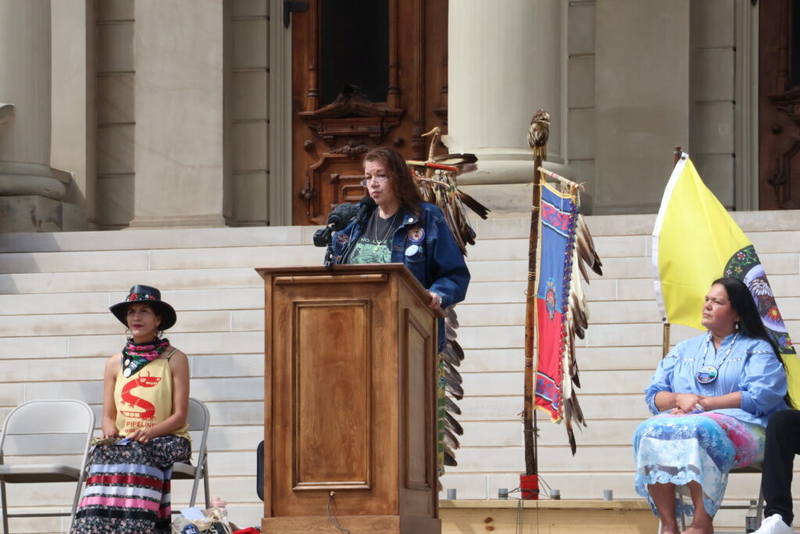
Clean Water Action Michigan Water Justice Organizer Nichole Keway Biber, Michigan Environmental Justice Coalition Deputy Director of Programming Andrea Pierce and Little Traverse Bay Bands of Odawa Indians Chairperson Winnay Wemigwase at a rally opposing Enbridge's Line 5 pipeline held at the Michigan State Capitol on Aug. 26, 2026. (Photo by Kyle Davidson/Michigan Advance)
Following a flurry of developments surrounding Enbridge’s Line 5 tunnel project, tribal citizens and environmental advocates gathered in Lansing to share concerns about the project and lay out the next steps in their yearslong fight to have the pipeline decommissioned.
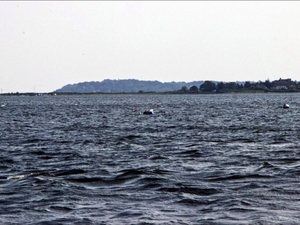
The controversial Line 5 pipeline runs from Superior, Wisconsin to Sarnia, Ontario, with a 4.5-mile segment of dual pipelines running through the Straits of Mackinac, where Lake Michigan and Lake Huron meet.
Organized by the Anishinaabe Friendship Center, Wednesday’s rally welcomed leaders from the Little Traverse Bay Bands of Odawa Indians and the Saginaw Chippewa Indian Tribe, along with environmentalists and state officials calling for Line 5 to be shut down.
“This is not just a Native issue, and let me repeat that: it’s not just a Native issue,” said Winnay Wemigwase, the chairperson of the Little Traverse Bay Bands of Odawa Indians. “It is not just an environmental issue. It is a Michigan issue. It is a human issue.”
The pipeline transports up to 23 million gallons of crude oil and natural gas liquids per day, with opponents raising concerns about the consequences of a spill into the waterway.
Opponents of the pipeline have pointed to the 2010 Kalamazoo River oil spill stemming from Enbridge’s Line 6B and a 2018 anchor strike which dented Line 5 in places as proof of their concerns. Several speakers at Wednesday’s rally also pointed to research from the University of Michigan, which determined that the Straits of Mackinac are the ”worst possible place” for a Great Lakes oil spill, with more than 700 miles of shoreline facing contamination if the pipeline were to rupture.
While Enbridge is working to construct a utility tunnel beneath the lakebed in hope of mitigating concerns of further anchor strikes and a Great Lakes oil spill, environmental advocates and tribal citizens have raised further concerns around the company’s proposed solution and its impact on natural and cultural resources.
“Their answer is to blast a tunnel through four miles of sacred bedrock directly beneath the straits,” Wemigwase said. “They want us to give them permission to drill through thousands of years of Anishinaabe sacred sites, excavate hundreds of thousands of cubic yards of ancient stone, and lock in fossil fuel infrastructure for another half century. All to protect a pipeline that acts primarily as a shortcut to ship Canadian oil right back into freaking Canada.”
Wemigwase explained that the Straits of Mackinac hold immense spiritual significance for the Anishinaabe, likening tunneling through the straits to running an industrial pipeline beneath the floor of the Vatican.
Andrea Pierce, a tribal citizen of the Little Traverse Bay Bands of Odawa Indians and the deputy director of programming for the Michigan Environmental Justice Coalition, said if the tunnel project moves forward, they will need to dig up the remains of their ancestors on both sides of the straits.
“They were put there to last for eternity, not to be moved at the whims of a pipeline from other countries or any country,” Pierce said.
In an email to Michigan Advance, Enbridge spokesperson Ryan Duffy said that site surveys have found “no confirmed Tribal ancestral burial grounds within the proposed construction areas,” and that the company would be implementing a strict artifact recovery protocol in coordination with Tribal experts “to ensure any findings are handled appropriately and respectfully.”
@michiganadvance State Rep. Betsy Coffia (D-Traverse City) speaks at an anti-Line 5 rally at the Michigan Capitol with a message for Gov. Whitmer. @BigGretchWhitmer ♬ original sound – Michigan Advance
In a recently reissued permit for the tunnel project, the Michigan Department of Environment, Great Lakes, and Energy states “This project will have adverse effects on known historic and cultural resources, including their destruction and/or removal. These resources are unique and highly significant to the Anishinaabek communities, as well as the State of Michigan. The permittee shall, as a primary condition of this permit, mitigate the loss of historic, archaeological, and cultural resources.”
Enbridge is required to submit a Cultural Resources Mitigation and Monitoring Plan to EGLE by Dec. 31, 2026.
Wemigwase also highlighted the impact that a Great Lakes oil spill would have on the waters, noting that 40 million people rely on the lakes as a source of drinking water.
“A catastrophic spill in the Straits would poison municipal water intakes across Michigan, Ontario, and in downstream communities,” Wemigwase said. “You cannot drink oil. You cannot wash your dishes with crude.”
Nichole Keway Biber, Michigan water justice organizer for Clean Water Action, discussed the pipeline’s impact outside of the Great Lakes, noting that 12 miles of Line 5 run through the Bad River Band of the Lake Superior Tribe of Chippewa Indians’ reservation in Wisconsin.
Enbridge is currently working to reroute that segment after a federal judge determined the company was trespassing on the Bad River Band’s sovereign lands. Keway Biber noted that Enbridge has already released 1,900 gallons of drilling fluid as part of the reroute.
On Tuesday, Enbridge and the Wisconsin Department of Natural Resources confirmed to the Wisconsin Examiner that a segment of the pipeline had leaked natural gas after a truck rolled over a natural gas transmission line at an open excavation site for a Line 5 valve project.
“Near U.S. Route 2, Line 5 runs along the north shore of Lake Michigan, where it crosses 16 tributaries within nine miles of the lake, 11 of which are less than four miles from both shores,” Keway Biber said going on to note that south of the Straits, the pipeline runs across the Indian River, Little Sturgeon River, Pigeon River, Upper Black River, and sits within a few miles of several inland lakes.
While EGLE and the U.S. Army Corps of Engineers recently granted permits for the project, the Michigan Supreme Court struck down a critical permit from the Michigan Public Service Commission after determining the regulatory board did not properly consider the environmental harms that could come from extending the pipeline’s operations.
Amid these developments, Liz Kirkwood, the executive director of Flow Water Advocates, urged Line 5 opponents to do three things.
The first is to tell Governor Gretchen Whitmer, who pledged to take action against Line 5 during her 2018 campaign, to “finish the job” she started when she revoked Line 5’s easement to operate on the Great Lake’s bottomlands in 2020.
“Our ask is simple: implement the Michigan Supreme Court’s ruling, withdraw EGLE’s recent permit for the tunnel, and finish the job you started in 2020, and shut down this pipeline before you leave office,” Kirkwood said.
Kirkwood’s second request was for the public to show up to the Michigan Public Service Commission when they open tunnel project proceedings to the public.
“When it does, the public needs to be there,” Kirkwood said. “Ask the hard questions. Would a tunnel extend Line 5’s life for decades? What would that mean for the waters held in public trust for us as beneficiaries for future generations? The Great Lakes are not the only route, they’re just the route Enbridge already occupies.”
Kirkwood’s final request was to question every candidate up for election in November on their stance toward Line 5.
“Our job between now and Nov. 3 is to make sure no one gets elected to statewide office in Michigan without telling the people of Michigan on their record where they stand on oil in the Great Lakes,” Kirkwood said, noting that the state is set to select a new governor and a new attorney general, two positions with significant power over the pipeline’s future.
State Rep. Betsy Coffia (D-Traverse City) was even more direct in her message to the governor.
“The flag of this state says Tuebor. That is Latin for ‘I defend,’” Coffia told the crowd. “Gretchen Whitmer, your job when you leave this office is to defend the Great Lakes, to honor the treaties, to remember that water is life, and to use your considerable power to shut down Line 5. Make sure, governor, that your legacy is not one covered in oil and lies.”
Lansing, MI