Kansans fear impacts of data centers despite promise of economic benefits
Aug 26, 2026 | 9:00 am ET
Description
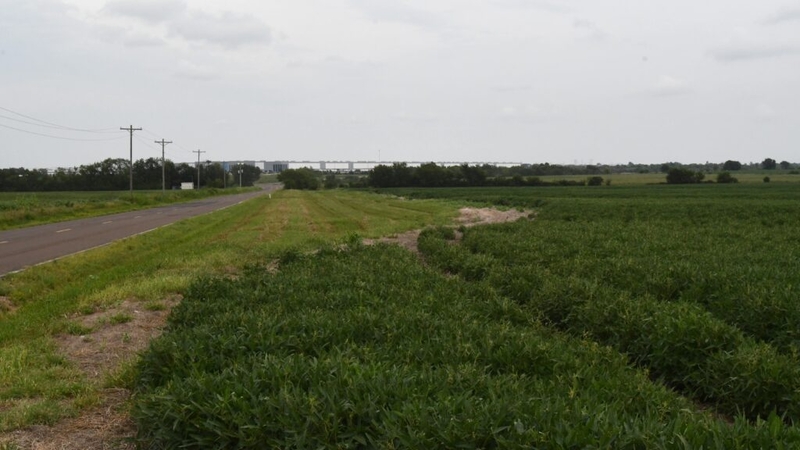
Agricultural land to the west of the Kanza Fire Commerce Park on 77th Street southwest of Topeka is the proposed location of a 10-building distribution center to be built by Compass Datacenters. To the east are the Walmart Distribution Center and the Mars manufacturing plant. (Photo by Morgan Chilson/Kansas Reflector)
TOPEKA — Local government officials consider hyperscale data center development with an eye toward economic benefits and property tax revenue that would allow them to meet Kansas residents’ demands to lower taxes.
But in Kansas and nationally, an outcry against data center development is rising, with a recent Gallup Poll showing that 48% of Americans “strongly oppose” building data centers in their neighborhood, while an additional 23% fall into the “somewhat oppose” category. A scant 7% “strongly favor” and 20% “somewhat favor” the idea.
Data center distrust is so strong that Kansans are putting forward petitions to stop local governments from developing the facilities. In return, at least three Kansas cities are suing constituents over those petitions — Edgerton, El Dorado and Emporia. In Tonganoxie, residents are raising money to start a legal fight over a proposed data center.
Some states put moratoriums in place to temporarily halt data center development. New York was the first to do so, stopping development for one year of data centers using more than 50 megawatts of power while the state determines effects on resources and communities.
Amazon pulled a proposed project in Maryland after residents made it clear they didn’t support the development, Maryland Matters reported.
It’s unlikely the need for data centers will slow. Capital expenditures in the industry are expected to surpass $3 trillion worldwide by 2030, according to a Dell’Oro Group report.
Nationally, economic reports on the construction industry show data centers and the “artificial intelligence buildout” are bolstering what otherwise might be slowed growth in building, Construction Dive reported.
Transparency and data
Experts nationally are researching what communities must do to make sure they see positive results from any construction.
Kathryn Kline Tyndall led a team for the Bipartisan Policy Center in Washington, D.C., that explored key considerations in data center development, holding roundtable discussions nationwide, including in Kansas City, Missouri.
Among a list of six issues identified to address during development is the critical importance of trust and transparency throughout the process, Tyndall said.
“One thing that was really sharpened as an important issue for us is just making sure that you’re communicating information at the right level,” she said.
Tyndall’s report also noted that any economic development agreements must be thoroughly reviewed and made public, with only “genuinely competitive information” being withheld.
Transparency often correlates with access to information, a factor highlighted by Kansas Health Institute analyst Emma Uridge, who has a master’s degree in public health. KHI looked at the environmental footprint of data centers.
“The signing of (nondisclosure agreements) is a common occurrence with data centers, but really all large-scale economic developments are not new to that,” Uridge said. “Microsoft actually ended their use of NDAs being signed with elected officials because of the public backlash that they received.”
Uridge said there aren’t many ways to get detailed data on how much water a project will use or is using, a primary concern raised by opponents. Tools exist that can help, Uridge said, such as a San Jose, California, research initiative called “When Will the Taps Run Dry?”. The project includes a water consumption calculator based on the projected wattage the data center uses.
Topeka-area resident Meghan Ryan co-founded Protect Kansas, a group fighting to require more regulation of data centers and speaking out against possible health and environmental issues. She has a master’s degree in public health and said keeping up with complexities around data centers is nearly impossible.
The goal of Protect Kansas is to gather people with different skills, from marketing to a science background, to raise questions and communicate the answers, she said.
“I do not believe the data exists to show what the true cost this would be on the community,” Ryan said.
Protect Kansas created a flyer that asks Kansas to adopt stronger ways to hold data centers accountable, including requiring multiple independent studies and enforcement processes.
The benefits
Talk of high property taxes dominated the 2026 Kansas legislative session, but no strides were made to reduce those taxes.
Mike Morse, partner at Kansas Commercial Real Estate Services Inc. in Topeka, said data centers offer a solid path to provide the property tax relief that Kansans want.
“This is far and away the best way we will ever reduce property taxes across the board for the entire state,” he said.
A proposed Topeka-area development by Compass Datacenters is equivalent to attracting multiple Mars manufacturing facilities, he said. Mars, which opened a manufacturing plant in 2014 in Topeka, received property tax abatement and other support from the city, which isn’t happening with Compass, Morse said.
Mars paid $2.8 million in property taxes in 2025. Morse said the amount of estimated annual property tax Compass will pay, assuming the site is appraised at the expected $3 billion when it is operational, is $122 million, he said.
That would include an estimated $37 million annually to Shawnee County, $28 million to the city of Topeka and $43 million to the Auburn-Washburn school district.
Morse said he understands concerns residents have about data centers. Bad developers exist just as they do in any industry, he said.
“The state of Kansas is very late to the game, and the benefit to that is that people have made the mistakes, and we learned from other people’s mistakes, and that’s what we call wisdom,” he said. “We learn from mistakes. We get better.”

Max Nelson and his son Parker Thompson are spearheading a movement against a proposed data center in Coffeyville. The bad actors in the field and potential long-term effects worry him.
“We’re not anti-data center,” he said. “What we’re trying to do here is ask for a moratorium.”
Communities are rushing to approve data centers without enough information, Nelson said. Although data centers have been around for years, the hyperscale facilities being proposed will draw more significantly on local resources like water and electricity, he said.
“What we’re seeing not only in Kansas, but across the country, is really shady tactics,” Nelson said. “This is a multi-billion dollar industry. They have lobbyists that are putting money in larger than big oil, so that should tell you something.”
Updated technology
Shady tactics hurt companies like Compass that develop data centers in partnership with the community and use updated technology to limit local resource impacts, said Brett Collard, senior vice president of land development for Compass. The Texas-based company is proposing a 10-building data center southwest of Topeka at 3303 S.W. 77th St. in Wakarusa.
Collard said Compass uses a closed-loop system that never draws water from the local water department. It is initially filled from water trucked into the facility, he said. The only water the company will use from the local water department is for toilets, sinks and other normal office building usage.
“We will never charge or discharge our closed-loop system inside of the service authority,” Collard said. “We will truck in the water or the mixture and fill that one time. And in the event that it needs to be discharged, it will be trucked back out, leveraging the same company, to be recycled.”
Despite Compass’ information about how the facility will use water, a Protect Kansas blog post highlighted a Michigan data center that operated with a closed-loop system.
The blog post said the data center developer lied to the community about not polluting the water, as evidenced by a request from Michigan’s Department of Environment, Great Lakes, and Energy for a permit to increase pollutants being released into a river near the data center.
However, the Michigan department spokesman, Josef Stephens, said wastewater discharges in Michigan fall under National Pollutant Discharge Elimination System (NPDES) permits, which set limits to protect water quality and public health and require regular monitoring.
The permit was actually about the discharge of treated sewage water from bathrooms at the facility, he said.
“The permit does not authorize the discharge of any other type of treated waste,” Stephens said in an email. “Also, the limits required by the permit are the most restrictive that are required for these types of discharges.”
Such confusion is part of the difficulty in understanding data center development, and why transparency and access to data is important, those studying the issues say.
“I think there has been some conflating of a lot of the impacts because a lot of it is not known,” Uridge, at KHI, said. “There’s no mandated requirement to disclose usage for water, for example. I know there’s some legislation floating around to regulate some of that disclosure and actually have some level of assessment and monitoring, and even compliance standards around usage.”
Some localities are capping water and energy usage, and some are just making it required that the actual water usage be open record, she said.
Hearing the concerns
Nelson, in Coffeyville, said most people want their government officials to just listen to what they have to say and to protect them.
“They’re all valid concerns,” he said. “They’re not wanting these in their communities. They want safeguards. They want ratepayer protections. They want environmental studies, and they filed petitions that are legal. And now the city commissions are suing their own citizens. Like, that’s not American democracy.”
Topeka Mayor Spencer Duncan said he’s learned one thing from studying other communities and talking with mayors around the world through an international Bloomberg program: Data center developers that come to the community and do extensive communication, answer questions and speak openly about their plans before filing an application create a smoother process.
“It doesn’t mean they always end up building, or that it was a right fit for the community, but it does mean that people had more trust in the conversation,” Duncan said. “They felt more informed. They had an opportunity to ask all their questions, and so there was some rapport that was built.”
“You can’t just sort of come in the back door and hope that everyone else in the community will do it for you,” he added. “If you want it to work, you’ve got to be the lead.”
Topeka recently passed a one-year moratorium on data center and battery storage development, responding to concerned citizens who flooded city council meetings to object, Duncan said.
Even if there isn’t a data center looking at the community, Duncan said, having the conversations and preparing are good ideas.
In the Bipartisan Policy Center’s roundtable discussions, which included data center developers, Tyndall said, “good, reliable, accurate information” was always discussed. Those developers knew it couldn’t come from them because they’re not a trusted source, she said.
“There is an open question about is this something where state agencies should be taking more active role in education,” Tyndall said. “We sort of pointed to and we heard from our roundtables that community directors that are in the space can be really valuable intermediaries, and even elected officials at the town level, but it is really an open question that hasn’t been resolved yet.
“Who can convey this information in a way that feels trustworthy and safe and honest?”
Kansas Gov. Laura Kelly is reluctant to take away local control over data centers. In an emailed response to Kansas Reflector, she said Kansans have legitimate questions and concerns about the potential environmental and community impacts of data centers.
“These questions merit serious attention and real answers,” Kelly said. “County and municipal governments are best positioned to respond to Kansans’ concerns regarding business developments, including data centers.”
The state has provided some guardrails regarding water and electricity, she said. For instance, the Kansas Corporation Commission implemented a tariff designed to ensure Kansans won’t subsidize any business’ energy costs or electric grid maintenance costs, she said.
Companies also are required to develop and adopt a comprehensive water stewardship plan that addresses water conservation, Kelly said.
The state will provide technical assistance to any Kansas community considering pros and cons of data center development, she said. Stronger tactics, such as a statewide moratorium, would take away local control and decision-making power, Kelly said.
Topeka, KS