From top billing to the cutting room floor and back again: A recap of NV’s film tax credit saga
Nov 07, 2025 | 8:17 am ET

Description
The most recent iteration of the bill totaled $1.8 billion, which would be the largest public subsidy in Nevada’s history, eclipsing the two Tesla megadeals and the football stadium.
(Getty Images)
A proclamation has yet to be issued announcing the date and agenda of a much rumored, unofficially announced special legislative session, which may happen as soon as next week. However, it is largely expected that the proposal to massively expand Nevada’s film tax credit program will be among the things up for consideration.
In preparation for the Summerlin Studio: The Squeakquel (apologies to Alvin and the Chipmunks), which was a spinoff of a “one bill, two studios” proposal from a prior session, here’s a recap of what the state’s film tax credit is, what the backers of the expansion want it to be, and how we got to this point.
What’s a film tax credit program?
Nevada’s film tax credit program was established in 2013 and pitched as a way to bring new jobs to the state and boost an economy still reeling from the Great Recession. Democrat Aaron Ford — then a state senator, now attorney general and gubernatorial candidate — spearheaded the effort.
Legislative failure aside, Nevada still has film tax credits, and MrBeast wants another $2.5m worth
The state’s program is is intended to lure productions to Nevada by offering a financial incentive — transferable tax credits, which we’ll explain in more depth shortly.
Nevada’s film tax credit program is currently capped at $10 million per year.
The last iteration of the film tax credit bill proposed raising the $10 million per year cap to $120 million per year, for 15 years, beginning in 2028. The majority of those transferable tax credits, $95 million per year, would be reserved for productions taking place at a proposed film studio in the Summerlin neighborhood in Las Vegas. The remaining $25 million per year would be for productions not attached to the studio.
Altogether, that’s equivalent to $1.8 billion in public subsidies for the television and film industry. It would be the largest public subsidy in Nevada’s history, eclipsing the two Tesla megadeals and the football stadium.
Fiscal staff for the state have described transferable tax credits as “negative revenue” because the state has to account for the tax credits when setting the state revenue forecast each biennium. They do impact the state budget.
Projects subsidized by transferable tax credits are supposed to grow the economy and raise revenue to offset themselves, but the actual return on investment is dubious, according to analyses from other states, from think tanks, and from the state’s own economic development agency.
Proponents of the film tax credit bill have argued incentive programs in other states are not comparable to what’s being proposed in Nevada because those do not involve the building of a massive 31-acre studio. The Lincy Institute, in a policy brief on the film tax credit proposal, concluded that the state would likely be better off supporting construction and building through its existing Nevada State Infrastructure Bank.
How transferable tax credits work
The state incentivizes film and television production companies to shoot in Nevada by offering them transferrable tax credits.
Production companies can get, as a transferable tax credit, 15% of qualified production costs and either 12% or 15% of wages and salaries. There are also some bonuses available for using majority Nevada residents as workers or shooting in rural areas.
But most production companies won’t owe in taxes more than the transferable tax credit they receive. So, they turn around and sell them to other companies with bigger tax burdens. Transferable tax credits sell for less than face value — a discount of about 10% isn’t unusual.
So, let’s say the state issues Sony $50 million of tax credits. MGM Resorts International could buy them from Sony for $45 million. Then, instead of paying the state $50 million in gaming taxes, MGM gives the state the tax credits it bought from Sony.
MGM would get a $5 million tax break. Sony gets $45 million. And the state, which otherwise would have received $50 million in tax revenue from MGM, gets nothing.
Details about who’s buying transferable tax credits, and for how much, are not public record. However, the Nevada Film Office does disclose through annual reports what the transferable tax credits were applied toward. In the most recent fiscal year, the credits were largely applied to the insurance premium tax, which is levied on insurance companies based on the premiums they collect from policies issued in the state. Some transferable tax credits also applied to the state’s gaming percentage fee and modified business tax.
Opponents of the film tax credit bill describe a “Hollywood handout” but Sony wouldn’t be the only deep-pocketed corporation to benefit from an expanded film tax credit program.
A recap of last season/session
State Sen. Roberta Lange, a Democrat from Las Vegas, during the 2023 Legislative session unveiled an eye-popping $4.9 billion proposal to massively expand the state’s existing transferable film tax credit program. The legislation would have set up not one but two film studios in Southern Nevada.
Lange has said she worked on the project for years with Birtcher Development and the University of Nevada Las Vegas when Howard Hughes Corporation and Sony Pictures Entertainment decided they wanted their own studio.
Lange’s 2023 proposal failed to make it to a floor vote. She vowed to continue working on the proposal and reintroduce the legislation during the 2025 Legislative Session.
Parallel film tax credit proposals should be single bill, says sponsor (of one of them)
But at some point during that interim period, Sony ditched Lange and teamed up with Democratic Assemblymembers Sandra Jauregui and Daniele Monreo-Moreno. Lange has said the company “went radio silent” on her.
So, during the 2025 Legislative Session, Lange introduced a bill to back just the Birtcher/UNLV project known as Nevada Film Studios. Jauregui and Monroe-Moreno introduced their competing bill known as the Summerlin Studios Project with Howard Hughes and Sony.
Lange’s bill was given a Senate committee hearing but advanced no further. She pushed for the bills to merge again.
Jauregui’s bill narrowly passed the Assembly. It was listed on the agenda for a full Senate vote in the last hour of the session but lawmakers hit the statutory deadline for ending the session before it could be voted on.
Where do lawmakers stand?
Republican Gov. Joe Lombardo in February, at the start of the legislative session, expressed skepticism about expanding the film tax credit program, saying it didn’t seem like good state policy. But the governor also said “the devil’s in the details” and that he would consider it. He never vowed to veto the bill, as he did with other high-profile proposals during the session.
NV Senate GOP leader, Dem assemblymember unite to fire shot across bow of movie studio bill
Over the summer, Lombardo acknowledged the film tax credit expansion proposal was not dead and could potentially appear during a special session sometime this year. As governor, he issues the proclamation calling the Legislature into session, and he sets the agenda for the session.
Senate Majority Leader Nicole Cannizzaro was largely quiet on the issue of film tax credits when they were discussed in the 2023 and 2025 regular sessions, but last month she threw her support behind the project, appearing at a rally held by the labor union-backed political action committee pushing the proposal, according to The Nevada Independent.
Three other state senators representing parts of Southern Nevada — Republican John Steinbeck and Democrats Rochelle Nguyen and Marilyn Dondero Loop — also attended that rally, the Independent reported.
Senate Minority Leader Robin Titus (R-Wellington) has publicly come out in opposition of expanding the program, telling Newsmakers she’d done her due diligence by speaking to Georgia state lawmakers about their expansive film tax credit program. Titus said in a webinar earlier this week that members of her caucus have said they cannot give “an absolute” position until they’ve seen the language of the bill.
Support for the film tax credit proposal does not fall on clear partisan lines. That much is evident in the Assembly, which narrowly passed a version of the film tax credit bill in the waning days of this year’s regular legislative session. A tie vote would have meant the measure failed.
Among the 27 Democrats in the Assembly, 15 voted in support and 12 voted against. Among Republicans, seven supported and eight opposed. Here’s a reminder of who voted what on the film tax credit bill:
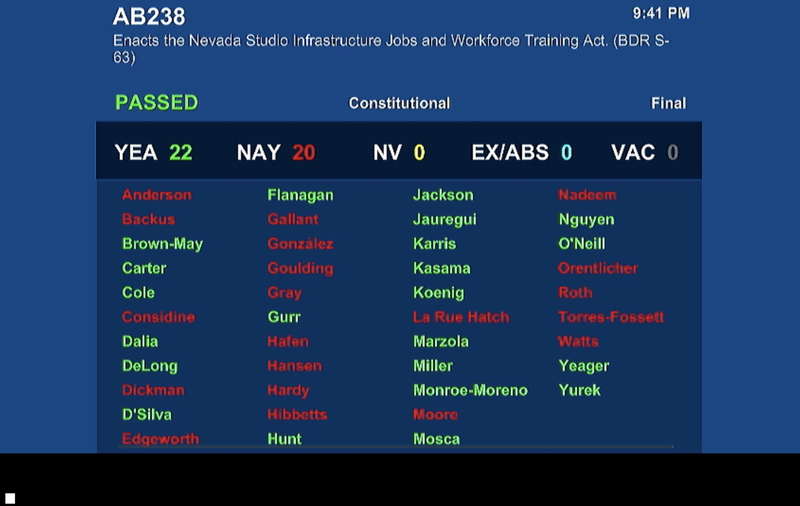
Since that vote, Republican Assemblymembers Toby Yurek and Ken Gray vacated their seats. The former supported the measure while the latter voted against it. Their successors do not appear to have publicly spoken in support or opposition of the bill.
Las Vegas, NV