A tale of Anatevka — and small town Alaska
Aug 05, 2026 | 8:39 pm ET
Description
Image courtesy Bruce Botelho
Recent federal immigration enforcement events in Juneau, mirrored in small towns and big cities across America, bring to mind the musical Fiddler on the Roof and the fictional shtetl of Anatevka in early 20th century Russia. There, villagers eke out an existence largely isolated from the political currents of the outside world, hoping to be ignored by distant rulers whose policies could upend their lives. At one point the village rabbi is asked whether there is a proper blessing for the Tsar. He replies: “Of course. . . May God bless and keep the Tsar . . . far away from us!” Unfortunately, the Tsar’s regime does come for them, ordering all Jews to be expelled from Anatevka.
President Donald Trump’s immigration crackdown has emphasized detention, expedited removal and sharply curtailed avenues for asylum or humanitarian relief against people with no meaningful political voice who are trying to survive under a regime that sees them as expendable or suspect. And now the Tsar has come to Juneau.
Juneau is a close-knit community. Our residents are passionate about many things and, being a government town of sorts, we particularly argue over politics. But we also recognize that much of what Juneau is today was built by foreign labor: in the mines, the canneries and all manner of enterprise. And when we encounter a health care worker who happens to be from Haiti, or a construction worker who is Guatemalan, or a chef who is Mexican or a handyman from Ukraine, we don’t ask them for their identity papers. They are our neighbors and we judge them for their willingness to work, their competence and their desire to belong.
We can readily accept the idea of removing “the worst of the worst,” but these are not the people who are disappearing from our streets. Being “undocumented” is now a crime. A young man from Peru with a wife and special-needs child was removed from the community after being arrested and charged with refusal to take a breathalyzer test‚ removed well before his state court trial date — or an Ecuadorian arrested for driving with a broken headlight and without a valid license, leading to an ICE detainer order and his ultimate removal from the country. Nearly an entire Haitian community was compelled to leave after repeated text threats from ICE that said “we will find you” after prematurely terminating their temporary protected status. In recent days a visitor from Mexico with a valid visa was boxed in by two black SUVs as he tried to exit the parking lot of our local Fred Meyers store. The vehicle was searched and, because nothing was found and his papers were “in order,” he was released.
Not surprisingly, these interventions cause panic, not just among the undocumented, but any residents who are foreign-born or who are awaiting actions on asylum or permanent residency applications. The Trump administration has intentionally slow-rolled these actions, leaving many in a regulatory purgatory. Everyday decisions now become real-time risk assessments: Do I accompany my children to school? Is it safe to go shopping? Should I forgo needed surgery in Anchorage because I might be detained at the airport?
In recent days there has been a new twist. Recreational boaters that I know have been stopped on the water by agents on small Coast Guard vessels who demand identification from all on board “for security checks.” These are not the typical safety checks that the Coast Guard regularly provides. It is a more ominous development whose on-land equivalent is randomly pulling over a car on a public highway and demanding to see identifications of all passengers.
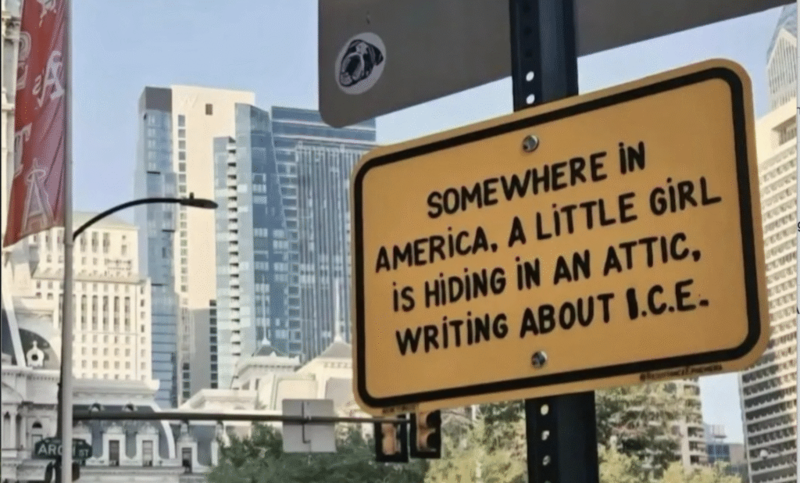
A dear friend recently sent a screenshot of a street sign in Philadelphia that captures the horror we are allowing to play out in our country without halt: “Somewhere in America, a little girl is hiding in an attic, writing about I.C.E.” This nation should choose a different path, one that resists gratuitous cruelty and insists on due process and basic humanity.
The incidents referred to in this commentary are recalled firsthand by the author as part of his immigration advocacy work.
Juneau