If anything can bring the people of New Hampshire together, it’s the threat of a data center
Aug 05, 2026 | 5:46 pm ET
Description
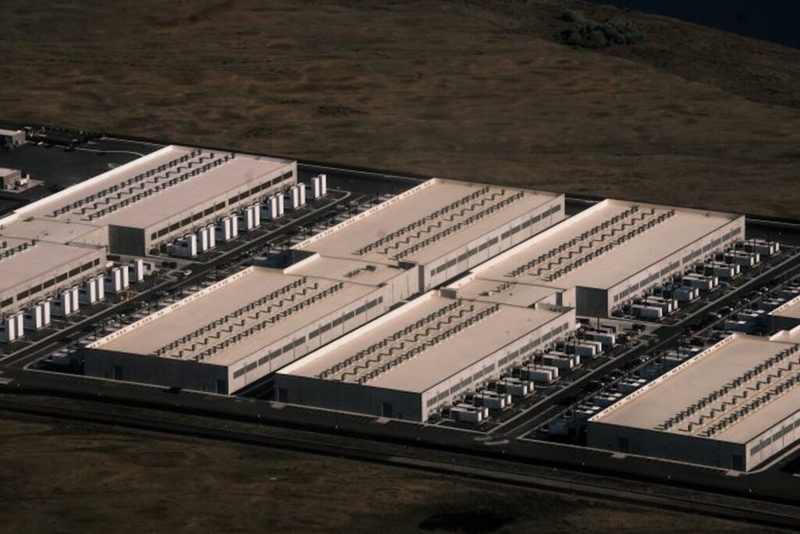
A data center in northeast Oregon on May 18, 2026. (Photo by Jordan Gale/Oregon Capital Chronicle)
When technical adjustments are made to the website you’re reading right now, they are typically considered to be either back-end changes or front-end changes. When the change is on the back end, that means that while the manner in which a reader’s experience is delivered might be different, the experience itself isn’t.
But a front-end change? Regular readers would indeed notice, and they would have feelings. Probably strong ones.
What makes the uproar over data centers unique is that they are, in many ways, the epitome of the back end. The computer networks they house are what make so much of modernity possible, from shopping on Amazon to posting vacation photos on Instagram to the storage of those photos in the cloud. But with the march of artificial intelligence requiring more and more networking capacity, and larger and larger physical structures, data centers have become a very big front-end issue.
The short of it is that AI is likely to dramatically change lives — and lives are already changing because of the data centers they require.
Unlike the debate over how governments should respond to climate change, which very quickly devolved into a partisan issue because of fossil fuel companies’ influence over the Republican Party, a bipartisan public consensus on data centers is emerging. As Jasmine Sun told Ezra Klein of The New York Times this week upon returning from a Midwest reporting trip, she heard one phrase over and over again: “Nobody wants this.”
The Bulletin’s own reporting backs that up. In a May story about the uproar over a proposed data center in Nottingham, partisan divides were absent.
“A lot of times I’ll get emails that are, you know, chain emails that are just being dumped to the Legislature, but these were all local people,” said Rep. Paul Tudor, a Northwood Republican, of the Nottingham proposal. “And there wasn’t one person that was for this.”
Last September, ahead of the most recent legislative session and well before Nottingham, the political debate over data centers in New Hampshire fell upon familiar lines — a left-right divide with a little bit of centrist overlap.
“I think New Hampshire should court any business into the state,” Londonderry Republican Rep. Doug Thomas, vice chair of the House Science, Technology, and Energy Committee, told the Bulletin at the time. “In order for them to come here, there has to be a market. And so we have to … show them that we’re interested.”
The main Democratic position was decidedly more cautious, and led to an ill-fated effort to prohibit data centers outright and form a committee to study their environmental impacts. The Republican-majority House ultimately voted that bill “inexpedient to legislate.” A Senate bill with a narrower aim, to allow “municipalities to regulate data centers in commercial and industrial zones,” also failed to advance. It will likely be a different kind of debate in the next session as local opposition grows, and New Hampshire is not alone in its conundrum: The National Conference of State Legislatures reports that 15 states are considering or have considered a ban on the centers, while only New York has enacted a moratorium.
New Hampshire already has 10 data centers, according to the Data Center Map, but the Nottingham proposal arrived in a charged atmosphere in which the general public seems to be well aware that they are witnessing the possible villain origins of Silicon Valley giants like OpenAI and Anthropic. There’s a NIMBY aspect to the local opposition for sure, which New Hampshire saw play out similarly with an Immigration and Customs Enforcement detention center proposed for Merrimack. Data centers are unattractive, carry environmental and energy concerns, and are noisy — hardly the kind of new neighbor a small town like Nottingham is looking for.
But as Sun and Klein discussed at length, there’s something deeper at play.
People, regardless of political affiliation or any of the other ways we mentally carve up communities, are wary of AI in general and how aggressively it’s being inserted into their lives.
“I think it feels to a lot of these folks like they are pawns in some tech billionaire’s game, and they do not like to feel that way,” Sun said.
In trying to frame the tech billionaires’ pro-AI rationale, besides the desire to accumulate even more wealth and power, she boils it all down to one big con and one big pro: Yes, AI might kill us all; but then again, it could create utopia.
For the tech bros, the promise of some form of utopia outweighs the risk of annihilation.
But even that ultimate pro feels like a big stretch in a world where wealth inequality is very much trending in the wrong direction. The smart bet is that AI will crown a few winners, and most everybody else will lose. Dreaming of and striving for utopia is one thing, but trying to establish a version of it, especially when the model is designed, implemented, and unleashed by powerful others, is something else entirely.
An artificial paradise is not what we need. We need better and more affordable access to housing and healthcare. We need wages that keep pace with rising consumer prices. We need less profiteering by elected officials, less war, less pollution. We need more time in the sun and the rain, and less time behind screens. We need to be more human, and it’s hard to see how AI can ever deliver that.
Amid all that trepidation, it’s still not difficult to imagine the ways AI could benefit humanity broadly. Medical advancements, scientific discoveries, and, perhaps most importantly, more time for everybody. More time for the people and activities that bring them the most joy, that make life worth living.
And that is largely what’s being sold.
But what the public seems to collectively understand, across every kind of human divide imaginable, is that this limited promise of AI is not what is truly being offered. What is being proposed is a new kind of economy, a new kind of workforce, a new kind of relationship with machines — or nothing short of a remaking of what it means to be human.
If there’s a positive to be found in the fact that we are not so much riding the AI wave as being swept away by it, maybe it’s this: For the first time in a long time people seem to be focused on how we are different from what is artificial and inhuman rather than how we are different from each other.
I don’t expect that new understanding to translate into the easy resolution of our fundamental back-end debates about the direction of this state or this country, nor do I expect our harmful front-end culture wars to abate any time soon. But maybe the narrowest of common paths has opened up, built on some of the things the majority of us cherish regardless of how we vote: the natural beauty of the world we inhabit, the well-being of our loved ones, the strength of community, and the sweet unpredictability of human imperfection.
The AI genie may be out of the bottle, but so are we.
Concord, NH