Maine Democrats may be unable to rank presidential primary under proposed DNC rule
Jul 30, 2026 | 9:06 am ET
Description
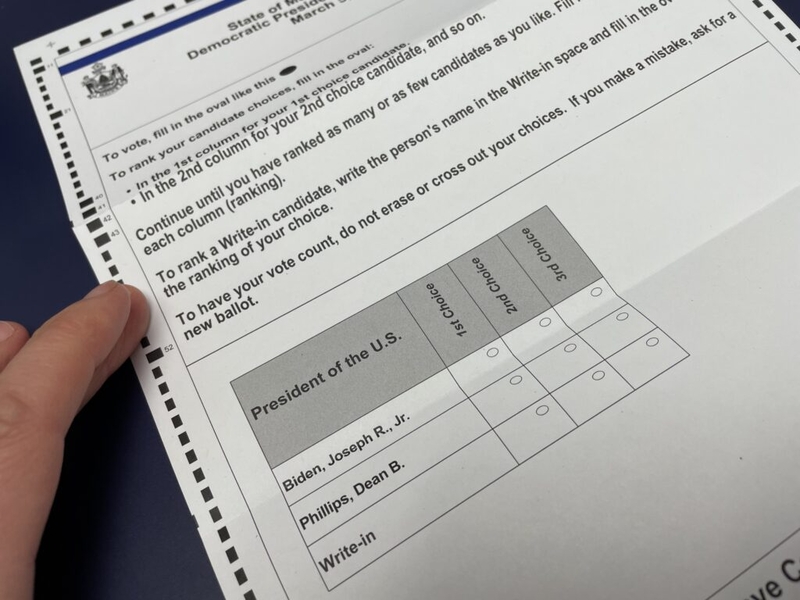
During the March 2024 primary election, Democratic voters in Maine were asked to rank the presidential candidates. (Photo by Lauren McCauley/ Maine Morning Star)
Maine Democratic leaders are raising alarms after a national party committee gave initial approval to a rule that would prevent the state from using ranked choice voting in presidential primaries.
Ahead of the full Democratic National Committee meeting Aug. 13-15, the DNC’s Rules and Bylaws Committee has met several times to finalize the 2028 presidential primary delegate selection process.
That included a meeting in May where the committee voted 28-14 to add new language to the section governing “Fair Reflection of Presidential Preference” that states: “No ballot used for purposes of allocation of delegates among presidential preference shall permit voters to express more than one presidential preference. Where state law provides for multiple presidential preferences in a primary, only the first round will be considered for delegate allocation purposes.”
That means that for a state like Maine that uses ranked choice voting for presidential primaries, the party will not count the full results — instead it will determine delegates based solely on voters’ first round selections.
Kyle Bailey, former state representative and advocate for ranked choice voting, said that despite state law allowing ranked choice voting, the DNC is trying to pressure Maine Democrats to ignore it.
“That’s problematic to me,” Bailey said. “That a national private organization would try to steamroll the Maine people, Maine Legislature and ignore the will of the people.”
In a statement, committee co-chair Jim Roosevelt said ranked choice voting is incompatible with the party’s delegate allocation process.
“However, the Rules and Bylaws Committee respects the right of every state to make their own decisions on important voting procedures, which is why the rules include clear guidance for states with statutory requirements like Maine,” Roosevelt said. “We look forward to working with the Maine Democratic Party to ensure every Mainer’s voice is heard in the 2028 presidential primary.”
The Maine Legislature passed a bill in January 2020 to expand ranked choice voting to presidential elections and primaries. That bill passed into law without Gov. Janet Mills’ signature, which meant the law did not take effect until after the March presidential primary, in which former President Joe Biden won with 34.1%, defeating U.S. Sen. Bernie Sanders by less than 3,000 votes.
The law was in full effect for the state’s 2024 Democratic presidential primary, but only two candidates were on the ballot: Biden and Dean Phillips. And in that case Biden — who ended up being replaced by Vice President Kamala Harris on the ticket — won more than 80% of the vote, so the primary did not have to go to a ranked choice tabulation.
Bailey said that under the DNC proposal, Maine Democrats would still have a ranked choice ballot for the presidential primary — because it’s required under state law — which would likely confuse voters.
“If I go to the polls and I pick a candidate — I will have a ranked choice ballot, because the law of Maine uses the ranked choice ballot, that’s not going to change — but I rank my choices one through whatever. What the DNC is saying is that only my first choice will count,” Bailey said.
DNC rules dictate that a state assigns delegates to presidential candidates in proportion to the percentage of votes a candidate won in the primary — as long as a candidate received at least 15% of the vote. Any candidate that doesn’t meet the 15% threshold will not be awarded any delegates at the nominating convention.
The party says that 15% threshold is the main conflict with ranked choice voting. Under ranked choice voting, the winner of an election must get more than 50% of the votes. After counting all first round votes, if no candidate reaches 50%, the candidate in last place is eliminated and those votes are reallocated to each voters’ second choice. That process continues until someone surpasses 50%.
At the May committee meeting, Frank Leone, the committee member who proposed the language for the rule change, said his goal was to give states clear guidance on the role of ranked choice voting.
“Now, personally, I’m not really a fan of ranked choice voting, but this motion doesn’t address ranked choice voting in general,” Leone said. “There may be times when ranked choice voting is appropriate, and in fact, if we had a winner-take-all system, where you had to reduce a field to one person, it might make sense. Where it doesn’t make sense is in our delegate selection process, and there’s been a national effort to get states to adopt ranked choice voting for presidential primaries, as well as everything else.”
But Bailey said there are other ways to align ranked choice voting with the party rules. He suggested that after the first round calculations, all candidates that fall under 15% could be eliminated in one batch, and their votes reallocated. Once that is done, the count could stop without requiring tabulations to reach the 50% marker.
That would preserve the DNC rules and keep all the benefits of ranked choice voting, Bailey said.
“It makes sure their voice is heard, their vote’s never wasted,” Bailey said. “And allows candidates to run who might otherwise be told that they’re not viable. Because there’s no worry about wasting your vote or having to vote strategically. It just all goes away, and it gives voters the freedom to vote their hopes and not their fears.”
Leone said during the May meeting that the proposed rule change wouldn’t prevent states from using ranked choice voting in other elections.
“Everybody who’s doing ranked choice voting can continue to do it, except for when it comes to our delegate selection process,” Leone said. “The state law has to be consistent with our rules, or else our rules govern.”
At that meeting, committee members also discussed the importance of having consistent rules and a uniform system across states for the presidential primary.
But Bailey said that’s simply not realistic, regardless of how ranked choice voting factors in.
“I think there’s 50 different states and at least 50 different ways of running elections,” Bailey said. “So the sort of glossing over the reality that states have control over elections and that we have local control of elections, it’s just how we do elections in the United States, and I don’t think that a national organization should try to prescribe to individual states and voters and legislatures to tell them how they can and can’t run elections.”
Some committee members agreed, including Michael Kapp, a representative from California.
“To sit here and tell these state parties that they can’t use a system their own voters chose — that’s not party rule,” Kapp said. “That’s a veto over the democratic will of millions of people.”
Bailey said the national party should instead be working to involve voters and encourage changes like ranked choice voting.
“The DNC in particular should embrace reforms like ranked choice voting that bring more people into the primary process, that excite voters, that electrify the base of the party and bring more people into the process to have more voices heard,” Bailey said. “That’s what political parties should be aiming to achieve, is to have a more vibrant, exciting democracy and ranked choice voting enables that.”
Augusta, ME