Superior Court Justice Richard Licht to preside over Shekarchi’s bid to halt ethics probe
Jul 01, 2026 | 4:33 pm ET
Description
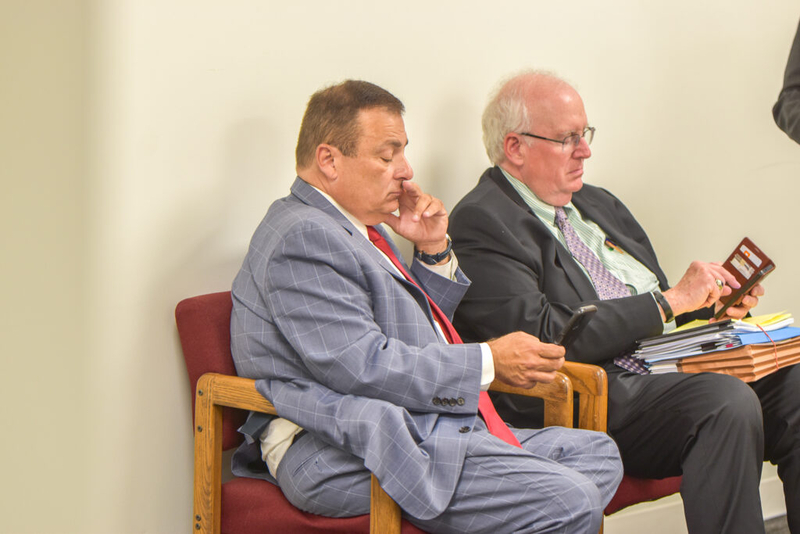
Former House Speaker K. Joseph Shekarchi, left, scrolls through his phone while the Rhode Island Ethics Commission meets behind closed doors on June 23, 2026. Next to Shekarchi is his attorney, Thomas Dickinson. (Photo by Christopher Shea/Rhode Island Current)
A Superior Court judge whose own jump from one branch of state government to another will weigh whether former House Speaker K. Joseph Shekarchi can do the same in his bid to join the Rhode Island Supreme Court.
Shekarchi on June 25 filed suit against the Rhode Island Ethics Commission seeking to block its investigation into whether his application to become a justice on the high court violates the state’s “revolving door” rule, which bars sitting lawmakers from taking on another state job.
Overseeing that challenge now is Richard Licht, a former state senator and lieutenant governor during the 1970s and ‘80s. He has served on the Providence County Superior Court bench since his own controversial appointment by then-Gov. Lincoln Chafee in 2014. At the time of his court appointment, Licht had been director of the state’s Department of Administration.
“There’s quite a bit of irony that it got assigned to Licht,” John Marion, executive director of Common Cause Rhode Island, said in an interview.
When a seat opened up on the Superior Court in 2013, Licht sought an advisory opinion from the Ethics Commission on whether his interest in the lifetime job violated the revolving door rule, enacted in 1992.
Licht argued that the state’s restrictions for non-elected state workers only apply to those holding “senior policy-making” positions. The commission ultimately agreed with him.
“It is a different revolving door than the one in question for Shekarchi but poses some similar issues,” Marion said.
For Licht, the question was whether it was okay to move from an appointed position within the executive branch to the judiciary. Shekarchi, while no longer House speaker, still remains an elected representative.
Under the revolving door law, sitting legislators cannot seek or accept employment with any state government agency for at least one year after leaving elected office. But it does exempt lawmakers who seek or accept election to a constitutional office.
The Ethics Commission is looking at the question of whether the Rhode Island Supreme Court is considered a constitutional office after a complainant was filed May 7 by Roger Williams University School of Law Professor Michael Yelnosky.
Shekarchi insists his application is eligible under the law. The Ethics Commission similarly agrees that the judiciary is a constitutional branch of government, but argues the exemption applies only to candidates for general office holders: governor, lieutenant governor, treasurer, secretary of state, and attorney general.
An initial hearing has not been scheduled as of Wednesday. Shekarchi’s attorneys have asked the court for an emergency hearing before the July 28 Judicial Nominating Commission meeting when five finalists, including the former House speaker, will be interviewed to fill the vacancy created by the March retirement of Justice Maureen McKenna Goldberg.
Judicial Nominating Commission loosens public comment policy
Members of the public can speak about the candidates at the July 28 meeting before the interviews start. They only have to email the commission no later than noon on July 27. That’s more time to request permission to speak than has been allowed in the past.
The Judicial Nominating Commission typically has required the public to sign up two weeks in advance, a policy that was set by the panel in 2022.
However, the agenda for the upcoming judicial interviews now allows one day notice to speak about candidates. Zachary Mandell, chairman of the nine-member commission tasked with recommending candidates to fill Rhode Island’s judicial vacancies, did not immediately respond to request for comment on the policy change.
The American Civil Liberties Union (ACLU) of Rhode Island sent a letter to the commission’s previous chairperson in January criticizing the “restrictive policy” for public comment after the leader of the progressive group, The Womxn Project, was denied the chance to speak during a meeting.
The Womxn Project had planned to oppose former Sen. Stephen R. Archambault’s candidacy for two Superior Court seats that eventually went to two women.
“I am hoping this is a permanent change,” Steven Brown, executive director of the ACLU of Rhode Island, said in an interview. “This is an extremely critical public body performing extremely important work for our state — it needs to be as open as possible.”

Providence, RI