Sullivan goes on attack in first post-primary faceoff for Alaska’s U.S. Senate race
Aug 28, 2026 | 7:27 pm ET
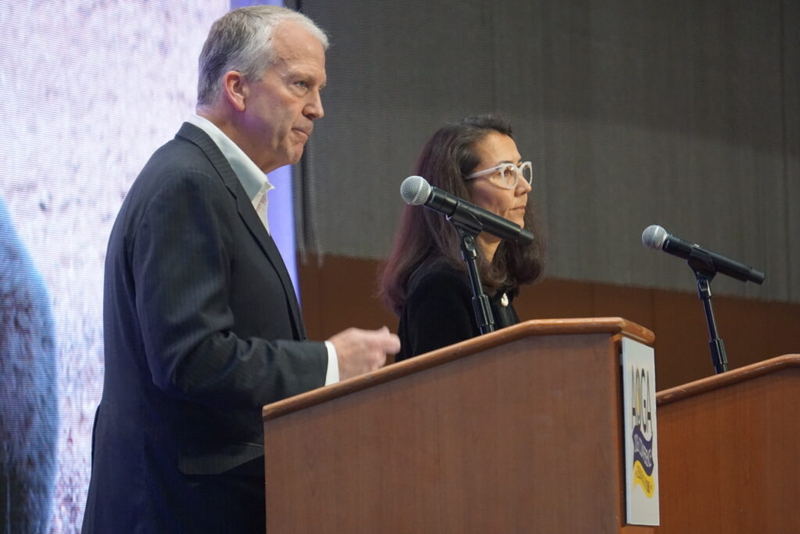
Description
Sen. Dan Sullivan, R-Alaska, and former U.S. Rep. Mary Peltola, D-Alaska, listen to a question at a candidate forum held Aug. 27, 2026, by the Alaska Oil and Gas Association. The Alaska Senate race is considered critical to control of the body, which currently has a Republican majority. (Photo by Yereth Rosen/Alaska Beacon)
In their first faceoff since the Aug. 18 primary election, Republican U.S. Sen. Dan Sullivan used the term “Lower 48 liberal” or some variation of it 16 times to attack his opponent, Democrat Mary Peltola.

“My opponents’ liberal Lower 48 anti-Alaska allies in the Congress and the White House were focused on completely shutting down Alaska oil and gas and killing thousands of jobs,” he said.
Sullivan and Peltola are the front-runners among four top vote-getters advancing to the general election. The winner will represent Alaska in the U.S. Senate for a six-year term.
Sullivan claimed Peltola “consistently voted with Lower 48 liberal allies of hers against our interests, and that is why this election is so important.”.
And he warned that a Peltola victory would allow Democrats and environmentalists to resume what he described as deliberate attempts to harm Alaska. They would continue their efforts to block oil development in the Arctic National Wildlife Refuge and impose environmental restrictions on development elsewhere in Alaska, he said.
“If my opponents’ liberal Lower 48 allies get power again, the Democrats, if (Senate Minority Leader) Chuck Schumer is in charge again — she’s committed to supporting them — they will,” he said. “If elected, she would once again empower, vote with, and be beholden to the same far-left politicians who for decades have worked to crush our state.”
The primary election results indicate that Sullivan is facing headwinds as he runs for a third term in the Senate.

The race is considered pivotal to control of the Senate, where Republicans currently hold the majority.
Peltola voices support for oil and gas development
At Thursday’s event, Peltola largely refrained from attacking Sullivan directly.
She described herself as pro-development and a champion for the oil industry.
Peltola was the first Alaska Native woman elected to U.S. Congress in 2022, and served a two-year term before being defeated by current U.S. Rep. Nick Begich III in 2024.
At the event, she took credit for winning approval for ConocoPhillips’ huge Willow project on the North Slope from a reluctant President Biden.
She is “proud of the work that I did within the Biden administration to talk about Willow in a way that they could understand,” she said. “And we moved Willow forward, thanks to me.”
Sullivan took issue with that statement, pointing out that Willow development had been approved in the first Trump administration, before Peltola was elected to the House. However, a court ruling in 2021 overturned that Trump approval, finding it to be based on flawed analysis that violated federal law. That left the decision about Willow approval up to the new Biden administration.
Peltola, in line with a message common among Alaska Republicans, used several remarks at the forum to criticize Lower 48 regulators whom she said do not understand Alaska conditions. Among those conditions are seasonal restrictions, she said.
“Our construction windows are so short in Alaska. They’re like nowhere else. Developing in the Arctic is so unique,” she said. “If we miss a barge, that can cause a year’s delay or two years’ delay. if we miss a shipping window that can have devastating effects for the life of the project.”
Overall, Peltola lauded the Alaska oil industry as critical to the state and its economy.

That percentage is outdated, however. Oil royalties, taxes and fees once provided as much as 90% of the money used for state government operations, that percentage has diminished over time. As of December, oil royalties, taxes and fees provided only about a quarter of the unrestricted general funds, according to the Alaska Department of Revenue. Investment earnings of the Alaska Permanent Fund, the state’s sovereign wealth fund, actually provide the majority of unrestricted-use revenues, and that has been the case for several years.
In many of her remarks at the AOGA forum, Peltola echoed Sullivan somewhat. She lobbed a bit of criticism at the Biden administration. Her specific target was former Interior Secretary Deb Haaland.
Peltola faulted Sullivan for voting to confirm Haaland, the first Native American to serve in that position. She claimed Haaland was “one of the biggest stumbling blocks Alaska has ever seen.”“We need to make sure that we’re confirming secretaries that are going to understand our mission and not be roadblocks and not be activists,” she said.
Haaland, a Laguna of Pueblo tribal member, is now running for governor in New Mexico. While serving as Interior Secretary, she visited Alaska and spoke at the Alaska Federation of Natives conventions and was celebrated by that organization.
Most of the AOGA event focused on issues directly related to the oil industry. High-profile issues like inflation, healthcare policy and the Iran war and their effects on Alaskans were not discussed.
Peltola did slip in a mention of fisheries issues, which have become a hot debate topic in this year’s election.
She said she worked to prevent an Endangered Species Act listing for Alaska Chinook salmon, and that such a listing would have had unintended ripple effects on other fisheries. Other species of salmon, such as sockeyes and chums, swim with Chinook salmon, she said. “If we preclude Alaskans from being able to harvest Chinook, that means we’re precluding them from harvesting just about everything during the summer,” she said.
Trump administration impacts
Peltola also voiced a specific criticism of the Trump administration.
The mass federal government firings carried out through the administration’s so-called Department of Government Efficiency, or DOGE, exacerbated staffing shortages that were already slowing needed federal services in Alaska – including permitting for development projects, she said.

Sullivan has tied himself closely to the Trump administration, delivering effusive praise for the president and his cabinet members. As he has elsewhere, he spoke at the forum of his close relationship with Trump and said he has helped the president focus on pro-development Alaska policies.
“We were able to get the Trump administration, who issued an executive order on day one to unleash Alaska’s extraordinary resource potential,” he said, referring to an order that overturned Biden-era environmental protections around the state.
Trump administration cabinet members, in turn, have praised Sulivan in their recent visits to Alaska and described him as a close Trump ally.
One was U.S. Energy Secretary Chris Wright, a keynote speaker at the AOGA conference. In his speech to the industry audience on Thursday, he said Sullivan has been a staunch ally of oil developers and the Trump efforts to reverse past environmental policies and deemphasize renewable energy in favor of oil, natural gas and coal.
He said Sullivan and the other two members of Alaska’s all-Republican congressional delegation. With their defense of fossil fuel production and “have been there in a battle to try to roll back some of these choosing-expensive-energy policies that have so burdened Americans.”
Earlier in the month, at an airport stop during a tour of Alaska, U.S. Homeland Security Secretary Markwayne Mullin also praised the senator.
“No one advocates for Alaska and what is the need today and the future buildout of what it’s going to look like down the road than Dan does,” Mullin said during a brief airport news conference on Aug. 11 with Sullivan and the commandant of the U.S Coast Guard. “It’s amazing, because he’s got such a good relationship with the president, which that’s vital to be able to get something done.”
But support among voters has declined. Recent polling puts Trump’s approval rating below 40% and indicates that he has net disapproval in almost all states, including Alaska.
U.S. House candidates speak
Candidates in Alaska’s other federal race, the contest for the state’s sole U.S. House seat, met later in the day for what turned out to be a more congenial and low-key forum.

Begich used the forum to talk about what he said were his successes during his first term in office. Begich has also aligned closely with President Trump and his administration.
“I’m only one member of the United States House out of 435, but we have delivered historic wins for our great state,” he said.
He cited numerous bills that mandate more oil drilling and other resource development on public lands in Alaska. Those successes, he said, included opening the Arctic National Wildlife Refuge to oil development and winning a higher share of future royalties from oil produced on federal land. Those victories “are 50-year objectives” that generations of Alaskans have tried to achieve, he said.
“I’m also proud to report that I’ve passed more legislation into law than any other member of Congress in the 119th Congress,” he said. “I’m also proud to report that we have passed more legislation, had more legislative wins than any freshman in House history.”
Begich, though a Republican and an ally of President Trump, is a member of a Democratic family active in Alaska politics. His grandfather, also named Nick Begich, was a Democratic U.S. House member who died in a plane crash in 1972. One of his uncles, Mark Begich, was Anchorage’s mayor and served one term as a Democratic U.S. senator. Another uncle, former state Sen. Tom Begich, is currently a Democratic candidate for governor.
Hill, a former teacher and school superintendent whom polls indicate is not well known among a wide swath of Alaska voters, used the forum to describe his biography.
He is a Dena’ina Athabascan from the Bristol Bay region and has fished commercially since he was 8 years old, he told the AOGA audience. He worked as a construction worker, spent 25 years working in education and is the owner of a small business, he said.
Hill said he is grateful for the benefits that oil development has brought to the state.
“As a young kid, I worried about the idea that I would have to fly out of my home community of Kokhanok to attend high school,” he said, naming the Iliamna Lake village where he grew up. “But then the oil and gas industry came to Alaska. It transformed Alaska. It transformed opportunities in Alaska.”

“So I am a product of the oil and gas industry,” he said.
As an independent, he would be in position to work effectively if control of the administrative or legislative branches switched in the midterms or later, he said.
“We can weather the swings between administrations. Part of that requires having somebody who can work across party lines, and I would like to do that work for you,” he said.
The forum ended on a friendly note, with both candidates naming their preferred fish — red salmon for Begich, Bristol Bay salmon for Hill — and discussing their affinities for muktuk and pilot bread, two iconic Alaska food items.
But the morning after the forum, the National Republican Congressional Committee issued a news release attacking Hill as an anti-fossil fuel “radical” who wants Alaska to transition from its oil dependence.
“Liberal Bill Hill wants to bring back Biden’s failed energy policies and put D.C. Democrats ahead of Alaskans. Hill’s radical agenda would raise costs, crush Alaska’s economy, and kill jobs. Liberal Bill Hill will be resoundingly rejected this fall,” committee spokesperson Zach Bannon said in the statement.
As of Wednesday, Begich had 45.2% of the vote in the open primary, while Hill had about 32%, according to the Division of Elections. Matt Schultz, a Democrat who suspended his campaign in July and threw his support to Hill, had 8%, according to the results. In third place is Eric Hafner, a Democrat currently serving a federal prison sentence in New York, with 3.77% of the vote. Democrat John Williams got 2.6% of the vote and fourth place, advancing to the general election in November.

Juneau