New Mexico Forward Party makes its case for ballot access before a federal judge
Aug 28, 2026 | 7:37 pm ET
Description
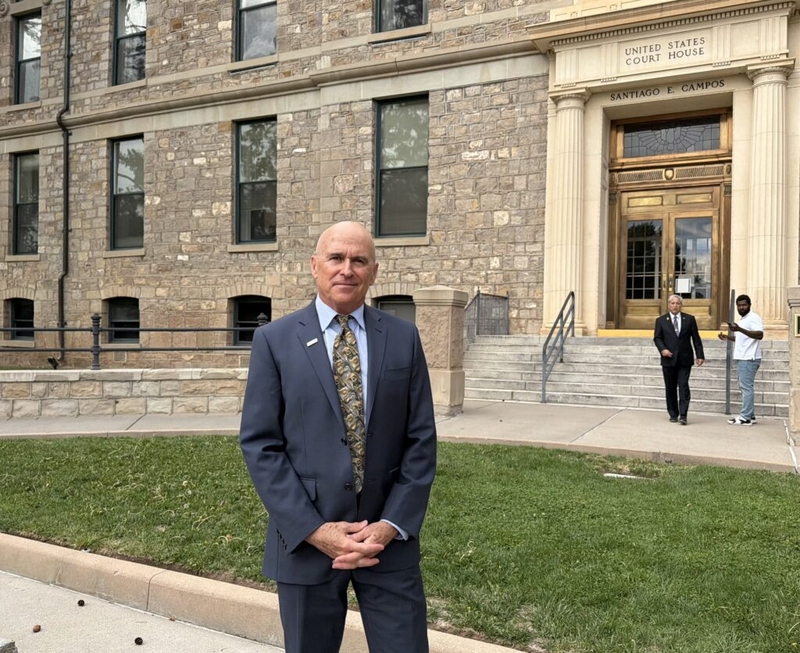
New Mexico Forward Party Chair Bob Perls stands outside U.S. District Court in Santa Fe on Aug. 28, 2026, after his attorneys argued that New Mexico Secretary of State Maggie Toulouse Oliver enforced unfair ballot access requirements on minor party candidates. (Joshua Bowling/Source NM)
Attorneys for the New Mexico Forward Party on Friday told a federal judge that New Mexico Secretary of State Maggie Toulouse Oliver held minor party candidates to an unfairly burdensome standard to qualify for the upcoming Nov. 3 general election ballot.
Even though the state Forward Party officially qualified as a minor party in New Mexico earlier this year, its small voter base has meant that its statewide candidates — such as Party Chair Bob Perls, a former state lawmaker who filed to run for U.S. Senate this year — had to collect as many signatures as independent candidates: more than 14,000. By comparison, Democrats and Republicans seeking statewide office have to collect 2,500 and 2,350, respectively.
In June, Perls failed to make the ballot in the race against incumbent U.S. Sen. Ben Ray Luján (D-N.M.) and Forward Party candidate Michael Vigil failed to qualify as a challenger to State Auditor Joseph Maestas.
Perls filed his lawsuit against Toulouse Oliver in U.S. District Court in July.
“New Mexico’s political status quo has been frozen,” Oliver Hall, an attorney and executive director of the Washington, D.C., Center for Competitive Democracy representing Perls, argued in court Friday. He added that he believes New Mexico has the most stringent requirements in the nation for minor party candidates.
Former presidential candidate Andrew Yang launches NM Forward Party
Attorneys for Toulouse Oliver responded that the Forward Party’s local candidates successfully qualified for the general election, and that the current signature requirements for statewide candidates are meant to keep “frivolous” candidates off the ballot.
They called on Lindsey Bachman, the Secretary of State’s communications, legislative and executive affairs director, to testify remotely via Zoom. Perls’ attorneys alleged that he and other Forward Party candidates did not have the proper access to the state’s online voter signature portal for a portion of the summer and argued that it put them at a significant disadvantage compared to candidates who could gather signatures electronically.
Bachman responded that nothing was stopping them from continuing to gather voter signatures with a pen and paper.
“We continue to receive petition filings that include paper and online (signatures),” she said, adding that there “likely is an ease” to gathering signatures digitally, but has had “candidates tell me they don’t like using the online form.”
U.S. District Court Judge Margaret Strickland told attorneys on both sides that she would issue a written ruling “quickly.”
After Strickland left the courtroom, Perls told reporters he thought much of Friday’s hearing focused on the minutiae of Bachman’s testimony and not his lawsuit’s allegations of First and Fourteenth Amendment violations.
As for the assertion that higher signature requirements keep “frivolous” candidates off the ballot, Perls noted that New Mexico typically suffers from “empty ballots,” pointing to the lack of contested primary races for the state Legislature and beyond. The Republican nominee for Luján’s U.S. Senate seat, for example, ran unopposed as a write-in candidate in the June primary.
“All we want to do as the Forward Party is bring competition, bring choice to voters, in some small way solve the problem of lack of choice,” he said.
Santa Fe, NM